Areas designated as special alert prefectures are making moves to set their own criteria for easing or lifting restrictions set due to the spread of the coronavirus.
While giving top priority to preventing the collapse of medical systems, prefectural governments are accelerating efforts to create exit strategies so that economic activities can be resumed.
The Aichi prefectural government on Monday released criteria for relaxing its request to stay home and suspend business operations. It has set two levels, "caution" and "danger," and will determine the level depending on specific figures in three categories, such as the number of new infections. Using these criteria, the government will consider easing or reissuing requests for restraint.
The three categories are the average number of newly infected people, the percentage of people testing positive in polymerase chain reaction (PCR) tests and the average number of hospitalized patients. The figures will be taken from the past seven days. The "caution" level will be reached if there are 10 people for the first category, 5% for the second category and 150 people for the third category. For the "danger" level, the thresholds are 20 people for the first category, 10% for the second category and 250 people for the third category. If any of the criteria are reached for the "caution" stage, the prefectural government will consider once again asking people to refrain from going out and requesting businesses to close. If all three criteria are met for the "danger" level, it will take the most stringent measures, including instructing businesses to suspend operations.
Aichi Prefecture has already seen its figures in all three categories fall as low as the "caution" level. The government intends to decide whether the restrictions will be eased by also referring to an analysis by an expert panel of the central government. Gov. Hideaki Omura said at a press conference, "Considering the current situation, we're now in the stage of preparing to resume economic activities and reopen schools."
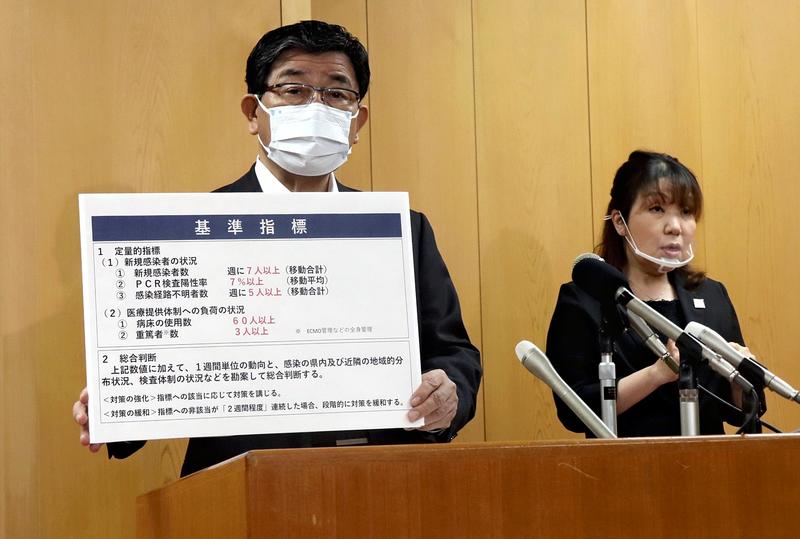
The Osaka prefectural government will lift its restrictions, including a request for business suspensions, if each of three conditions are met for seven consecutive days. The conditions are the number of new infections being below 10, the percentage of people who test positive in PCR tests being less than 7%, and the percentage of hospital beds for patients with severe symptoms being below 60%.
The Ibaraki prefectural government has set six categories such as the number of people with unknown infection routes and the percentage of those testing positive. Similarly, the Gifu prefectural government has set five categories to determine whether to relax restrictions.
Fukuoka Gov. Hiroshi Ogawa said at a press conference Monday that the prefectural government will consider easing current measures, such as a request to shorten business hours, even though the prefecture is not excluded from the designation of special alert prefectures.
On the other hand, the Tokyo metropolitan government plans to continue asking businesses to stay closed through May 31 as the period for a national state of emergency has been extended to that day.
However, the metropolitan government intends to present its exit strategy based on expert opinions. "I would like to present a roadmap for certain stages in the future," Gov. Yuriko Koike said.
While setting such criteria for lifting restrictions, local governments are also cautious about a mood among the public that has seen them relaxing efforts to stay home, and have indicated thresholds at which they would again ask for self-restraint to prevent a possible second wave of infections.
Read more from The Japan News at https://japannews.yomiuri.co.jp/