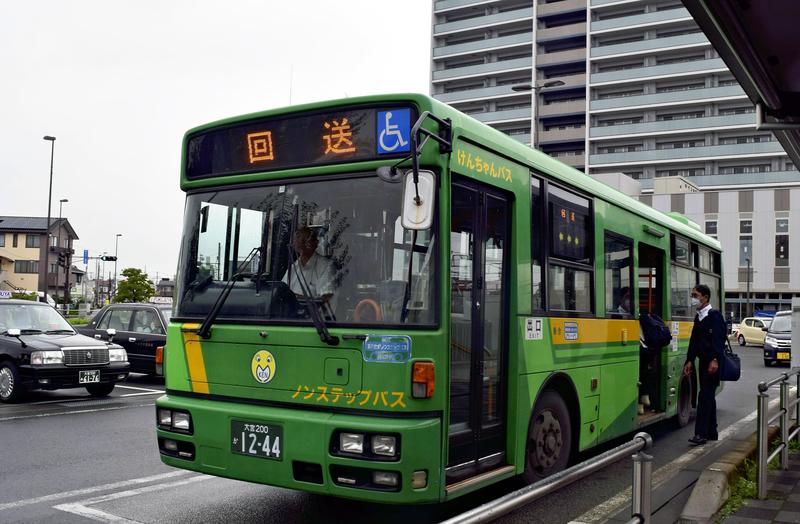
The novel coronavirus outbreak has left local fixed-route bus services in dire straits.
These services, which have already suffered a persistent deficit as a result of factors such as depopulation, have been hit by a further drop in the number of users in the wake of the pandemic, cutting the incomes of many operators in half. Should this continue, bus routes may be abandoned altogether.
-- Community transportation
"Commuting will become quite a hassle if we lose the bus service," said a professor who commutes to a university in the town of Ina, Saitama Prefecture, lamenting the business failure of Maruken-Jidosha Corp., an operator of fixed-route services that has a stop in front of the university.
Launched in 2003, the company's buses run 22 routes -- 230 kilometers in total -- covering six cities and one town within the prefecture. The company, based in the city of Ageo, is affectionately known by local people as "Ken-chan Bus," taken from the name of company President Kenji Motomura. The company covers areas where rival companies have ceased operations, becoming a vital mode of transportation for the local people.
However, when the central government declared a state of emergency in April, the number of Maruken-Jidosha's passengers sharply dropped to about 10%, due in part to the requests to refrain from unnecessary outings and also from an effort to avoid traffic congestion.
Average monthly sales of about 30 million yen fell to roughly one-third, and total debt reached about 500 million yen. In May, the company filed for court protection under the Civil Rehabilitation Law with the Saitama District Court, becoming the first fixed-route bus operator to go bankrupt in connection with the novel coronavirus.
Currently, the company is managing to remain in operation through a reduction in the number of services, and several companies have announced their intention to support Maruken-Jidosha. The company has now recovered slightly less than 80% of its passengers.
"We've been on the edge since the beginning," Motomura said. "As long as infections continue to spread, there will be no end to the anxiety."
-- Passenger total drops by half
According to a survey on operators of fixed-route bus services conducted by the Land, Infrastructure, Transport and Tourism Ministry, the numbers of passengers in April and May were halved from the same months last year. Half of the 172 companies that responded saw their revenues from transportation drop by more than 50%. After the state of emergency was lifted, the number of users was 30% lower in June from the same month the year before, and July and August are expected to see similar declines.
Regional fixed-route buses are chronically in the red. A transport ministry survey in fiscal 2018 showed about 70% of 240 bus operators nationwide were in the red. In the 10 years up to fiscal 2016, the total distance of abandoned routes reached about 14,000 kilometers, with more routes feared to be abandoned as a result of the pandemic.
Currently, the central government provides financial assistance to operators, such as shouldering part of expenses for vinyl sheet installation to prevent the spread of airborne droplets or through its subsidy program for small and mid-sized businesses to sustain operations amid the pandemic.
A bus operator in the northern Kanto region said: "We were making up for deficits of fixed-route buses with profits from tourism and expressway buses, but it has become difficult to do that these days. At the same time, we can't reduce the number of fixed-route bus services because that would in turn create crowding aboard the buses. We hope the central government will more seriously consider the situation faced by route buses that are still operating despite being in the red."
-- Joint management
Some bus companies have found their way out by cooperating with other bus companies.
Under the Antimonopoly Law's special rules, which will go into effect by the end of this year, regional bus operators, who have seen a decline in profit, are allowed to jointly operate bus services.
Five bus operators in Kumamoto Prefecture, which are currently making preparations for joint operations, aim to maintain their routes by eliminating those that overlap and streamlining vehicle allocation.
"We've already been preparing for the merger, but the infection surge worsened our business climate, heightening the necessity [to cooperate with each other]," a person in charge of the merger said. "We'll further strengthen our cooperation to overcome the coronavirus disaster."
In Hiroshima, a system to standardize a commuter pass usable for several bus operators was introduced in May 2018, and seven companies have currently joined.
An official of one of the participating companies, Hiroshima Electric Railway Co., said, "We'd like to make use of the framework of cooperation and come up with measures to cope with the coronavirus infections."
The transport ministry said it intended to utilize the existing subsidy for bus services or implement typical measures against coronavirus infections for the time being as a step to support bus companies.
"Joint management can be an effective measure, and we'll promote it," a ministry official said.
Read more from The Japan News at https://japannews.yomiuri.co.jp/