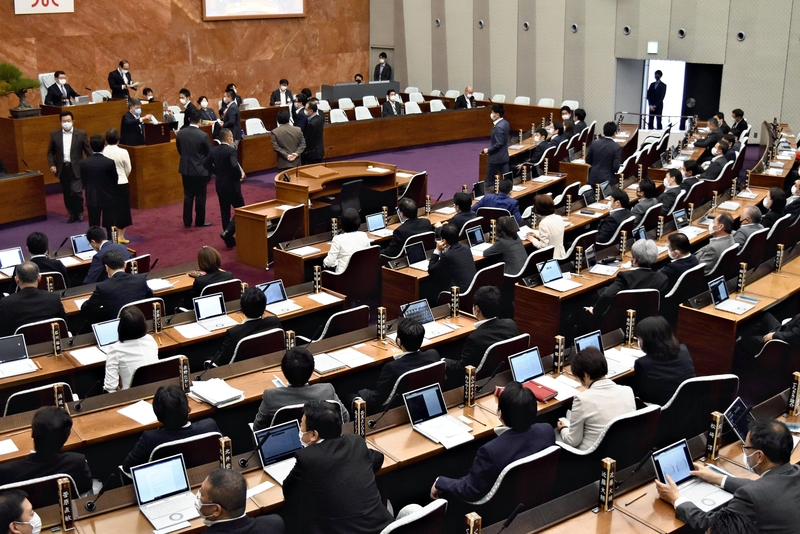
In order to prevent the spread of the coronavirus, local assemblies have taken measures such as restricting the number of members in the assembly hall by half, or utilizing technology such as videoconferencing. This is because the "Three Cs" -- closed spaces, crowded places and close-contact settings -- can easily occur in places such as assembly halls and committee rooms.
However, some assemblies have canceled their general interpellations altogether or shortened their schedules. This has given rise to concerns that "they cannot play a role in conveying the opinions of residents to administrators in an emergency."
At a regular plenary session of the Kanagawa prefectural assembly on May 22, all assembly members wore masks and the doors of the hall were open for ventilation. When a new chairman was being elected, staff of the assembly secretariat confirmed that there was no one coming in or going out so that the doors could remain open, even though it was declared that the hall was closed.
At an extraordinary meeting of the Shizuoka city assembly held from May 20 to 22, half of the assembly members watched the deliberations on monitors in a separate room and entered the hall only when a vote was being taken. According to the Local Government Law, deliberations can be held effectively if at least half of the assembly members attend.
At the Iwata city assembly in Shizuoka Prefecture in late April, members of the assembly's steering committee made arrangements through videoconferencing tool Zoom. "The system is convenient, which can lead to an increasing ability to take measures in an emergency," the 55-year-old committee chairman said.
On April 30, the Internal Affairs and Communications Ministry expressed its views on assemblies conducting online deliberations, saying that it does not allow it for plenary sessions but that there is no problem for committees if it is difficult to have members gather at the venue.
The city assembly of Miyako, Iwate Prefecture, decided not to allow general inquiries at its regular meeting in June, taking into consideration that the city needed time to implement measures against the virus and that gatherings present an increased risk of infection.
The Aomori city assembly will hold a regular meeting in June at which it will shorten the period of general questioning from four days to two days and reduce the time limit for questions from one hour to 30 minutes.
General interpellation, however, is a chance for members to verify the issues to be tackled by municipal administration on behalf of citizens. "[Canceling general interpellation] means denying the role of the assembly," said one of members of the Miyako city assembly.
Read more from The Japan News at https://japannews.yomiuri.co.jp/