The investment case for Lloyds Banking Group shares runs as follows: as the biggest player in the oligopoly that is the British retail banking market, Lloyds can't fail to make a lot of money one day. Pots of gold, it is suggested, await once the squalls in the UK economy pass.
The thesis was barely dented by the Independent Commission on Banking. Sir John Vickers' panel retreated on its threat to make Lloyds sell more branches than the 632 ordered by Brussels in the wake of the HBOS takeover; neither of the interested buyers, newcomer NBNK or the Co-op, represent a major competitive threat to Lloyds. And, while Vickers' recommendations contained measures designed to encourage switching of current accounts, apathy can't be legislated away.
But the investment case looks ragged for other reasons. First, the squalls in the UK economy are starting to resemble something worse. Lloyds today warned that a slower economy may mean delays in hitting revenue targets. Lower interest rates bring some compensations of course, such as lower impairment charges (for now, sceptics might say). But the vision of Lloyds as a growing bank remains extremely hazy: revenues in the first nine months of this year were down 15% on what the bank calls a "combined business" basis.
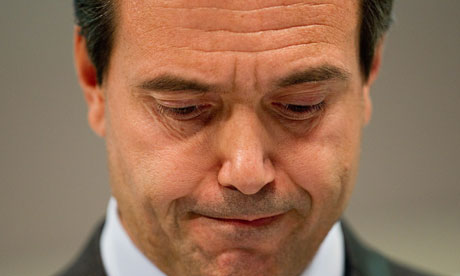
Then there's the management issue. Chief executive António Horta-Osório is off sick with stress. If he's unable to return, Lloyds will have to seek a replacement, and maybe at least one other executive since the job may be too big for one person. Indeed, there's a fascinating account of the grim life at the top of Lloyds in today's Telegraph written under a pseudonym by an executive departee. In-fighting, angst, low morale, it's all there.
Optimists among Lloyds shareholders may be inclined to think that such a portrait of dysfunctionality could be written about many large organisations, especially banks. Well, maybe. In the case of Lloyds, though, internal tensions seem to be built into the machine since the bank is trying to preserve Halifax's identity to persuade the outside world that there is internal competition between brands. It's an odd way to live, and probably not the most effective way to chase the end of the rainbow. One has to wonder if, by the time Lloyds arrives, the pot of gold will still be there.