Summary
It is mid-afternoon and Europe’s markets are holding their gains.
- FTSE100 +0.53% at 6397 points
- Germany’s DAX +1.8% at 9062 points
- Italy’s FTSE MIB +1.72% at 19,360 points
- France’s CAC40 +0.48% at 4117 points
On the FTSE100 Standard Chartered remains a big faller, down 8.3%, after announcing a fall in profits. Lloyds bank is down 1.4% after announcing job losses and branch closures. BP is up 1% despite suffering from falling oil prices and economic turmoil in Russia.
That’s all from the business live today. Thank you for following.
David Cameron has been urged to take a stand against modern-day slavery and the abuse of migrant workers in Qatar.
As David Cameron prepares to meet the Emir of Qatar, the Trade Union Congress said the prime minister should use his influence to seek to end the abuse of migrant workers in the Gulf state.
In an open letter to 10 Downing Street, the TUC called on Cameron to press the Emir of Qatar to take action against slavery and abuse of construction workers.
Conditions for foreign workers in Qatar, including those building the infrastructure needed for the 2022 World Cup, continue to be of grave concern.
Figures confirmed by Qatar show that 964 workers from India and Nepal alone died between 2012 and 2013, a rate of 40 every month, with unsafe working and living conditions equally to blame. Many other workers are left for months without pay. These workers are completely trapped by the sponsorship system known as kafala which gives employers complete power to grant or deny workers the right to leave Qatar.
The TUC wants to see an end to the kafala system, freedom for workers to join unions, and guarantees that the government will only use ethical recruitment companies.
TUC General Secretary Frances O’Grady said:
Silence from David Cameron will be taken as support for what is effectively slavery in Qatar. Britain must be part of the international campaign to ensure that Qatar improves living and working conditions for migrant workers.
Look ahead: US Fed meeting
Is it time to say goodbye to US financial stimulus?
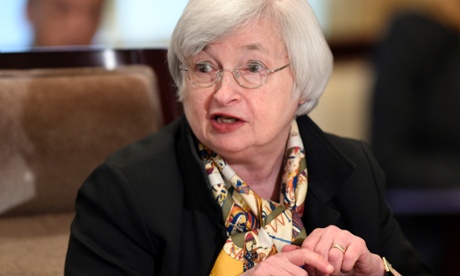
The US Federal Reserve’s interest-rate setting committee begins a two-day meeting, expected to conclude tomorrow with an announcement ending its asset-buying programme.
The Fed has purchased $1.6 trillion in Treasury bonds and mortgage-backed securities since September 2012, which has helped keep US interest rates down, allowing the economy to recover.
When Fed policymakers hinted they might end financial stimulus in 2013, investors threw taper tantrums, selling off equities and dumping foreign currencies.
Now the mood has changed. The consensus among market watchers is that the Fed will announce an end to its asset-buying programme, quantitative easing, when its meeting wraps up on Wednesday. The central bank is also expected to issue guidance on the timing of interest-rate rises.
All this comes just ahead of an update on third-quarter US economic growth on Friday, which is expected to show growth of 3.1%.
Economists are split on exactly when the Fed will wind up its bond-buying programme, according to a Wall Street Journal poll.
About two-fifths of economists—39%—expect the Fed’s bond purchases to end entirely in the third quarter of 2014. About one-third—34%—expect the central bank to halt the program in the fourth quarter, and 19% expect the end to come in early 2015.
Economists are equally divided on when the Fed will begin raising rates.
Some Fed officials are reported to want to stand by an earlier pledge not to raise rates until mid 2015. Others may are said to want to drop any reference to time, because they think it depends on the economic data.
Whatever they decide the consequences are likely to reverberate in markets around the world.
Nicholas Ebisch, currency analyst at Caxton FX, expects “profound effects” on currency and stock markets in the US and around the world.
The dollar is stable at the moment and has maintained a strong position since its steady appreciation in the second half of the year, but any sign of prolonging the QE programme, or extending low interest rates for longer should damage the greenback.
Further reading
Market Watch: Fed will hold market’s hand as it ends QE3
Wall Street Journal: Economists split on start of Fed pullback
Updated
“All options” considered to aid Europe’s oldest bank
In Rome, discussions about the fate of Europe’s oldest bank are underway.
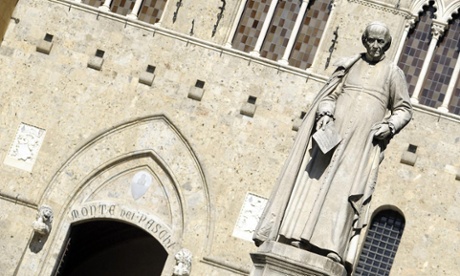
Banca Monte dei Paschi di Siena, founded in 1472, has been in the spotlight after failing European banking stress tests. Regulators said it needed to raise €2.1 bn ($2.7 billion) to meet capital thresholds - a key benchmark of the bank’s financial health.
According to Reuters, Italy’s Treasury may extend repayment deadlines on hundreds of millions of euros in state aid to help troubled lender.
Officials, who declined to be cited by name, said Monte dei Paschi Chairman Alessandro Profumo and Chief Executive Fabrizio Viola had held meetings in the Economy Ministry on Monday to seek options for the bank, after it failed European Central Bank stress tests.
It could be helped via Monti bonds, which are named after former prime minister Mario Monti, rather than the bank.
The person close to the situation gave no details of the talks but said nothing had been ruled out, including options connected with repayment of 750 million euros of state aid, offered in the form of “Monti Bonds” in 2013 to prop up the bank after a previous crisis.
Asked whether a delay in the repayment schedule or converting the loan into share capital in the bank was being looked at, the person said: “All options are under consideration. The bank is working on it. The system is solid.
No comment was available from Monte dei Paschi.
Shares in the bank are now up 2.23%, after yesterday’s dramatic losses when the bank saw a quarter of its value wiped out.
Updated
Over on the Guardian’s data blog, new figures reveal how Spain’s years of recession have damaged the country.
- Child poverty, already above the EU average, has risen, meaning that more than 2.7m Spanish children - one in three - lived in poverty or were at the risk of social exclusion in 2013.
- School drop-out rates are now by far the highest in the EU, with 23.6% leaving education early.
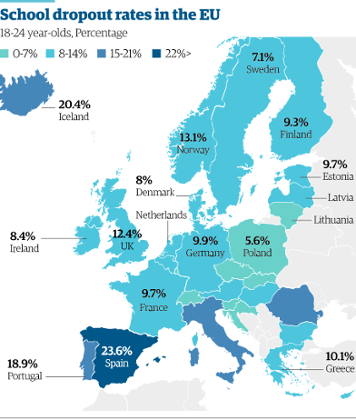
That, plus more data and graphics here
Updated
Brussels welcomes tougher budgets from France and Italy
Are France and Italy off the hook?
Both countries may have averted a fight with the European Commission over their budget deficits.
Under eurozone rules, countries must have their budgets vetted in Brussels to check whether they meet basic rules of the currency, for instance a budget deficit of no more than 3% of GDP by 2015.
The 2015 budget plans of France and Italy were both falling short.
But following pressure from the Commission, France has now promised extra spending cuts worth €3.6-€3.7bn (£2.8-2.9bn). French finance minister Michel Sapin wrote to the Commission on Monday, spelling out “additional measures”, including more ambition on cutting its structural deficit target.
Italy has also made a last-minute promise of extra cuts worth €4.5bn (£3.5bn).
A European Commission spokesman today welcomed the “useful, constructive contributions on budget talks from Italy and France”. Via Reuters
But analysts have said the changes do not add up to much.
Aurel BGC brokers economist Jean-Louis Mourier on France.
These are cosmetic changes aimed at responding to the Commission’s demands with as little as possible. We might have 4.1% of (headline) deficit instead of 4.3% but we won’t be at 3% .
Updated

The Chinese authorities are clamping down on officials playing the ancient game of mahjong, as part of continuing anti-corruption drive that has hit the sales of luxury goods firms.
The People’s Daily, a mouthpiece for the Communist party regime, accused officials for playing the game when they should be working.
The phenomenon of Communist officials going to rural retreats to have fun, play mahjong and poker... must resolutely stop.
The article called for an equally “resolute” end to government staff “spending public money to visit historical sites in the name of ‘study’, and then simply going to any old fun place.”
AFP explains what the crackdown is about:
The commentary was the latest in a series of state-issued broadsides against official extravagance, as China’s President Xi Jinping attempts to improve the Communist party’s image in response to widespread anger over endemic corruption.
The campaign has led to an unprecedented investigation into retired security czar Zhou Yongkang, though the vast majority of officials punished since Xi came to power have been from the government’s lowest levels.
The campaign against graft has been blamed for falling sales of luxury items, and hit business at expensive hotels and restaurants, according to reports.
Updated
European markets are up, with Italy and Germany’s benchmark index leading the way.
- Germany’s DAX +1.39% at 9026 points
- France’s CAC40 +0.26% at 4107 points
- Italy’s FTSE MIB +1.66%% at 19.345 points
- UK FTSE100 +0.44% at 6388 points
The markets have reversed yesterday’s decline, mostly thanks to healthy corporate earnings lifting shares.
The risk of deflation in Sweden has not disappeared, despite today’s unprecedented decision to move to zero interest rates.
Jessica Hines at Capital Economics warns that Sweden may have to resort to stiffer measures, such as currency intervention to avoid deepening deflation and a Japan-style lost decade.
The Riksbank had little choice but to cut today. It has been roundly criticised for not responding quickly enough to the low level of inflation and a failure to act would have undermined its credibility further. Moreover, it would also have put upward pressure on the krona, which the Riksbank would not have wanted given that exporters are still struggling.
With the policy rate at zero, the Riksbank will need to start thinking about what action it might taken if inflation continues to be weaker than it has forecast.
Climate change threat means most fossil fuels "unburnable" says BoE
The Bank of England is concerned that climate change could damage the earnings and solvency of the UK insurance industry.
The FT reports that the bank’s Prudential Regulation Authority, has written to insurance companies asking them whether they have considered climate change could affect their investment portfolios.
Here is a flavour:
Scientists have been warning for years that greenhouse gas emissions from burning fossil fuels are driving warmer global temperatures and could increase the frequency of devastating natural disasters such as Typhoon Haiyan, which killed thousands of people when it ploughed into the Philippines last year.
But the Bank of England appears to be one of the first central banks to address potential climate risks for insurers.
The insurance industry is doubly exposed to such threats. First, it faces rising payouts to policy holders battered by natural catastrophes that have caused average global insured losses of $56bn a year over the past decade, according to Munich Re .
However, it also invests in assets that could be affected by such disasters, such as properties, and fossil fuel companies facing tougher government rules on greenhouse gas pollution, like those the US launched this year to reduce power plant emissions.
According to the paper, the bank also confirmed reports that governor Mark Carney told a World Bank seminar in October there was analysis showing most fossil fuel reserves are “unburnable” if the world is to avoid risky climate change.
Updated
Nice chart from Jamie McGeever at Reuters on why Sweden has embarked on zero interests.
Why Swedish interest rates have been cut to 0%. Inflation threatening to turn into deflation: pic.twitter.com/kvdTIJtoGo
— Jamie McGeever (@ReutersJamie) October 28, 2014
Spare capacity in the electricity grid system has fallen, but the National Grid has said there is no risk of blackouts.

As my colleague Sean Farrell reports:
In its winter outlook, the operator of pipes and pylons said that electricity margins – the difference between peak demand and available supply – had fallen to 4.1% from 5% at peak periods last year because of planned generator closures, breakdowns and delays to new plants.
Gas supplies remain strong after last year’s mild winter, with gas capacity higher than the maximum expected demand, National Grid said.
Energy Minister Matt Hancock has been touring the studios with the same message.
There will be secure energy supplies this winter. There will be no power cuts to householders. Of course, there may be bad weather and we have taken measures to ensure that the distribution networks are stronger than they were last winter...
He also said security of supply was more important than tackling climate change or cutting costs for consumers.
My view is that those three things aren’t equal - cost, climate change and energy security. For me, energy security comes first because if you don’t have secure supplies then the other two become completely second order.
Hancock quotes via PA
Updated
Standard Chartered shares hit 5-yr low
Ouch. Shares in the Asia-focused bank Standard Chartered have slumped to a 5-year low, after the bank reported falling profits.
Standard Chartered’s London-listed shares are down more than 9% to 993 pence this morning.
The bank surged ahead over the last decade thanks to high grow in China, India and South Korea, but now faces falling profits as a result of weakness in those economies. The bank also said it has rising compliance costs, in the wake of a failure of its money-laundering controls that led to a $300m fine.
Peter Thal Larsen of Reuters Breaking Views, says weaker [Asian] economies, rising expenses and bigger bad debts are all to blame.
Even with extra cost-cutting, it’s too early to say when StanChart’s fortunes will improve. Until the bottom line stabilises, investors will remains wary .
Updated
Sweden embarks on zero interest rates
Sweden’s central bank explains that it cut interest rates to zero because inflation is too low.
The bank has a target of 2% inflation
The Swedish economy is relatively strong and economic activity is continuing to improve. But inflation is too low. The Executive Board of the Riksbank has therefore decided that monetary policy needs to be even more expansionary for inflation to rise towards the target of 2 per cent.
Despite the fact that both GDP and employment have increased at a relatively good rate over the last 12 months, inflation has continued to be lower than expected. The broad downturn in inflation and the repeated downward revisions to the inflation forecast imply that underlying inflationary pressures are very low and lower than previously assessed. This, taken together with lower inflation and a weaker development of economic activity abroad, means that it is expected to take longer for inflation to reach 2 per cent.
Market watchers have taken note.
To boldly go where no-one has gone before - zero rates at Riskbank - what housing bubble? #SEK
— Michael Hewson (@mhewson_CMC) October 28, 2014
Swedish central bank #Riksbank cuts interest rate to zero to fight deflation risk. Non eurozone BoE watching closely
— Joe Lynam BBC Biz (@BBC_Joe_Lynam) October 28, 2014
Updated
Sweden’s central bank has taken markets by surprise by slashing interest rates to zero, sending the Swedish krona to a four-year low against the dollar.
The Riksbank had been forecast to cut rates to 0.1% from 0.25%, but went the whole way and reduced them to nothing to help avoid the risk of deflation.
Standard Chartered profits fall on slowing Asian growth
Asia-focused bank Standard Chartered has reported a 16% slide in profits, as the bank struggles to respond to slowing growth across the region and increased compliance costs.
Standard Chartered reported £1.5bn profits for its third quarter, down from £1.83bn the previous year.
The lender has also been hit by losses in South Korea, where it has been reorganising its business since 2011.
Peter Sands, Standard Chartered chief executive, said the bank was taking action to get back to profitable growth.
Whilst trading conditions remained subdued, we did see a modest return to year on year income growth during the quarter. We are executing our refreshed strategy, including reprioritising investments, exiting non-core businesses, de-risking certain portfolios and reallocating capital. To create more capacity for investment in the many opportunities in our markets, we are taking further action on costs, targeting more than US$400 million in productivity improvements for 2015.
Updated
The UK’s third-largest energy company BG Group reported a lower-than-expected fall in profits, hit by falling oil prices and falling production from its Egyptian refineries.
From Reuters
BG’s total operating profit came to $1.3 billion in the third quarter, undershooting a company-provided consensus of $1.4 billion, as its Egyptian output halved compared with the previous year to 55,000 barrels of oil equivalent per day (boepd) due to its depleting reservoir.
In the third quarter BG sold its oil at an average of $104 per barrel, down from $112 the previous year, while its average UK gas price fell 17 percent to 37 pence per therm.
The oil and gas producer has however started to reap benefits of costly projects in Brazil and Australia.
BG’s third-quarter revenue rose 4 percent to $4.6 billion as oil output from Brazil rose to more than 100,000 barrels of oil equivalent per day.
It is also on track to deliver its first liquefied natural gas (LNG) cargo from the Queensland Curtis LNG project by the end of the year.
BG also announced that they had appointed Helge Lund as chief executive. He replaces Chris Finlayson, who left earlier this year to join InterOil.
Lloyds shares are down 1.15% to 74.7 pence this morning.
The FTSE100 as a whole has nudged up 0.6% to 6401 points.
BP profits hurt by Russia problems
BP has been hit by a steep drop in revenues from its Russian partner Rosneft.
The oil company reported that underlying net income from Rosneft for its third quarter was $110m, against $808 m last year. The sharp drop off has been blamed on the depreciation of the rouble against the dollar and lower oil prices.
BP profits were in line with expectations at around $3bn, although lower than last year’s $3.7bn. The oil major upped its dividend by 10 cents a share, a 5.3% increase on last year.
Bob Dudley, BP chief executive, said BP’s operational momentum was delivering results.
Growing underlying production of oil and gas and a good downstream performance generated strong cash flow in the third quarter, despite lower oil prices. This keeps us well on track to hit our targets for 2014.
BP said western sanctions on Russia had had “no material impact” on its business.
During the quarter BP also hit a significant milestone, when compensation for the Deepwater Horizon spill reached $20bn. BP’s total bill for the disaster is $43bn.
Updated
PPI scandal 'far from over'
More reaction on Lloyds
BREAKING: Unite calls for no compulsory redundancies over Lloyds job losses #MoreSoon
— Unite the union (@unitetheunion) October 28, 2014
Unite’s Rob MacGregor: “These are deeply unsettling times for Lloyds staff.” #MoreSoon
— Unite the union (@unitetheunion) October 28, 2014
From Which’s executive director
The staggering PPI mis-selling bill continues. The extra provision announced by Lloyds today shows this scandal is far from over. @WhichNews
— Richard Lloyd (@RichardJLloyd) October 28, 2014
Updated
Lloyds no longer aspires to be 'the last bank in town'
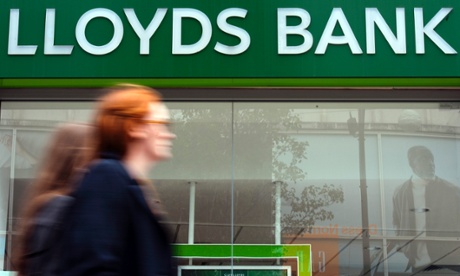
Lloyds bank will lose around 150 branches, although the company says that most customers will still have a bank within five miles.
This brings an end to Lloyds’ pledge to be the last bank in town.
We are committed to maintaining or growing our share of branches and will optimise our network by consolidating mainly urban branches in overlapping locations. We anticipate this will lead to a net reduction of about 150 branches. Over 90 per cent of Lloyds and Bank of Scotland customers will continue to have a useable branch within five miles of their home, while the Halifax branch network will be maintained.
Updated
Here are some of the other headlines from the Lloyds announcement this morning, courtesy of Reuters.
- Lloyds finance director expects bank to pass PRA stress tests
- Lloyds finance director hopeful of paying 2014 dividend
- Lloyds anticipates closing fewer branches than competitors
- Lloyds says increased PPI provision due to increase in “reactive” complaints
Unite warns on Lloyds job cuts
Here is how the Unite union has reacted to Lloyds job cuts - via the Guardian’s City editor.
Unite on Lloyds jobs cuts: "The wallets of top executives at Lloyds should not be getting fat by forcing low paid workers onto the dole"
— Jill Treanor (@jilltreanor) October 28, 2014
Updated
Summary
Good morning, and welcome to our rolling coverage of the world economy, the financial markets, the eurozone and the business world.
Lloyds Bank have announced they are cutting 9,000 jobs – in addition to the 45,000 that have gone since the 2008 bailout and rescue of HBOS.
Bailed out Lloyds Banking Group confirms 9,000 job cuts and 150 branch closures
— Jill Treanor (@jilltreanor) October 28, 2014
The bailed out lender, which is 24%-owned by the taxpayer, also revealed that it was putting aside a further £900m for to compensate customers for misselling PPI insurance policies, bringing the total bill to £11bn.
Here is how Lloyds announced the job losses:
Within the organisation, we will rebalance roles to reflect the evolving nature of the business and ensure we have the people and capabilities required for the transition to a more digitised, IT enabled business. We anticipate a reduction of approximately 9,000 full time roles across the business while building new capability in digital and IT.
Later this morning Lloyds boss António Horta-Osório will explain all, in a presentation to the City that will also set out a new three-year plan for technological change.
The banking industry faces more change in the next 10 years than it has seen in the last 200, according to Lord Blackwell, the chair Lloyds Bank.
From Lloyds statement:
Our plan outlines how we intend to deliver value and high quality experiences for customers alongside superior and sustainable financial performance within a prudent risk and conduct framework. We remain committed to Helping Britain Prosper*, supporting the UK economy and the communities in which we operate.
*Lloyds’ capitalisation
We will also be delving into results from BP and BG, as well as looking ahead to the Federal Reserve’s monthly meeting starting later today.
All that and more...
Updated