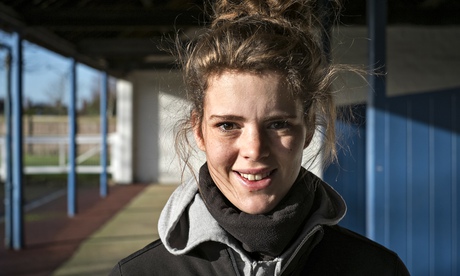
“I’ve come into this like being in business,” Lizzie Kelly said, shortly before riding her sixth winner in 11 starts at Leicester on Thursday. “I’m not just here to ride my mum’s horses in nice big races and get an occasional winner. I’m here to be doing this day in and day out and living it. As a 10-year-old girl, this is what I wanted to do. I’m here doing it, and I see myself in this hopefully for a good long time.”
It is an impressive mission statement, delivered with utter conviction by a 21-year-old rider on a roll. Kelly is a few months out of university and in her first season as a conditional jockey after five campaigns as an amateur, and so far, the numbers look good.
The headline figure for punters ahead of her ride on Tea For Two, the favourite, in Saturday’s Lanzarote Hurdle at Kempton Park is the £801 clear profit which would have been returned to a £10 level stake bet on all Kelly’s rides over the last two-and-a-half years.
Nor is that down to a couple of unexpected winners at huge prices. Only two of her 21 rides this season have started at double-figure odds and both finished unplaced, but Kelly’s consistency and strike-rate on the other 19 has once again made her one of the backers’ most dependable allies. Her strike-rate in the current campaign is 31%. In 2013-14, it was 29%, and in 2012-13, 40%, from an admittedly tiny sample of five rides.
Her earnings via prize money are healthy too, with Kelly’s mounts winning nearly £90,000 so far this season, including the £46,000 first prize for Aubusson’s victory in the Fixed Brush Handicap Hurdle at Haydock on 22 November.
But there is another less promising number which could be seen as the bottom line for any aspiring professional jump jockey. Kelly’s Haydock success came in a valuable Saturday handicap, one of the week’s most competitive and high-profile events. Since then, however, she has had just 11 rides – fewer than two each week.
The number of female jump jockeys riding regularly in Britain also remains very low, so much so that only Rachael Green, with nine winners, has more than Kelly this season. And while this week Kelly agreed to join Neil King as the stable’s conditional, the overwhelming majority of her rides to date have been in the colours of Jane Williams, her mother, and trained by her stepfather, Nick.
Does she think she would have been offered more opportunities outside the Williams yard by now had she been a man?
“Yes, I think so,” Kelly says. “It’s one of those things. I realise that there’s a ‘trainer’s daughter’ and a girl stigma about the whole thing and I want to step away from that, but it’s difficult.
“It’s a lot to do with females in general in the sport, but also the females who are in the sport perhaps have been lucky enough to have contacts already. My contacts would be my stepdad and my mum, and I’m in a great position and very lucky to be where I am, but I’m also aware that I have to be riding as well as the lads, and I have to be confident that my skills are just as good as theirs, because a lot of racing isn’t gender-specific.
“Whether you’re a boy or a girl, being a judge of pace isn’t gender-specific, and you don’t have to be a boy to be able to see a stride at a fence. Yes, OK, you’re stronger if you’re a lad, and you have to be able to hold a strong horse and do it for three miles, and still have the strength to push them out when it comes to the business end.
“But if you go to the gym every single day then you’re as fit as everyone else, or fitter.
“And you have to remember that this is the top of the top. If I ride in a race against AP McCoy, that’s like a footballer running around on a pitch with Steven Gerrard. You don’t see girls running around for the England football or rugby teams. I’m proud to say that I’m riding against the top lads in their professional sport, and it’s such a unique thing in our sport.”
Kelly feels no extra pressure as she prepares to ride Tea For Two in an ultra-competitive handicap on Saturday afternoon, though she knows her horse will be the cornerstone of thousands of Yankee bets. “It makes no difference to me what Joe Bloggs in Southampton thinks of my chance,” she says. “If he’s beaten a short-head but he’s run a career-best, then he’s run a career-best. Yes, I’ll beat myself up over the fact that I possibly could have won, but it makes no difference to me whether I’m favourite or a complete outsider.”
Riding for the family business, on the other hand, comes with its own demands, though the inherent danger in her chosen profession is not an issue.
“People sometimes make the assumption that it’s easier because I ride for my family,” she says, “and that couldn’t be further from the truth. It’s much harder, because you realise the work that’s gone in, and you also realise the consequences of winning a big race like the Fixed Brush and you don’t want to let those people down.
“But I think I’m fully aware of what I’ve set out to do. So far, touch wood, I’ve escaped any major injuries. My dad is not in racing at all and he struggles a lot with it, but people in racing know the risks of being in racing.
“My mum wouldn’t want to see me hurt myself but she’s not going to stop me from riding for that reason. There was no point me carrying on as an amateur because the money you spend just being an amateur is ridiculous, and the fact that I’m now able to make a career out of something that I love means more to them than me having a broken leg or something.
“Bones heal. But if I’m on my deathbed in 60 years’ time and I haven’t done this, that will hurt more than a broken leg.”