After her dramatic finish-line crash on Wednesday at the Avivia Women’s Tour, Lizzie Armitstead is hoping to recover in time to return to racing at next Sunday’s national road race championship in Lincoln. “You definitely see your career flying away in front of you in that situation,” said Armitstead. “But I’m sure I will be OK for next weekend.”
Armitstead initially feared that she had fractured her leg after losing control of her bike as she celebrated her stage victory in Aldeburgh, and the rest of her season might be compromised. “I really thought my leg was broken, I was lying there thinking that 2015 was gone but I’d be OK maybe for Rio.”
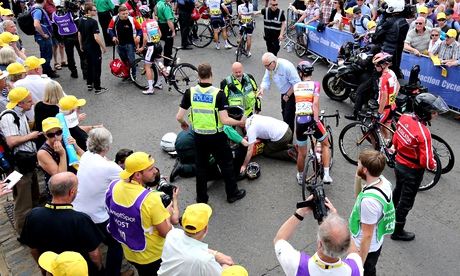
She collided with the rank of photographers stationed almost 40 metres after the line – almost three times the UCI regulation distance of 15m – with an initial impact as she collided with the race director, Michael Bennett, whose role is to keep tabs on the photographers and other press in the finish area and thus was positioned at the left end of the row.
Armitstead rolled at least twice and landed heavily on the left side of the road a few metres later and her injuries were eventually diagnosed as severe bruising to one leg, a sprained wrist and a blow to the head which has left her with headaches, although she did not recall losing consciousness. “I remember everything up to the impact. From the video I’m anticipating the impact, I’ve not gone floppy. After that I had plenty of laughing gas.”
Paramedics were tending to Armitstead within a couple of minutes, and she was kept immobile for over half an hour because of obvious fears she had a fracture.
“I’ve got an extreme dead leg, heavy bruising to the thigh. I was asking my team manager if the bone was sticking out, it was so painful. I’m amazed to have come away with just bruising. They were cutting my shoes off it because it had swelled up so much, the whole leg had gone into spasm and locked up. I’m a bit uncertain how to treat it, because with a broken leg it’s clear what to do, I’ve never had an impact like this before.”
The 26-year-old has been advised to keep the leg moving but at the same time has to avoid vibrations from the road in her sprained wrist, so she expects her initial return to her bike to be on a turbo trainer. “I hit my head hard and am still having headaches, so I won’t be pushing it. It will take a few days of rest.”
All major races have photographers stationed after the finish line in a rank that is allowed to extend up to a third of the road width – although at Aldeburgh the organisers Sweetspot had allowed a greater margin for what is referred to as the “escape area” – and the obvious hazard of cyclists sprinting at up to 45mph approaching a line of static human beings wielding lenses is an accepted one, however worrying the images might be of sprinters slamming on their brakes and swerving immediately after the line.
“It’s a risk you run in every race,” said Armitstead. “It was a complete accident, a racing incident, nothing could have prevented it, perhaps apart from me not celebrating.
“I remember sprinting, winning, putting my arms in the air and then either a gust of wind or something on the road made me dip to the left, took my front wheel. I went to save it, tried pulling away from the line of photographers but by then I was just too close. The bike just pulled me left, I tried to pull it to the right but I didn’t have enough time.”
There were, she felt, more photographers than is the norm at women’s events, although at only eight in number there were fewer than at major men’s races. “The finish was completely barriered off, there were more press there than we are used to at women’s racing but that’s a positive when you look at it. I don’t win bunch gallops very often so it was a new experience but perhaps I’ll do a shorter celebration next time.”