Afternoon summary
-
The SNP have protested strongly after it was reported that ministers intend to announce on Thursday plans to introduce “English votes for English laws” (Evel) by changing Commons standing orders. Angus Robertson, the SNP leader at Wesminster, said he has written to David Cameron about this. Robertson said:
The ramifications of Evel would be far-reaching – an issue with such magnitude must be properly considered, scrutinised and debated. We face the prospect of MPs being barred from specific votes, hindering our rights to represent our constituents properly.
Restricting the voting rights of some MPs could be the single biggest change to the rights of MPs in decades- and doing so without following the appropriate parliamentary procedure is totally unacceptable.
SNP MPs already don’t vote on English only legislation which has no financial impact on Scotland. We don’t need a change of the rules to determine what we can and can’t vote for. We certainly cannot have this rushed through without proper consideration of all the consequences.
- Ed Miliband has said that people in the Labour party are fully entitled to criticise his record. (See 3.52pm.)
-
The Conservatives have said that all Londoners will be able to vote to choose their party’s candidate for the contest to become the capital’s mayor. As the Press Association reports, the Conservatives will hold a primary to select their candidate for the 2016 election to succeed Boris Johnson in City Hall. All people on the electoral roll in London will be able to vote, although those who are not members of the Conservative party will have to pay £1 to register for the online primary.
That’s all from me for today.
Thanks for the comments.
I’m afraid I was not following the deputy Labour leadership hustings closely, because I was busy writing up the leadership one.
But luckily LabourList were on the case; they have posted a very good summary.
Miliband says he takes full responsibility for election defeat
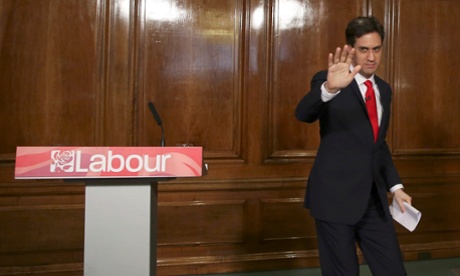
Ed Miliband has given an interview to Radio 5 Live today. He was speaking about the closure of Hatfield colliery in his constituency and, although he was not particularly forthcoming on other issues, he did speak about Labour generally.
Here are the key points.
- Miliband said he took “full responsibility” for the election defeat.
-
He said people in the party were “perfectly entitled” to criticise his record. Asked if he wanted to hit back at his critics, he replied:
I’m not going to be tempted. I lost the election, Labour lost the election. I took full responsibility for that. People will have their advice, their criticisms and their views and they are perfectly entitled to do that. I think my party is having a debate about its future direction and it’s right that it does.
- He said he would be staying out of the leadership contest.
- He said being able to see more of his children was one of the “consolations” of losing.
-
He said he would continue to speak out on political issues.
One of the great things about our parliament is that I have a job as a constituency MP and it’s a job I take very seriously ... I came back to parliament a couple of weeks after the election and spoke about issues I care about like inequality which is an issue I will carry on talking about.
I take a view that politics doesn’t just come from leaders, change doesn’t just happen because leaders make it happen; it happens because people play different roles and I’ll be playing a different role in the future.
I’ve taken the quotes from PoliticsHome.

Updated
Unions Together Labour leadership hustings - Summary and analysis
The Unions Together Labour leadership hustings went on for so long - just over two hours - that by the time they got to the final statements, even I had lost the bill to blog. But the final statements were actually rather good, because the four candidates used them to encapsulate their leadership USPs.
For Jeremy Corbyn, it was the fact that he was the anti-austerity candidate.
Austerity is a code word for greater inequality. The 100 richest people in this country own the equivalent of 30% of the wealth of the rest of the population. That is grotesque inequality, and it is getting worse.
Liz Kendall insisted that she was the change candidate. Labour’s situation “could get worse”, she said.
But I think we can win if we face up to this challenge, turn a page and make a fresh start.
The two frontrunners are Yvette Cooper and Andy Burnham. The hustings exposed minor policy differences between them (see below), but in this segment of the race, the contest is about life experience, not ideology. Cooper has 11 years’ experience as a minister, as opposed to Burnham’s five, and she is probably perceived as more steady too, and in her closing pitch she cast herself as the candidate with the most authority.
In about six weeks’ time you get to choose the leader of the Labour party. Make sure when you do so it’s also somebody you are confident can not just lead our party, but be a Labour prime minister. And can look like a Labour prime minister from the start. Because that is what the public are going to be looking for. And we have to make sure that is about being a Labour prime minister and being proud of Labour values.
Note repetition of “Labour”. That seemed to be a dig at Kendall.
While Cooper was boasting about her platinum reliability, Burnham chose to champion his authenticity - particularly, the fact that he comes from a northern, working class background. He recalled going from a comprehensive to Cambridge and described what he learnt.
What that did is open my eyes to what life is like. I saw life from the other side. I saw how it was much easier to get on in life if you had well-connected parents, if your accent sounded the right way. That is the world that I saw.
Then Burnham went on to attack Labour for being too elitist.
But years later, when I came to parliament, I saw the same thing. But I also saw this party doing the same thing, parachuting those people with the posher accents into the safe seats and putting those people straight onto the front bench in parliament. Is it any wonder that over the years the people’s party has looked more and more remote from the people, and isn’t speaking in a way that they understand and can relate to?
Burnham said he would be “a leader whose voice can carry into all the nations and regions of this country, a leader people can relate to” and he promised to appoint “a front bench full of accents and diversity.”
It did not look as if any one candidate particularly “won” the hustings. Judging by the #TUdebate tweets that have been most retweeted, Corbyn was most popular on social media. (For example, this, this and this have all been retweeted at least 40 times.) Corbyn seems to have been getting a very good reception at all the hustings. (He also came top in a LabourLeadership survey earlier this month.) Amongst the others, Burnham may have made the best impression. That’s because was best at making an emotional argument, as well as an intellectual one, as he did when he spoke about the posh-accent elite, or his commitment to reforming social care. (See 12.1opm.)
In news terms, here are the key points.
- Burnham accused Labour of being elitist in the past, and said that candidates with “posher accents” had been parachuted into safe seats and fast-tracked onto the front bench.
- Burnham said that when Tony Blair’s spokesman (Alastair Campbell) spoke about “bog standard” comprehensives in a Number 10 briefing, that was the “saddest day” for him in government. He could not believe Labour was attacking the comprehensive principle, he said. (See 12.31pm.)
- The candidates were divided over the extent to which to criticise the media. Kendall said Labour did not lose because of the media. But Cooper said that Ed Miliband was “outrageously treated” by the press. Burnham criticised New Labour for getting too close to the media and suggested that the newspaper attacks on Miliband were related to his support for the Leveson inquiry. Corbyn called for new laws on media plurality.
- Burnham called for young adults to be paid the same rate of minimum wage as adults. He said:
I can’t support a separate minimum wage for young people. An hour’s work deserves an hour’s pay whatever age you are, it seems to me.
Corbyn said the youth rate was hard to justify. But Cooper said that, although she thought the youth rate had been allowed to fall too far behind the adult one, there was a case for having a separate rate. Kendall said the Low Pay Commission should review this.
Updated
The Unions Together Labour deputy leadership hustings is starting now. You can follow it on the live feed here.
I won’t be covering it minute by minute, but I will be monitoring it and will post any highlights later.
Lunchtime summary
-
Liz Kendall, one of the Labour leadership candidates, has given a speech criticising those in the party who dismiss the importance of economic credibility. She said that arguing that arguing that fiscal responsibility was a Tory idea was helping the Tories and that, without “big changes”, Labour would lose again. She said:
If we continue to stick with the politics that we had at the last election or, indeed, over the last seven or eight years, we will get the same result. Einstein said the definition of madness was to continue doing the same thing over and over again and expect to get a different result. We need big changes. It’s not just that people didn’t trust us with the economy or with their taxes, or that we didn’t have a positive alternative that everyone can feel part of; people don’t think that we share their values of hard work, responsibility and taking care of yourself and your family.
Kendall and the other leadership candidates have just finished a marathon hustings for Unions Together. I will post a summary shortly.
- Downing Street has said that the number of Britons confimed to have been killed in Tunisia now stands at 21. It also said all Britons injured in the attack were now back in the UK.
- Jo Johnson, the universities minister, has refused to rule out an increase in tuition fees before 2020. Asked in the Commons to rule out an increase, Johnson only told the MPs the government was committed to ensuring “stable and sustainable” funding for universities, adding there needs to be a fair balance of taxpayer and student interests.
- More London Underground workers have voted to strike in a row over the new all-night Tube service. As the Press Association reports, members of the RMT and TSSA unions backed industrial action following a similar vote by drivers. Unions and management are meeting at the conciliation service Acas, a week before a planned 24-hour walkout by members of the drivers’ union Aslef begins at 9.30pm on July 8. The unions are in dispute over pay and conditions for the new all-night Tube, which is due to start at weekends from mid-September.
Jeremy Corbyn rounds up after 2 hours of #TUhustings: "We could have gone on all day couldn't we?'" [awkward silence] "Okay maybe not..."
— Asa Bennett (@asabenn) June 30, 2015
Question 8 - Labour priorities
Q: What should be the priority of Labour prime minister?
To help everyone get on in life, says Burnham.
Kendall says the priorities should be jobs and growth. There is a chronic problem with low pay and low growth.
Corbyn says Labour needs to democratise the movement and excite people about its ideas.
Cooper says she would like to priorities ending child poverty in a generation.
The candidates are now making their final statements. I will post a summary soon.
Question 7 - Anti-unions laws
Q: If you were Labour leader, would you repeal the anti-union laws?
Cooper says she would oppose the new ones proposed by the Tories, and would repeal them. She would not get rid of strike ballots.
Burnham says you have to fight today’s battles. He would fight the Tories’ latest plans all the way.
Kendall says she too would oppose the current Tory plans, and would reverse them in 2020. She would also go further to extend rights, for example for flexible workers and carers.
Corbyn says Labour in 1997 did not repeal all the anti-Tory legislation. Every worker should have a right to join a union and to be covered by collective bargaining, and trade union funds should be protected.
Question 6 - Rail
I’ve missed a question, but I will treat this as question 6.
Q: Do you support the workers in the London Underground dispute? What would you do to establish a publicly owned, publicly accountable railway?
Corbyn says he will support the questioner on his picket line.
He says Labour should support the CalMac workers facing privatisation in Scotland.
Cooper says she won’t join the questioner on his picket line. Industrial disputes and political disputes should be separate, she says. And she says it is best when industrial action can be avoided.
Burnham says the public want more public control of the railways. As with the NHS, there has been too much privatisation and fragmentation. He recalls being stuck on a train recently. He was told that, because the train had missed its arrival target, it was at the bottom of the queue, and was not given priority.
Kendall says turning the clock back is not the answer. She says the railways need more investment. What matters is what works, she says.
Andy Burnham came prepared for the quizz questions.
Superb. According to @Kevin_Maguire, at this Labour hustings Andy Burnham has a cheat sheet in front of him that says "pint of milk = 50p"
— Michael Deacon (@MichaelPDeacon) June 30, 2015
Cost of living quizz
Kevin Maguire says he has some “cost of living” quizz questions.
Cooper says, last time he tried this, they were stitched up. She jokingly suggests a candidates’ strike.
Maguire takes a vote. The audience want the questions.
To Corbyn.
Q: What is the basic state pension?
About £70, Corbyn says.
It’s £115, says Maguire.
To Cooper
Q: What is jobseekers’ allowance for over-25s?
About £80, she says.
It’s £73.10, says Maguire.
To Burnham
Q: What is child benefit?
It’s £20.70 for the first child, says Burnham.
Correct, says Maguire.
To Kendall
Q: At what rate does the higher rate of tax come in?
Around £42,000, says.
Correct, says Maguire. It’s £42,385.
Question 5 - Arts funding
Q: Will you reverse the damaging cuts to the arts?
Cooper says she cannot give that commitment. She does not know what the public finances will be like in five years’ time.
Burnham says that is a hard question for a former culture secretary. But he cannot promise to protect the arts budget, when money is being cut from kids with complex needs. But he understands the importance of the arts.
Kendall says she cannot give an assurance to protect the arts budget.
Corbyn says he wants to defend the BBC. The BBC is a huge investor in the arts.
He says he does not see arts spending as a subsidy. He sees it as an investment. Labour set up the Arts Council, and it should continue to invest in arts, he says.
Question 4 - Private schools
Q: Would Labour stop the public susbidy of private schools, and private schools charitable status?
Yes and yes, says Corbyn.
Cooper says the principle behind the question is the right one, but she does not want to make a commitment know because she does not know how practical that would be.
Burnham says in principle he agrees with the questioner. He strongly believes in comprehensive education. He says that the “saddest day” for him when Labour was in power was when the party [it was Alastair Campbell in a lobby briefing] described comprehensive schools as “bog standard”.
I could not believe what I was hearing.
(Campbell was not saying that about all comprehensives, as I recall, although he may have left that impression.)
Kendall says she does not agree with the proposals. But she does want to improve schools.
Question 3- Labour's manifesto
Q: Did we have the right manifesto? And what role did the media play? What the rightwing press did to Ed Miliband was terrible. Miliband suffered the worst attack since Michael Foot in 1983? Will you stand up to the press, or pander to them? And are you prepared to regulate them?
(This man seems to represent the “carpet bombing” faction I mentioned earlier - see 10.54am.)
Kendall says the manifesto was not good enough. It did not have enough to say to people who were not on the minimum wage or on zero hour contracts.
She says it was not the media’s fault that Labour lost.
Corbyn says there were lots of good ideas in the manifesto. He wishes it had been published earlier, so the plans were better known.
But it did not challenge the idea that spending had to be cut, he says.
He says Labour needs to tackle media plurality. Some 70% of the papers are owned by three people, he says. And Labour needs to use social media more effectively.
Cooper says Ed Miliband was “outrageously treated”, particularly over his father. He responded with great dignity, she says.
Labour should look to use social media more, he says.
She says she would have added to the manifesto more on the need to establish parity of esteem between educational and vocational education.
Burnham says he has praised Miliband for a reason.
Labour got too close to the media when it was in power. As a result, it did not listen to the Hillsborough victims. He suggests the attacks on Miliband were related to his support for Leveson.
He says the manifesto had more to say to his constituents on low pay than any other. The party needs to build on it.
Yvette Cooper’s teams have also sent out a hustings-related press release. In it, she says she would work with unions in a “shared mission to end maternity discrimination”. She proposes three specific ideas:
- Consulting on extending beyond three months the period during which new mothers can take up a workplace discrimination claim.
- Making it harder for women to be made redundant when they are on maternity leave
- Ending the current tribunal fees system.
Question 2 - Care
Q: How do you ensure that older people get the social care they need, and that care workers are paid properly?
Burnham says this is the key issue of our time. How can we show people care is an important vocation if people are paid the minimum wage, or less, because they don’t even get travel time.
He says he has been arguing for an integrated system in the party for years.
It is a scandal that Labour has continued to allow this.
He has not been able to get the policy through. But, if he is leader, he will.
It’s time this party had the courage of its convictions, brought forward big ideas in the best tradition of this party.
Kendall says there should be a radical plan to improve social care. And she she says her proposal to extend the remit of the Low Pay Commission would help raise pay in the social care sector.
Corbyn says he backs the plans in Labour’s manifesto. He also says the council cuts have made the situation much worse.
Cooper says this issue illustrates how public services have been devalued under the Tories.
Updated
Burnham says he would scrap government's system of employment tribunal fees
Before the hustings Andy Burnham’s team put out a news release, timed to coincide with the event, saying he was committed to getting rid of the government’s system of employment tribunal fees. Here’s an extract.
Burnham will also confirm [at the hustings] that Sir Keir Starmer MP, former director of public prosecutions, will lead a review on replacing the current fees system to ensure all workers can access justice, regardless of ability to pay, and maintain their rights. The review will include consultation with business and unions and will consider how to minimise costs to the taxpayer and give employers a quicker resolution.
The fees, introduced by the coalition government in 2013, see claimants pay £160 to launch a claim, £230 for a basic tribunal and may face charges of up to £1,200 for a full hearing. Employees who bring claims on unfair dismissal or discrimination pay an initial £250 followed by £950 for a hearing.
Figures from the Ministry of Justice reveal a 90 per cent fall in overall claims in the two years since the fees system was introduced – from 42,603 in the last quarter of 2012 to 4,386 in the same three months of 2014.
Updated
Question 1- Minimum wage
Q: Would you back having just one rate for the mimimum wage, instead of lower rates for the young, and would you raise it to £10?
Cooper says the youth rate has been allowed to fall behind the main one. There is a case for the youth rate being lower. But, because it has fallen behind so much, there should be a review.
Labour should review the minimum wage. By the next parliament it should be going up to that sort of level (ie, £10.)
She says she would want the youth rate to go up. The case for an apprenticeship rate is higher.
Burnham says he cannot support a separate minimum wage for young people. An hour’s work deserves an hours’s pay. And the apprenticeship rate is too low, he says.
He says he could not commit to a £10 rate now, but you would always want it to go up. And there should be better enforcement.
Kendall says that the Low Pay Commission should review the youth rate.
She believes in social partnership. Employers and employees should settle this between them, she says.
Corbyn says he remembers campaigning for a minimum wage in the 1970s. He praises Labour for bringing it in. He says the minimum wage should be going up towards £10.
He says the youth rate is hard to justify. Young people eat just as much as old people, he says.
Updated
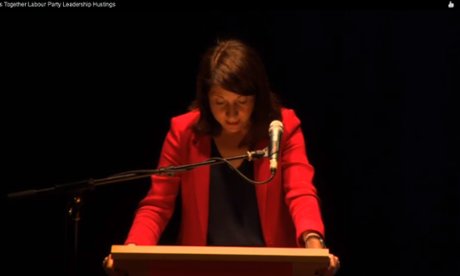
Liz Kendall's opening statement
Liz Kendall says she believes Labour can win in 2020. But it needs to restore it economic credibility, she says. Referring to her speech this morning, she says Labour will never get a hearing unless it is economically credible.
She says she wants to move the living wage to the next level, and extend it more widely.
She says she does not accept that you cannot be pro-business, but also in favour of social justice.
She says she wants the minimum wage to become a living wage. That will be difficult. But she would give the Low Pay Commission the power to move up the minimum wage to living wage levels, sector by sector.
She says she will not always say what is comfortable for the Labour party. But she will always say what she thinks is right.
Andy Burnham's opening statement
Andy Burnham says Labour suffered a dire defeat..
But it did not get everything wrong. He says he wants to give credit where credit is due. He praises Ed Miliband for putting Labour in touch with its grass roots, and says that he stood up to vested interests and started talking about key issues, like low pay.
But Labour lost its emotional appeal. He met people, all over the country, who had voted Labour before but who would not vote Labour again.
He says he has been able to stand up for what is right. When he decided that his party had gone too far in terms of letting the private sector into the NHS, he said so, even though he has been criticised for this. And he stood up to the establishment over Hillsborough.
He says he is Labour “through and through”. He will develop Labour alternatives.
He says this week he is proposing ideas to give councils the power to compulsory purchase homes from rogue landlords, who are letting properties bring down neighbourhoods.
He says protecting workers’ right should be the baseline for the EU renegotiation.
And he will protect union rights, he says.
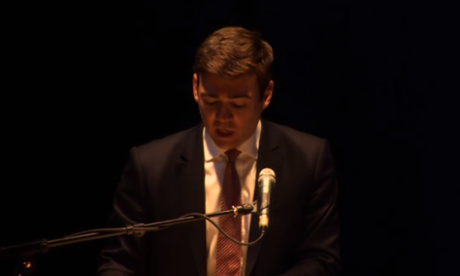
Yvette Cooper’s campaign has also put out a response to Liz Kendall’s speech. They are saying that her proposal for the work programme to be replaced with local alternatives (see 10.54am) is an idea that was in Labour’s manifesto. This is what the manifesto said:
And we will commission a replacement for the Work Programme at a more local level, working with local authorities to join up support for the long-term unemployed.
A Cooper campaign spokesperson said:
The policies set out in the 2015 Manifesto look very similar to the proposals being discussed this morning. There certainly appears to be more than a little continuity to them.
That is a dig at John Woodcock, the Kendall campaign figure who branded Cooper and Andy Burnham “continuity Miliband”.
Yvette Cooper's opening statement
Yvette Cooper says she did not want to be here today. She wanted to be in government, speaking as home secretary. Labour lost despite the hard work of union members.
It cannot let people down again, he says.
Labour needs a leader strong enough to take on David Cameron, and strong enough to change the party.
The union movement has given working people a voice in the corridors of power. She is the granddaughter of a miner, and the daughter of a union leader. Her father was one of the lead campaigners against Margaret Thatcher’s bid to end union rights at GCHQ. She was proud to be part of the government that restored those rights.
She organised a strike of prefects at her school because someone had his prefect badge withdrawn over not wearing white socks.
She says she would bring in a new law to make exploitation a crime.
She says she wants to tackle discrimination against working mums. She was the first minister to take maternity leave. Civil servants tried to downgrade her job. She was able to stop that. But other mothers aren’t in such a powerful position.
She says she would end tribunal fees for maternity cases.
She says it is not racist to talk about immigration. But it is racist to say, as some Ukip candidates did, that Lenny Henry should leave the country. Labour should take Ukip on.
It was not having too many doctors and nurses that caused Lehman Brothers to crash. “That is a Tory myth and we should never stand for it,” she says.
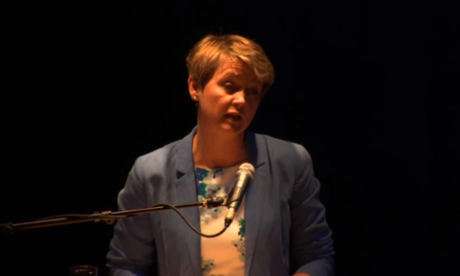
Corbyn says he used to work with wages councils. Labour and the unions need to become a social movement. They will stand by workers, and they need to organise internationally so the strategy of cutting wages does not become a race to the bottom around the world.
Let’s work together to renew our social movement.
Corbyn gets an enthusiastic round of applause.
Jeremy Corbyn's opening statement
Jeremy Corbyn starts by saying he was here when Hugo Chavez spoke.
Trade union money is the cleanest money in politics, he says.
He says he was at the protest last night to show solidarity with the people of Greece. What is happening in Greece is not the fault of the public, he says.
He says he wants to resurrect the idea that the unions and the Labour party are part of a social movement to change society.
He says the last Labour government allowed private finance to take over too much of the public sector. That led to the “millstone” of PFI, he says.
He says Labour needs to do something about public sector pay. For some it has gone down by 20% since the crash, he says.
He says Labour should defend the NHS, free at the point of delivery, as a human right. The same should be true of the welfare state. No one should be homeless, or go without food.
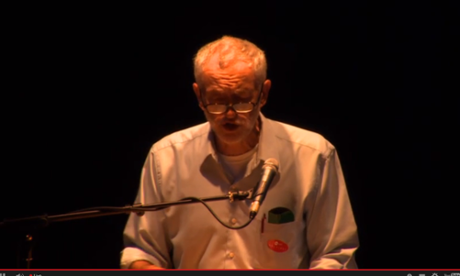
Labour leadership Unions Together hustings
Unions Together, the group that represents the 13 unions affiliated to the Labour party, is holding a Labour leadership hustings in Camden town hall.
There is a video feed here.
The Daily Mirror’s Kevin Maguire is chairing the event. He says it will run until 1.30pm. But that’s nothing, he says. Hugo Chavez spoke in this hall for more than four hours.
Maguire says all the candidates will get to make an opening statement up to 10 minutes long.
Jeremy Corbyn will go first.
David Cameron has been tweeting about this.
It's good news that the economy grew even more strongly than we thought. We can only secure our future by sticking to our long-term plan.
— David Cameron (@David_Cameron) June 30, 2015
Liz Kendall's 'Responsibility and Reform' speech - Summary and analysis
Liz Kendall made a promising start in the Labour leadership contest but in recent weeks her campaign has been perceived to be struggling a bit. Some Labour members clearly find her unrelenting focus on the need for economic credibility (seen as uber-Blairism) as unpalatable, to the extent that I’ve even heard it suggested that she could end up coming fourth, behind Jeremy Corbyn.
So today she had a chance to persuade people to have another look. Her speech was called “Responsibility and Reform” and it was billed as her first major speech of the campaign.
And it was serious and substantial. In fact, it was one of the best speeches any candidate in the campaign has given (admittedly, a very low hurdle). She had a distinctive, hard-edged message, and some reasonably newish things to say about policy. But whether he stance will appeal to those voting in the Labour leadership contest is another matter. And the Q&A also illustrated her weaknesses, as well as her strengths. On tax credits and the press, she was able to give clear, bold answers. But on other at least two other subjects, banking and Greece, she was more superficial than she should be for someone aspiring to be Britain’s alternative prime minister.
One final quibble. As she has often done before, Kendall used a quote about people wanting just basic things, somewhere to live, something to do, something to look forward to and someone to love. (See 9.31am.) It’s a lovely line. But it’s not hers; it’s from the late New Zealand prime minister, Norman Kirk. Kendall is probably not intending to pass it off as her own insight, but she never acknowledges it as his quote (at least, in any appearance I’ve watched) leaving her open to the charge of plagiarism. In 1988 this sort of thing helped end Joe Biden’s campaign for the America presidency.
Here are the key points from the speech and Q&A.
-
Kendall said that arguing that fiscal responsibility was a Tory idea was helping the Tories. In the campaign Kendall focus on the need for Labour to regain its economic credibility has led to her being criticised as too Tory. But Kendall insisted that a commitment to sound public finances was a Labour value.
Sound public finances are not an alternative to Labour values: they are Labour values. And they are the country’s values too. Remembering this is the first step we take in winning back the trust of the British people.
She justified this by quoting from Labour’s history.
Fiscal responsibility is part of a proud Labour tradition. People forget the strong commitment to fiscal responsibility in previous Labour governments.
In 1923 the manifesto of our first government demanded “the steady drain of a million pounds a day in interest is stopped”.
In his 1948 budget statement Stafford Cripps said: “We must secure an exceptionally large Budget surplus”.
In 1964 Harold Wilson’s election winning manifesto criticised “an ever-increasing burden of interest payments on the national debt, [while] vital community services have been starved of resources”.
And in 1997 Labour again won power because we were trusted on the public finances. In its early years the last Labour government delivered three budget surpluses in a row - more than the entire Thatcher-Major era delivered.
So when people say that fiscal responsibility is a Tory idea they are wrong. Worse, they are playing into our opponents’ hands.
-
She claimed that the public finances in their current state could not withstand another crash like the last one.
Could the public finances withstand another crisis as deep as the last? No they could not. And as long as that is the case, our debts are too high. So under my leadership Labour will not take risks with our country’s future.
-
She said that New Labour had been “too cavalier” about the threat posed to workers, not just on low incomes, by technological change.
Whilst the changes in our economy are opening up huge opportunities for some, too many people are being left behind. New Labour was sometimes too cavalier about this. The Labour Party I lead will not be. We’ve got to make these changes in our economy work for everyone.
Kendall is also being criticised as being too Blairite, and so it is helpful to her to be able to distance herself from the New Labour record.
Our great cities, towns and counties should not have to wait for Westminster to address housing shortages or fill skills gaps. They shouldn’t be stuck with national programmes, like the Work Programme, when they can do better themselves. And they shouldn’t have to look to central government for almost all of their funding.
So Labour’s replacement for the Work Programme won’t come from Whitehall, it will be designed and led by our towns, cities, and county regions. They know their local labour markets best. And they can build partnerships with local employers, mental health organisations, housing associations, and other agencies far better than any national programme.
-
She implicitly criticised Andy Burnham for not being fully committed to decentralisation.
Under my Leadership, Labour won’t equivocate about whether we back devolution. We will win power in order to give it away.
This was a reference to Burnham because he has been equivocal about the government’s Northern Powerhouse agenda, suggesting George Osborne is using it as a cover for cuts.
-
She said that she wanted to give workers “a real voice” in the workplace. In its manifesto, Labour committed itself to putting workers on remuneration committees. But Kendall said she wanted to go further.
In Germany and other European countries, there are significant rights for employees to be represented on company boards. So I want to see employees given a real voice in the workplace. Not just a single person on remuneration committees but a real voice in how their companies are run.
I also want more employees owning shares in the company they work for. My ambition is to open up opportunities for employees all over the country to own part of the companies they work for. Some companies do this already through share ownership schemes.
-
She said Labour should revisit the idea of giving people Individual Learning Accounts to pay for training.
We must also put power directly in the hands of individuals, so that they can get the skills they need in future. We should be brave enough to look again at individual learning accounts to give people proper chances and choices.
She used the word “brave” because ILAs were one of Labour’s biggest public policy disasters. They were wide open to fraud, and cost the taxpayer an estimated £100m.
-
She said too much money was being spent on tax credits. In the Q&A she said:
We spend £30bn a year on tax credits. That’s taxpayers’ money subsidising low pay. I want to see that change. I want to see good jobs that pay a better and decent wage, and we want a long-term strategy for that.
But she said it would be wrong for the Tories to cut tax credits without having a plan to increase wages.
- She refused to criticise the press for its treatment of Labour. Asked about this in the Q&A, she replied:
You don’t shoot the messenger. We’ve got a job to do to communicate a good messsage that is different from what we’ve been saying over the past five years. And I’m not going to criticise the newspapers for not liking politicians. That would seem to me not to be the right approach. We have to change our message ... I don’t believe in blaming the newspapers for Labour’s defeat. I blame ourselves for our defeat because we had lost touch with too much of the country.
This was a relatively risky thing to say because, in Labour circles, there probably some who favour not just shooting the messenger, but full-on carpet bombing.

Updated
Q: How would you combat the influence of the rightwing press?
Kendall says you do not shoot the messenger. She is not going to criticise the papers for not liking politicians. She would like more papers supporting Labour. She does not believe in blaming the papers for Labour’s defeat. She blames Labour itself. People did not trust Labour; “that was the problem, not the newspapers.” Our politics were in the wrong place, she says.
Q: At PMQs since the election Labour MPs have not been asking about the economy. What would you do about that?
PMQs is her “favourite half hour of the week”, she jokes. That was not true, she explains.
Change is difficult, she says.
Q: What would your message to trade union members be, about why they should sign up for affiliation to Labour and why they should vote for you?
Kendall says Ed Miliband’s decision to introduce proper “one member, one vote” was a great thing.
She says what people want is much the same everywhere in the country. As she has said before, she says, people want somewhere to live, something to do, something to value, and someone to love.
And that’s it. I’ll post a summary soon.
Q: [From the BBC’s Iain Watson] I have had several tweets from people saying they don’t understand what you are saying about Greece. Should they vote yes or no?
Q: Why do you think the UK should stay out of the euro, but Greece should stay in?
Q: Jeremy Corbyn says Greece needs debt write-offs? Do you agree.
Kendall says it is not for her to say how the Greeks should vote, or to spell out a plan.
But we need to strain “every sinew” to get a deal, she says. That needs give and take on both sides. We don’t know what the consequences of Greece leaving the euro would be.
Q: Do you really need to wait to the budget to know if you back tax credits?
Kendall says she has said what she thinks is the right approach. She has not seen Osborne’s plans.
We spent £30bn a year on tax credits. She says she wants to see that change. She wants more people in well paid jobs.
In the last parliament 95% of spending on housing was spend on housing benefit. Only 5% went on new homes. That needs to change.
Q: Where are you not continuity Miliband on skills and devolution? Ed Miliband, like you, also wanted to devolve power and do more to improve vocational training?
Kendall says the most important think Miliband got right was that most people were not seeing the benefits of growth even before the crash.
But Labour did not have a radical enough programme of reform.
Simply redistributing money via tax credits is not enough, she says.
Q: If Labour does not follow your approach, how long will you be out of power for?
Kendall says the hustings format has not been the best way to have a serious debate. Candidates are only allowed a one minute reply.
If Labour does not change, it will be out of power for 10 years at least.
[She means 10 years at least from 2010, I think, but it is not clear.]
She says she grew up in Watford. It was a Labour seat. Now it has a 10,000-strong majority.
Q: You want to get the deficit down. What tax rises or cuts would you support?
We need to get the deficit down, she says. Labour will respond when it sees the budget.
Q: Do you agree with John Woodcock that Yvette Cooper and Andy Burnham represent “continuity Miliband”?
Kendall is answering these questions in three. She does not directly address this point.
Q: You don’t like being described as a Blairite? How would you like to be described?
As a Kendallite, Kendall says.
She says Labour succeeds when it understands what people want. Labour won in 1945, in 1964 and 1997 when it applied its values to the world as it was then.
The policies that will be right in 2020 won’t be those that were right in 2010 or 2015, let alone in 1997.
For example, there has been a huge increase in the number of people self-employed. Labour has to offer them protections.
Q: Do you think you need to move to the right to win elections?
Kendall says it is not a matter of left or right. It is about right and wrong.
In Cardiff recently she met a couple of former Labour voters who were now voting Labour and Ukip. They said Labour did not believe in work. That was like a dagger through her heart, she said.
She says she is passionate about helping people on zero hours contract. But if you were not on a ZHC, and if you owned your own home, Labour had little to say to you.
Q: Are you saying Labour was not acting responsibly on the economy?
Kendall says Labour did not make the case for public finances strongly enough. This is not just about winning; it is because the poor suffer when the economy collapses.
During the campaign some people are saying these are Tory values. That is “completely wrong”. It plays into Tory hands. She wants to the the Labour leader that the Tories fear.
Q: So it doesn’t matter if your fiscal targets are the same as George Osborne’s?
Kendall says the government should get the deficit down, live within its means and run a surplus in good times.
But Osborne is not achieving his targets.
Q: Do you support George Osborne’s efforts to protect bankers from the EU restrictions on bonuses?
No, says Kendall. She supported the manifesto’s stance on bonuses.
But she is not anti-bank.
Q: Would you support ring-fencing banks, even if it hurt their commercial position?
Kendall says she is keen to look at this. Labour needs to come back to this.
Kendall says she recalls meeting an Asian businessman during the election campaign. He said Labour had nothing to offer people like him.
Q: When do you want the EU referendum to take place? In 2016?
Kendall says she has not expressed a view. But David Cameron has shown appalling leadership. Reducing our membership of the EU to a question of whether P0les get benefits was a mistake.
Q: What is the minimum that Cameron should get?
Kendall says Cameron should be stressing the advantages of being in the EU campaign.
And Labour should not boycott a wider pro-EU campaign. This would give the party a change to improve its relationship with business.
Q: Do you agree with George Osborne that Greece holds a warning to the UK?
Kendall says Greece shows that politics and economics are not separate.
Q: Someone has said if Greece were a bank, it would already have been saved. Do you agree?
Kendall says no one knows what would happen if Greece went bust. We need a better settlement.
Q: Would you consider taking us into the euro?
No, says Kendall. She does not think that is right of us.
Liz Kendall's Q&A
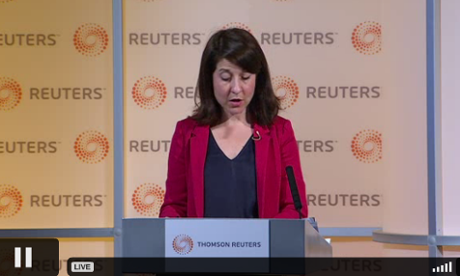
Liz Kendall has finished the speech. I will post a summary a bit later, when I’ve seen a text.
She is now taking questions. She is being interviewed by Alex Threlfall, a Reuters editor at large.
Q: Isn’t it harder to sell your message to the Labour party than to the public?
Liz Kendall acknowledges that there is something in this, but says it is up to a leader to do this.
Q: So you are not going to tone down you call for change before September to increase your changes?
No, says Kendall. She says she is not going to not say what she believes. It is not in her DNA to do that.
With Greece on the brink, and the future of the eurozone and even the EU at stake, the Labour leadership contest may not be most exciting story in the world today, but I write about Westminster and here the day has a distinct Labour-focus.
As I write, Liz Kendall, one of the four leadership candidates, is giving a speech to Reuters. Here are some of the lines that have emerged.
"Fiscal responsibility has a proud history in the Labour movement," says Kendall, citing Cripps in '48 and Wilson in '64. #reuterslive
— Stephen Bush (@stephenkb) June 30, 2015
Kendall says having 'sound public finances' is not a 'Tory idea' but a Labour one. pic.twitter.com/govmIbV1C0
— Ned Simons (@nedsimons) June 30, 2015
In a swipe at her rivals, Kendall says calling fiscal responsibility as a Tory value helps the Tories. From the Cripps to the blood (feud).
— Stephen Bush (@stephenkb) June 30, 2015
"New Labour was too cavalier" about the impact of globalisation, says Kendall, "the government I lead will not". #reuterslive
— Stephen Bush (@stephenkb) June 30, 2015
There is a live feed of the speech here. I will cover the Q&A when it starts, and post a full summary of the speech when I’ve seen the text.
Here is the agenda for the day.
8.30am: Liz Kendall gives a speech to a Reuters Newsmaker event.
9am: Chris Leslie, the shadow chancellor, gives a speech on the forthcoming budget.
11am: Labour leadership candidates take part in a Unions Together hustings.
As usual I will be covering the breaking political news as it happens, as well as bringing you the best reaction, comment and analysis from the web. I will post a summary at lunchtime and another in the afternoon.
If you want to follow me on Twitter, I’m on @AndrewSparrow
Updated