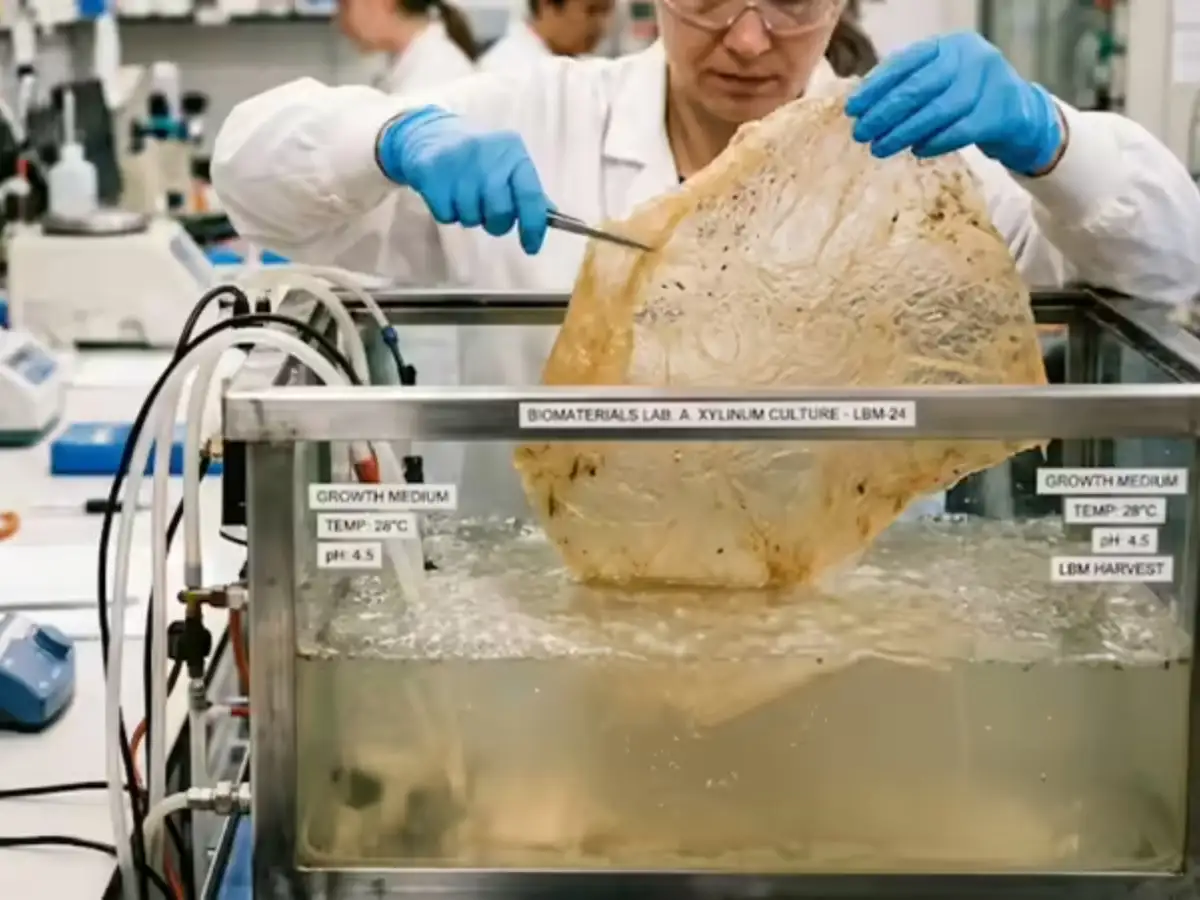
Researchers in the United States have developed a groundbreaking living supermaterial using bacteria-grown cellulose that could one day replace traditional plastics in packaging, electronics and industrial manufacturing.
Scientists from Rice University and University of Houston revealed the innovation in a study published in Nature Communications. The research focuses on a new form of bacterial cellulose that is strong, flexible, lightweight and biodegradable at the same time.
The development of this living supermaterial is attracting global attention because researchers believe it could help tackle plastic pollution and reduce dependence on fossil-fuel-based manufacturing.
How Scientists Built the Living Supermaterial
The new living supermaterial is based on bacterial cellulose, a natural material produced by specific bacteria. Unlike plant cellulose, bacterial cellulose is considered one of the purest forms found in nature and has unique structural properties.
To create the material, scientists designed a rotating bioreactor that directs bacterial movement while cellulose fibres are formed. Instead of allowing bacteria to move randomly, researchers guided them into organised patterns, producing highly aligned cellulose nanofibres.
According to the research paper titled Flow-induced 2D nanomaterials intercalated aligned bacterial cellulose, the alignment dramatically improved the material’s performance and durability.
Lead researcher M.A.S.R. Saadi explained the process simply by saying, “The bacteria move in all directions; we tell them to move in a certain direction.”
The resulting living supermaterial reportedly achieved tensile strength levels of up to 436 megapascals, making it comparable to some metals and glass while remaining transparent and flexible.
Why This Living Supermaterial Could Replace Plastic
One of the biggest advantages of the new living supermaterial is its environmental sustainability. Traditional plastics are made from petroleum-based chemicals and often break down into harmful microplastics that pollute ecosystems and oceans.
By contrast, bacterial cellulose is biodegradable and naturally produced.
Researchers also enhanced the living supermaterial by introducing boron nitride nanosheets, which significantly improved heat dissipation. The upgraded material reportedly transferred heat three times faster than conventional cellulose sheets.
Scientists believe the material could eventually be used in food packaging, flexible electronics, wearable technology, thermal management systems, textiles and energy storage devices.
Muhammad Maksud Rahman, assistant professor of mechanical and aerospace engineering at the University of Houston, said the team hopes “strong, multifunctional and eco-friendly bacterial cellulose sheets become ubiquitous”.
Can Living Supermaterials Solve the Plastic Pollution Crisis?
Plastic pollution remains one of the world’s biggest environmental challenges. Scientists worldwide are searching for sustainable alternatives that can match plastic’s affordability and versatility without damaging the environment.
The new living supermaterial could become an important breakthrough because it combines industrial-grade strength with biodegradability and renewable biological production.
Experts say one of the most promising aspects of the innovation is scalability. Many environmentally friendly materials struggle to move beyond laboratory testing because they are expensive or difficult to mass produce.
However, researchers behind the living supermaterial claim their bacterial cellulose manufacturing process can potentially be scaled up for industrial production using a relatively simple one-step method.
That could make the technology commercially viable in industries currently dominated by plastic-based materials.
The Future of Manufacturing May Be Grown, Not Built
For decades, plastics have dominated global manufacturing because they are cheap, lightweight and easy to produce. But the environmental cost of plastic waste has forced industries to rethink the future of materials science.
The emergence of the living supermaterial suggests manufacturing may increasingly rely on biological systems rather than fossil fuels.
Instead of extracting crude oil to create synthetic materials, future factories could potentially “grow” advanced materials using bacteria and bioengineering techniques.
While questions still remain about production costs and large-scale commercial use, scientists believe this breakthrough marks an important step towards greener manufacturing and sustainable industrial design.
The rise of living supermaterial technology may ultimately reshape how industries think about packaging, electronics and even the future of sustainable infrastructure.
Inputs from TOI