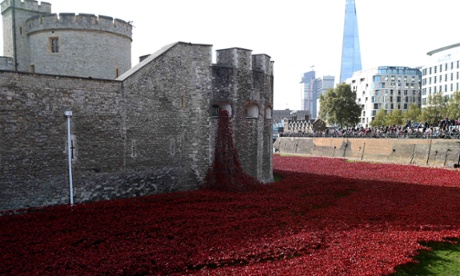
It seems to me that the Field of Remembrance is less crowded than it once was. Perhaps I went too early – a week before Armistice Day – or maybe the popular sensation of the Tower of London’s ceramic poppies has siphoned off some of the audience. And – how can I say this? – the kind of people who come aren’t quite what they were, at least on Wednesday’s evidence. When I first went, 16 years ago, the lawn next to Westminster Abbey contained lots of spry, straight-backed men aged 60 and upwards who carried umbrellas and wore bowler hats and overcoats with velvet collars. Retired guards officers, I suspected at the time; certainly gentlemen of the old school. “What is the name of that splendid girl?” I heard one ask; “How many are we to lunch?” said another.
I suppose it may have been the Queen Mother’s presence that day that attracted them, courtly moths to the flame of her ancient gaiety. She was 98 and in high heels and came smiling down the line of old soldiers with the help of a walking stick. Bowlers were raised. “Good morning, ma’am, you’re looking well today,” said the man in front of me, to which she replied, “Oh, thenk you,” like a debutante marking her dance card. Quite a few of these men must have served in the last world war; some of them would have been young children during the previous one, in which an older brother of the woman to whom they were raising their hats had died, at Loos in 1915.
In the years since then, another great chunk of “living memory” has collapsed, like ice from an ice shelf and dissolved into the sea. It’s strange now to think that one or two of my teachers served on the western front.
But at least the arrangements at the Field of Remembrance are much as they were on my first visit. Presumably they have been since 1928, when the tradition began of turning the lawn into a miniature military cemetery for a week every year. A couple of hundred plots, each marked with the name of a regiment, service or association, line the paths. A visitor who wants to remember a dead friend or relative does so by gently hammering a six-inch plywood memorial into the turf. Each memorial has a poppy pinned to it. Most of them are crosses, but stars of David, Muslim crescents and Sikh daggers are available, as are plain markers signifying other (or no) religious beliefs and a slightly bulbous one that the man at the Royal British Legion stall told me was for “all kinds of Indians”.
I put a fiver in the collecting box and selected a cross, and in ballpoint inscribed it with the name of a great uncle, “Jack Birmingham”, and then, remembering that I had great uncles on my mother’s side who had also died, added “and two Gillespies”. Then I borrowed a mallet from the Legion’s stall and went to look for the plot of the Royal Scots, in which all three men – and my grandfather, who survived – had served.
A ghostly army spreads across the lawn, a reminder of how large and various British militarism once was. There are plots devoted to all kinds of fusiliers, grenadiers, dragoons and hussars; in this place, the Artists Rifles live on, the North Irish Horse gallops beside the South Irish Horse, the Glider Pilots Regiment remains aloft and the Army Film and Photographic Unit is still in the darkroom. Space has also been made for civilians: the war widows, the nurses and midwives, the Association of Perioperative Practice, the Bevin Boys lined up beneath a symbol that shows a pithead rather than a flaming grenade, a canon, an anchor or an eagle. Great Uncle Jack worked down the pit in Fife for a while, long before Bevin Boys had been invented, and down the same pit in the late 1920s my father met a miner who said of him, “He was a guid lad. He wad hae geen away his ain arse an’ shitten through his mooth.”
This is the only memory that I can take to plot 44, where the Royal Scots are gathered. We know that he died aged 35 as a company sergeant major in the Third Battle of Ypres, otherwise known as Passchendaele, on 20 September, 1917. We know that he was born in India of an army father and had a wife named Aggie, memorable to me because it was a name shared in my childhood with Dan’s auntie in Desperate Dan.
Tap, tap with the mallet and his little memorial slides an inch into the earth.
The shame of the Libyan cadets is our shame, too
Several hundred Libyan army cadets invited to the UK for training are being sent home from their Cambridgeshire barracks after scenes of such violent disorder that the Ministry of Defence has drafted in the Royal Highland Fusiliers “to bolster security and reassure the local population”. Two recruits have pleaded guilty to assaulting women in Cambridge; another two have been charged with raping a man in a park; local reports suggest barracks cleaners have been molested and the local supermarket emptied of vodka. A scheme that was intended to train 2,000 troops to “help build a safe and stable Libya” has now been abandoned, although not before some of the first batch – unconfirmed reports suggest 20 – applied for political asylum.
As well they might. To quote the BBC website: “Libya has been in a state of flux since Colonel Gaddafi was overthrown … the country is divided between two rival governments, with disparate tribes, militias and political factions fighting for power.” In the past few weeks, more than 200 people have been killed in Benghazi, where Islamist fighters control large parts of the city and assassinations are routine. Islamists have declared another coastal city, Derna, as a caliphate. The country’s internationally recognised government quit Tripoli, the capital, in July and is now camped out in Tobruk, handily placed for the Egyptian border, should the government need to leave in a hurry.
How many foresaw this when RAF Tornados were helping to obliterate the Gaddafi regime, AKA “protecting Libya’s civilian population”? Judging by the record of the parliamentary debate on Britain’s involvement, very few. “This is different to Iraq,” Cameron told the Commons on 21 March, 2011. “This is not going into a country and knocking over its government, and then owning and being responsible for everything that happens subsequently.” The last 11 words are certainly true.
Only 15 MPs voted against a motion that committed Britain to “UN-backed action”. From the Tories, John Baron; from Labour, Graham Allen, Ronnie Campbell, Jeremy Corbyn, Barry Gardiner, Roger Godsiff, John McDonnell, Linda Riordan, Dennis Skinner, Mike Wood, Katy Clark, Yasmin Qureshi; from the SDLP: Mark Durkan and Margaret Ritchie; and Caroline Lucas, the Greens’ only MP. If there could be an anti-war memorial, or simply a monument to the cautious and the wise, these names would certainly be on it.