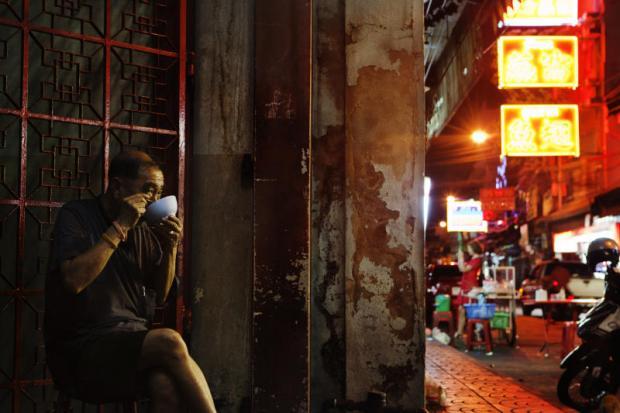
Veteran British photojournalist Yan Cohen adds an emphatic touch to his take on life in the backstreets of Bangkok's Chinatown in his debut photo exhibition "Chinatown By Yan Cohen". Held at Contemporary Art Space, River City Bangkok, the event -- which features 26 photos -- runs from now until March 1.
Just when you thought photojournalists had exhausted the subject, Cohen manages to find a fresh perspective on Chinatown -- breathing life and meaning into the mundane daily activities of local residents at which many would otherwise not bat an eyelid.
The vibrancy and depth of field in each image impact the composition of his larger-than-life characters -- residents who have called Chinatown their home since birth. Photographed at night, he brings out the character of his subjects in the most matter-of-fact manner. Walking through the exhibition, it becomes obvious that he took the time to get to know his subjects and their surroundings intimately prior to documenting the encounters.
Cohen, whose photojournalism career spans over three decades, has worked with such top publications as Time magazine and The New York Times. When asked why he chose Chinatown as the subject of his exhibition, he said there was no better place to connect with the city's roots.
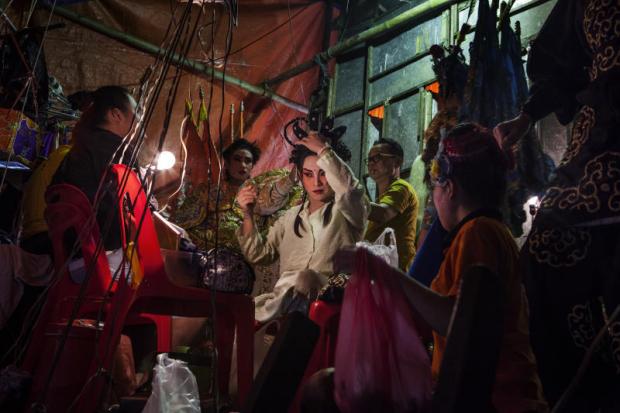
"Why? Because Chinatown still has history," he explained. "It has history not just in the sense of buildings, but communities and culture. You can go to Chinatown and savour the aroma of history in a very sensory way. In other words, you can eat from food vendors who have been there for generations. You can see rituals and performances that have been performed there for generations. You can come into contact with the culture that began perhaps in China but that has evolved into its own form in Thailand and Thai-Chinese culture. You also still find yourself in a physical environment by buildings that have history, perhaps over a hundred years old."
"That is a very special, especially at a time where the evolution of the city is being defined by progress and modernisation," he added. "The city is being redefined by being rebuilt. Many, many historical buildings that were here when I first arrived 30 years ago have now gone. They've been replaced by modern skyscrapers."
To the 52-year-old photographer, such modern structures have a certain element of prefabrication, and in that sense, lack a connection to the past: "Our identity today, as all cultures and history know, is defined by our past. So if you remove your past, it changes your identity today, and it leaves you somewhat rootless."
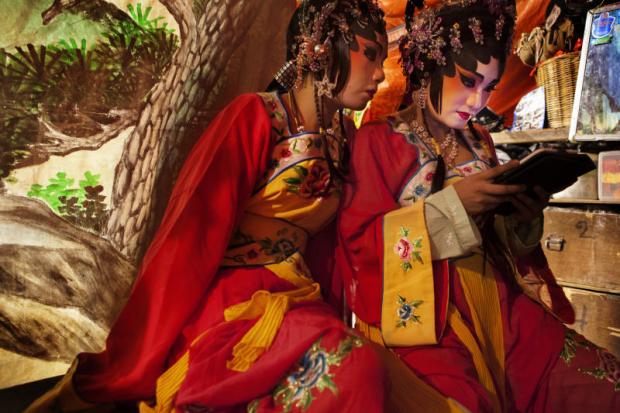
Chinatown still has that connection to something rooted and authentic and not prefabricated. "It has sort of grown organically," he said. "You can see that in a very visual sense because when you look at the walls, they are organically toned with layers of dust, grease and hand marks. You can see the layers of life there. I think that is an experience that's much more satisfying if you're talking about just experiencing a city. This is what inspired me to go down to Chinatown."
The photo exhibition wasn't planned. It's simply the result of a long-held fascination with the area. Over the course of a decade or so, his documentation of the area evolved into a collection.
"I don't think great art is necessarily planned," he said. "It's an expression that happens as a result of a sequence of events, usually starting with inspiration. For me, I found Chinatown inspiring."
He pays homage to the late Bob Halliday, the Bangkok Post columnist, who took him for long walks in Chinatown, leading Cohen to develop his fascination with the area.
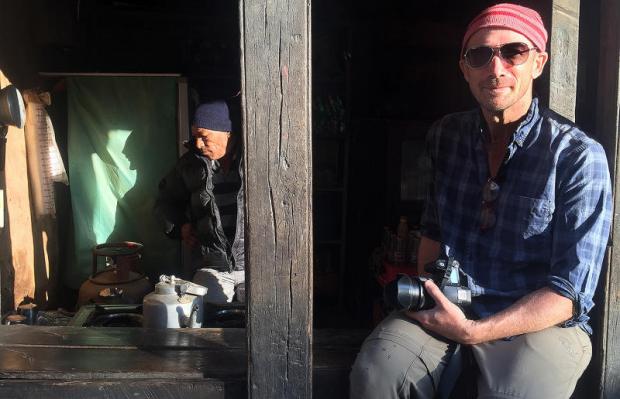
"Bob helped me to see [Chinatown] in a profound way, in the sense that it made me want to get a little deeper in the area," he said. "I just kept going down there. It expanded to an interest in Chinese opera which is very much part of their annual ritual, which makes for a beautiful visual."
When asked how confident he was ahead of his first photo exhibition, the seasoned photographer admitted that he was never entirely happy with the outcome of his work.
"I think it should be that way," he explained. "I'm very critical of my work. I always think, is this really the best or could I do better?
"I would say to photographers that are starting off to never think you are really good, because if you do, you'll stop trying to get better. So you should always think you are not as good as you should be. I think this goes to whatever you are doing, but art is a good area to apply this to because art isn't a process you can do mechanically."
For more information, visit Facebook: River City Bangkok, Instagram: rivercitybangkok and www.rivercitybangkok.com