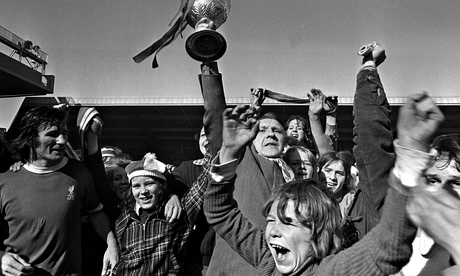
It isn’t easy to imagine how Bill Shankly’s family must have felt in the weeks after his widow, Nessie, died in 2002 when they began the process of looking through all those boxes of memories and going into the loft at 30 Bellefield Avenue to discover, to cite just one example, the telegram wishing him well in the 1965 FA Cup final, signed by John, Paul, George and Ringo.
What they found was a treasure trove of nostalgia: the red book from Shankly’s appearance on This Is Your Life; the framed Apollo mission badges Neil Armstrong gave him on a visit to Anfield; the letter of resignation Shankly wrote on 18 June 1974 (and the classic old Olivetti Lettera typewriter that formed it) and the silk scarf — “God Bless Bill Shankly” — that was thrown from the Kop as he took the crowd’s acclaim. You might remember the story. Shankly tied that scarf round his neck, but not before ticking off a policeman who had got there first and tossed it to the side. “Don’t you do that,” Shankly said. “That’s precious.”
It is certainly fair to say there are some wonderful old exhibits to be found behind the glass cabinets inside the hotel, named after Shankly and incorporating its own museum, that will open next Saturday inside the old flatiron-style building in Liverpool’s Victoria Street. Nessie had even kept her husband’s razor, so there was absolutely no way she was going to throw out the original key to the Shankly Gates.
His tactical jottings can be found in several notebooks and, all this time later, there is a boyish sense of delight about flicking through some of the yellowing pages, filled with his spidery handwriting, and coming across some familiar old names in his scouting reports. One entry, marked 11 April 1960, is typical. “Big raw boy, could be a player” is the verdict on a young centre-half he has seen at Dundee United. Ron Yeats did, indeed, become a player.
Liverpool, the city, has always been good at embracing its past and the Shankly Hotel, on the site of the old Imperial Advance bank, is all the better for the fact it is the great man’s grandson, Christopher Carline (middle names: William Shankly), who is driving a project that revives the memories of when Merseyside felt like the hub of the football universe.
It is just a pity, perhaps, for the people of this city that it isn’t easy to know when those days might be here again – and that is not just referring to the red half of the divide. Shankly’s personal belongings also included the ticket stubs from the days, in retirement, when he was a regular at Goodison Park. It would pain him, more than anything, that Liverpool have gone a quarter of a century since their last league title. But he could probably never have imagined either that Everton would have spent even longer watching somebody else’s party. Or that his adopted city could be in the position where, embarking on a new season with all the hope and expectation that usually brings, the eyes of the football world are generally elsewhere.
When Louis van Gaal was asked who could be considered as authentic title challengers, he replied, matter-of-factly, that it would be the same four clubs who occupied the Champions League places last season. José Mourinho and Arsène Wenger did mention Liverpool, but only fleetingly – and that is probably fair enough when nobody at Anfield seems to think it plausible either and, ultimately, we all know another distressing result for Brendan Rodgers at Stoke on Sunday would put the bloodhounds back on his scent.
As for Manchester City, the distinct impression is that they tend to regard Liverpool these days in a way that is reminiscent of the story James Lawton recounts in his new book, Forever Boys, when he recalls ghost-writing a newspaper column for Malcolm Allison around the time the sides met in 1973. Yes, Allison said, Liverpool had built a fine tradition and were a strong side, but they had lost the power to intimidate in the old way.
“Tell me,” he asked, “what have they won recently? They have become, for a team like mine, just a bunch of trial horses.” It was a classic Allison polemic that earned Lawton a telephone call from the manager’s office at Anfield and one of the more emphatic rollickings of his long and distinguished journalistic career, the most memorable line from the Scottish voice at the other end being that he should be ashamed of himself for “consorting with a maniac”. Then Shankly returned to the business of winning the Football League, which he did again.
The relevant question for today’s Merseyside is simple: will a time come again when it is the most successful region in English football? And the answer has to be yes, eventually, at some unspecified time in the far distance, given that football through the ages has always been cyclical and, lest it be forgotten, there was once a period when the banner read “Manchester – Trophy Free Zone”, and the same question was posed of the teams from Old Trafford and Maine Road.
The skyline in Liverpool has changed during the summer and the new structure that is rising in place of Anfield’s old main stand is another sign that its occupants have wised up since that stage when John Scales, in Simon Hughes’s excellent Men in White Suits, remembers the club being “caught in a time warp”. More supporters will mean greater income and that, in turn, should mean better players and more chance of releasing some of the pent-up yearning.
But it won’t be a quick process. There are four teams with a considerable head-start. Two of them, Chelsea and City, belong to football’s super-rich and it might take several more years before Liverpool are looming in their wing-mirrors and threatening the kind of overtaking manoeuvre that, briefly and enthrallingly, seemed possible when Luis Suárez was lifting the team to exhilarating heights.
The amazing thing is that a Liverpool fan under the age of 30 will not remember a time when the championship trophy resided in Anfield’s cabinet. That period has still brought some unforgettable moments, including two of the most dramatic FA Cup triumphs there have been, and a wild Champions League night in Istanbul in 2005 that partly explains why a summer revamp of their Melwood training ground includes a replica of the trophy, on a 15ft-high plinth, in the foyer.
But football has changed, unmistakably, from the days when Shankly talked about Liverpool being a “bastion of invincibility”. You might recall the old joke: if you are watching in black and white, it went, Liverpool are the team with the ball. Or the speech Bob Paisley gave about the team’s unremitting success. “Mind you,” he said, “I’ve been here during the bad times too. One year we were second.”
As for Everton, they are another proud old club whose supporters must crave more. A match at Goodison, crammed into those tightly packed red-bricked terraced streets, can still be invigorating when the volume is turned high, but one top-four finish in the Premier League era can feel like a bland existence for the fourth most successful league club in the country.
Everton have become detached from the elite in a way that means there is no straightforward route back. The Merseyside derby, in turn, has felt less significant, and more parochial, than before. Once it was one of the season’s main events. The last one was seventh place versus 12th; before that, it was 11th against 14th.
The balance of power will shift again, whenever that may be, but in the meantime the supporters of both clubs might have to grit their teeth and cling to the hope that when they do get back to the top they will enjoy the view all the more because of how long they have spent trying to get there.
Life and death? No, it’s much more important than that.

Bend rules for one-off tribute
AFC Rushden & Diamonds retired the No1 shirt for Dale Roberts after their goalkeeper killed himself in December 2010, and, until the last few weeks, had printed only two more off in that time. One was to display in the club’s bar and the other was presented to his parents.
Except now the club have reached the Evo-Stik League Southern Division One Central they have been ordered to bring it out of retirement to fit in with the league’s rule that teams are numbered from one to 11, the old-fashioned way.
Ordinarily, it would be no bad thing to see a league wanting to stick with tradition and maintain some sense of shirt-related order – we all probably remember Nicklas Bendtner switching to the 52 shirt while at Arsenal, saying it had always been a special number to him, not long, coincidentally, after he had received a new £52,000-a-week contract.
But, in this particular case, was it really beyond the relevant authorities to follow what happened when the Northamptonshire club were in the United Counties League, and slightly amend the rules?
The case has gone to an appeal to the Football Association and hopefully the decision-makers will realise, as a one-off, it isn’t going to bring down the league to show a little compassion.
Those in glasshouses shouldn’t complain about Stones
If Everton are correct in their suspicion that there is a deliberate campaign going on at Chelsea to unsettle John Stones then Roberto Martínez and everyone else at Goodison Park is entitled to be aggrieved by the drip-drip tactics by Stamford Bridge.
It isn’t widely known, for example, that the Premier League’s rules forbid anyone from one club – no matter if it is the manager, the kitman or whoever runs the souvenir shop — talking up the possibility of buying a player who is registered somewhere else. The players may not have memorised Rule T.8 in the list of regulations marked Public Statements, but Martínez was right when he complained that John Terry should not, in theory, be discussing the prospect of Stones joining Chelsea.
At the same time, Everton are conveniently forgetting their own tactics, and this is a much less publicised story, when they were trying to sign another young English centre-half, Jamaal Lascelles, then at Nottingham Forest and now of Newcastle United.
On that occasion, Lascelles and his agent were invited to Goodison, given a guided tour of the club’s training ground and, naturally, the promise of a hefty pay rise. Yes, two wrongs don’t make a right, but it was one of the few cases when a club has been found guilty of making an illegal approach.
It resulted in a £45,000 fine and, as tapping-up goes, it was of a very different nature to a couple of strategically placed sentences in the newspapers.