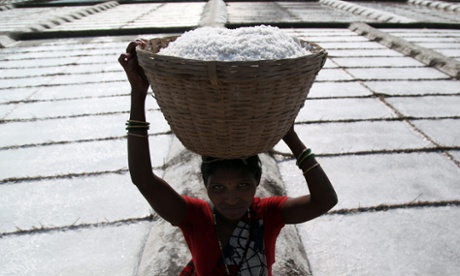
When iodine was introduced into salt supplies in the US in 1924, it improved IQ by 10 points among those most deficient in this common mineral. It was the second large-scale programme of its kind (after a similar programme in Switzerland in 1922) and presents a convincing argument of the impact of food fortification on improving nutrition and health.
Indeed, food fortification - adding vitamins and minerals to staple foods - was recently ranked among the top three international development priorities by Copenhagen Consensus, a group of economists who calculate the most cost-efficient ways to improve the wellbeing of populations.
So why isn’t food fortification implemented on a large scale in all countries that are struggling with malnutrition? One argument is that fortifying foods, which needs to be done by the private sector companies that sell them, translates to a higher cost for the consumer. In India the government lifted the ban on non-iodised salt in 2000 to allow people to buy slightly cheaper salt, which medical researchers said jeopardised advances against iodine deficiency.
Even if countries introduce legal requirements to fortify food, as happened in Tanzania in 2012, laws can be hard to enforce. The poorest are most likely to buy their flour from small-scale distributors, who don’t appear on government records and therefore can’t be monitored to check that they are adding iron, vitamin A and zinc to their products.
So how can the development community overcome the obstacles to food fortification? Does it need explicit mention in the sustainable development goals? And how can governments, donors, NGOs and the private sector work together to end nutrient deficiency on a large scale?
Join an expert panel on Thursday 19 March, 1-3pm GMT, to discuss these questions and more.
The panel
Greg Garrett, director of large-scale food fortification, Gain, Geneva, Switzerland, @gsgarrett
Greg is on the board of the Iodine Global Network and is on the executive team of the Food Fortification Initiative.
Anushree Shiroor, policy advocacy officer (nutrition), Results UK, London, United Kingdom, @ashiroor
Anushree has experience of community-based nutrition programmes for children and women in India and Uganda.
Mark Fryars, vice-president, programme and technical services, Micronutrient Initiative, Ottawa, Canada, @micronutrient
Mark has over 35 years of international development experience in Asia, Africa, Eastern Europe and the Americas.
Afidra Olema Ronald, Africa coordinator, Food Fortification Initiative, Kampala, Uganda
Ronald is a public health and nutrition expert in micronutrient food fortification for improved health of women and children.
Mohammad Raisul Haque, head of health nutrition and population programme, Brac, Dhaka, Bangladesh, @BRACworld
Mohammad has three decades of public health service delivery experience especially in nutrition.
Francis Zotor, head of family and community health, University of Health and Allied Sciences, Ho, Ghana
Francis is the president of the African Nutrition Society and works in Ghana.
John Hoddinott, professor of food and nutrition economics and policy, Cornell University school of applied economics and management, Rockville, USA
John Hoddinott is the lead author of the 2012 Copenhagen Consensus paper on investments to reduce hunger and malnutrition.
Susan Horton, global health economics professor, University of Waterloo, Waterloo, Canada
Susan works on the economics of nutrition and public health in low and middle income countries.
Louis Laleye, president, Biosol Consulting, Ottawa, Ontario, Canada @BioSol_inc
Louis is an international consultant in the area of food security, food fortification, nutrition and food technology.
The live chat is not video or audio-enabled but will take place in the comments section (below). Get in touch via globaldevpros@theguardian.com or @GuardianGDP on Twitter to recommend someone for our expert panel. Follow the discussion using the hashtag #globaldevlive.