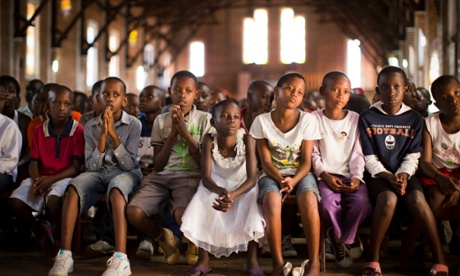
The World Development Report on conflict, security and development made waves in 2011 when it reported that no fragile state had yet achieved a single millennium development goal. While there has been significant progress since then, preventing conflict recurring is crucial to achieving long-term development. But where do you begin to unite a country divided by war or genocide?
Peace-building is an increasingly popular development strategy, from school workshops in Rwanda discussing ethnicity, to training former child soldiers to be leaders in Burundi. Digital initiatives like the Crack in the Wall project, which encourages Israelis and Palestinians to share their experiences, also offer a way to connect more people.
It’s not just about trust and community building, though. Leaders at a summit for fragile states called for political settlements, security, justice, jobs, growth, revenues and services to all be included in the Monrovia peacebuilding and statebuilding objectives.
But attempts at peace-building in the past haven’t always been inclusive. Speaking about the situation in Afghanistan last year, William Hague, Britain’s then foreign secretary, said he was “saddened that women still have to ask to be included at the negotiating table, as if it were a concession to be granted, when in fact it is the only route to stronger and safer societies”.
So how can peace-building strategies involve all members of society? What are the most effective ways to reconcile communities after trauma? And how can governments ensure there are fair and just legal processes to deal with abuses committed during conflict?
Join an expert panel on Thursday 16 July, 1–3pm BST, to discuss these questions and more.
The live chat is not video or audio-enabled but will take place in the comments section (below). Get in touch via globaldevpros@theguardian.com or @GuardianGDP on Twitter to recommend someone for our expert panel. Follow the discussion using the hashtag #globaldevlive.
Panel
Mandeep Singh Tiwana, head of policy and research, Civicus, Johannesburg, South Africa @mandeep_tiwana1
Mandeep is the head of policy and research at the global civil society alliance, Civicus.
Thomas Wheeler, conflict and security advisor, Saferworld, London, UK @TJAWheeler
Thomas focuses on the inclusion of peace in the sustainable develeopment goals.
Christopher Louise, programme manager, UNDP, Nicosia, Cyprus @chrisjlouise
Christopher has 20 years experience of working with peace building civil society organisations in Europe and Africa.
Marriët Schuurman, special representative on women, peace and security, Nato, Brussels, Belgium @MarrietS
Marriët is a Dutch diplomat who previously served in post-conflict areas in the Western Balkans, Africa’s Great Lakes region and Sudan.
Andrea Ó Súilleabháin, senior policy analyst, International Peace Institute (IPI), New York, USA @Andrea_O_S @ipinst
Andrea works on inclusive peacebuilding and conflict mediation, examining how participatory approaches improve the quality of peace.
Francesco Mancini, Adj Associate Professor, Lee Kuan Yew School of Public Policy, National University of Singapore, Singapore, @ManciniFr
Francesco is a senior advisor at IPI, on the research committee of the Global Peace Index and on the editorial board for the Peacebuilding journal.
Rajendra Mulmi, country director, Nepal Search for Common Ground, Kathmandu, Nepal, @rmulmi
Rajendra currently chairs the Association of International NGOs in Nepal, a network of 116 INGOs working in Nepal.
Raseema Alam, founder, connected development advisers, Toronto, Canada, @raseemaalam
Raseema is also founder of millionactsofpeace.com. She advises and implements community development projects in conflict states.
Andy Carl, executive director, Conciliation Resources, London @CRbuildpeace
Andy co-founded and leads Conciliation Resources. He developed the charity’s programme work and established the Accord publication series.
Hussein Kasim, chief policy analyst, Sahan and Somalia Stability Fund, Nairobi, Kenya
Hussein previously worked in Ethiopia’s public sector. He is doing doctoral research into how political institutions affect policy outcomes in Uganda and Rwanda.