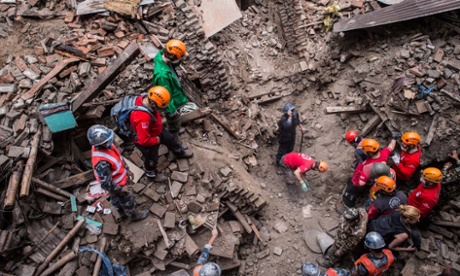
“Local actors are always the first to respond,” says Elhadj As Sy, secretary general of the International Federation of Red Cross and Red Crescent Societies (IFRC). “In 2015, we saw local people and organisations at the centre of operations; rescuing thousands trapped in rubble after the earthquake in Nepal, setting up evacuation centres in the wake of Cyclone Pam in Vanuatu, and on the frontline of the protracted conflict in Syria.”
Local NGOs are often the most effective in conducting humanitarian operations. They are effective because of their local perspective, their understanding of language and cultural norms, and their permanent presence in affected communities.
But despite their critical role, local and national organisations often struggle to secure the funding or support they need. Of the total funding given to international, regional, national and local NGOs between 2010 and 2014, nationals and local NGOs received just 1.6%, according to the 2015 World Disasters Report.
As Sy says that while international partners “still have a critical role to play” in humanitarian response by providing specialised resources and expertise, such support should be brought “with a commitment to building local capacity”.
So how can international aid agencies build successful and balanced partnerships with local NGOs? What measures can be taken to secure sufficient funding for smaller organisations? And how can larger NGOs support local humanitarians to deliver assistance in complex environments?
To mark the final global consultations before the World Humanitarian Summit next May, join a panel of experts to discuss these questions and more on Thursday 15 October 1-3pm BST.
The live chat is not video or audio-enabled but will take place in the comments section (below). Get in touch via globaldevpros@theguardian.com or@GuardianGDP on Twitter to recommend someone for our expert panel. Follow the discussion using the hashtag #globaldevlive.
Panel
Lesley Bourns, humanitarian affairs officer, UN-OCHA, New York, @ochapolicy
Lesley is a member of OCHA’s policy branch and the co-author of a forthcoming study on humanitarian effectiveness.
Christine Knudsen, director, Sphere Project, Geneva, @SpherePro
Christine is the director of the Sphere Project, a leading standards-setting initiative in the humanitarian sector.
Nayeem Wahra, director - disaster management and climate change, BRAC, Dhaka, @bracworld
Nayeem has worked in disaster management and humanitarian response for 35 years, working for NGOs in countries such as Kurdistan, Somalia, Myanmar.
David Loquercio, head of policy, advocacy and learning, CHS Alliance, Geneva, @DavidLoquercio, @CHS_Alliance
In addition to his work at the CHS Alliance, David is the executive editor of a report examining how the WHS can make humanitarian response more effective.
Vanessa Ortiz, technical adviser - organisational development, International Rescue Committee, New York, @theIRC
Vanessa helps to strengthen the capacity of local partners by providing organisational support, focused on management and governance.
Robert Tickner, acting under secretary general - partnerships, International Federation of Red Cross and Red Crescent Societies, Geneva, @RobertTickner, @Federation
A former CEO of the Australian Red Cross, Robert champions humanitarian diplomacy and of capacity building for locally-driven fundraising initiatives.
Jennifer Poidatz, vice president - humanitarian response, Catholic Relief Services, Baltimore, @CatholicRelief
Jennifer oversees and ensures support to CRS’ and local partners’ emergency response and recovery work around the world.




.png?w=600)