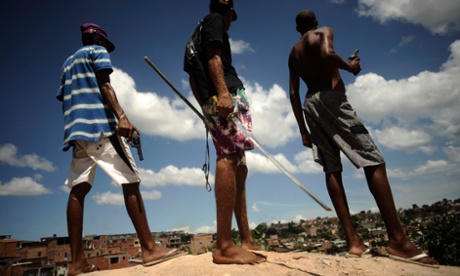
Homicide rates in Latin America are higher than fatality rates in some of the world’s worst war zones. In May this year, Brazilian thinktank Igarape Institute launched the Homicide Monitor, an online tool collating country-by-country statistics on homicides from a range of sources. “Making information available about homicide is the first step towards doing something about it,” says research director Robert Muggah.
Violence hold countries back in many respects, so how can development organisations tackle this complex issue? In Colombia the mayor of Cali, Dr Rodrigo Guerrero, developed an innovative data-led approach towards crime which saw a dramatic drop in homicide rates, from 80 per 100,000 in the 1990s to just 16 per 100,000 in 2012 in Bogota.
Guerrero found a root cause of gang crime to be groups of friends hanging around in the neighbourhood with no money, who are susceptible to criminals offering quick cash. So social intervention is important, but what programmes work best? How can you tackle violence in cities where the police are untrustworthy? And where do you start when violence is deeply entrenched, as in the world’s most dangerous cities?
Join an expert panel on Thursday 25 June, 1-3pm BST, to discuss these questions and more.
The panel
John de Boer, senior policy adviser, United Nations University, Centre for Policy Research, Tokyo, Japan @JdeBoerUNU
John is an expert on development, humanitarian, and security challenges in situations of conflict and violence. He leads research on urban violence, urban disaster, and organised crime.
Iain Overton, author, Gun Baby Gun, London @iainoverton
Iain is a writer, filmmaker and campaigner. He is director of investigations at the charity, Action on Armed Violence.
Damian Platt, researcher, activist and author, Rio de Janeiro, Brazil @DamianPlatt
Damian has been working with human rights protection and violence reduction since 1997. He worked on Amnesty International’s Brazil desk from 1997-2005.
Natasha Leite de Moura, project adviser, public security programme, United Nations, Lima, Peru @natashaleite
Natasha has worked on citizen security and youth violence prevention programmes at the UN for the last ten years in Latin American and Caribbean.
Venessa Padayachee, national advocacy and lobbying manager, Nicro, Cape town, South Africa @NICRO_
Vanessa is a social worker with an MA in Criminology. She has worked for Nicro for 20 years.
Robert Muggah, research director of Igarapé Institute, Rio de Janeiro, Brazil, and the SecDev Foundation, Canada @igarape_org
Robert has led studies in over 40 countries in Africa, Asia and the Americas and gave talks on fragile cities and organised crime at TED Global, the Web Summit and the World Economic Forum. He received his PhD from the University of Oxford.
Anilena Mejia, research fellow, The University of Queensland, Brisbane, Australia @anilena18
Anilena is a researcher. She is currently involved in projects for preventing violence in Latin America through parenting and family interventions.
Enrique Roig, director, citizen security, Creative Associates, Washington, DC @enriqueroig
Enrique is director of citizen security and a former coordinator for the Central America Regional Security Initiative at USAID.
Luigi De Martino, senior researcher, Small Arms Survey, Geneva @luigi_demartino
Luigi works on armed violence issues and is the coordinator of a diplomatic initiative called the Geneva Declaration on Armed Violence and Development.
The live chat is not video or audio-enabled but will take place in the comments section (below). Get in touch via globaldevpros@theguardian.com or @GuardianGDP on Twitter to recommend someone for our expert panel. Follow the discussion using the hashtag #globaldevlive.