Summary
That’s it from me, Aisha Gani, and this is the end of the event and day 2 of the Logan Symposium.
Issues ranged from protecting whistleblowers, methods of investigation, a speech from Daniel Ellsberg the Pentagon papers whistleblower, what we can expect in the future, strategies of the future and a live video appearance from Julian Assange.
Follow more coverage from the Guardian tomorrow.
Have a good evening!
And that’s it for questions with Julian Assange.
I asked Julian Assange how the Guardian “trapped” him in the UK.
He said he thought he had one newspaper, a decent newspaper in his corner, and thought he would have a significant chance in legal process.
Then he attacked the Guardian, alleging:
Assange says that the guardian did everything to get him arrested and pushed for his extradition #LoganCIJ14
— Aisha S Gani (@aishagani) December 6, 2014
Assange explains @guardian trapped him in the UK; "I made an institutional mistake.... rather than individuals, I dealt with an institution"
— Peter Jukes (@peterjukes) December 6, 2014
I am sure senior Guardian staff who dealt with Assange will have a different version of events.
Updated
Assange is asked about the sexual allegations:
“I wish people would understand the details, but no-one wants to report the details.”
“I have been detained for four years.”
“There is a growing realisation of how unfair it is”, he says.
“In Sweden they have also come to greater realisation”, that the prosecution was in violation alleges Assange.
Assange asks: It’s extremely interesting that the details of the women in the case, they didn’t want to file a complaint, why aren’t those details reported in the UK?
Here are a round-up of tweets:
"The threat of quantum computation is going back in time and decrypting communications you make now" says Julian Assange to #LoganCIJ14
— Peter Jukes (@peterjukes) December 6, 2014
Julian Assange: "If Islamic extremists disappeared, then we're fucked" in reference to the use of surveillance #LoganCIJ14
— Aisha S Gani (@aishagani) December 6, 2014
Assange is talking about rapid biometric signature reading + identification at LoganCIJ14 conference
— Jude Fleming (@flemingjude) December 6, 2014
Almost no one uses computer communications in a way that is invulnerable to a targeted attack. - Assange #LoganCIJ14
— Naveen Srivatsav (@sumergoconicio) December 6, 2014
Julian Assange says he has an insight of the UK, and makes a dig at The Guardian:
Being trapped in the UK by the Guardian newspaper – that’s why I was here”
Adding:
I had impression of being patted on the head”
Updated
On the court decision announced yesterday, Assange said he had not read it but:
It’s no surprise. I despair of the United Kingdom.”
He adds:
People born in the UK grow up in a very plastic class system, and it’s why oligarchs prefer to set up home in the UK.”
Assange says when Edward Snowden was given asylum, supporters were secretive, “but it was speed which gave us the edge”.
“And I think that is something to be optimistic about,” Assange adds.
He says that yes, big organisations such as the NSA have the resources – but the bigger the organsation the more incompoetemt and useless they are.
So the ability to carry out an operation “without cocking it up is pretty low”.
The Wikileaks founder says:
Let us not think that the only way to be effective is to be secretive. Speed and simultaneity are effective tools as well.
Here’s a vine of Assange speaking to the audience via video-link:
Updated
Assange begins to discuss international relations, and discusses the intervetion in Libya: “Yes part of that was about expansionist pressure to grab Libyan oil.
But he asks “what is the purpose of the National Security Agency?” It’s to achieve power, Assange says. And to get these agencies need resources, according to the Wikileaks founder.
Assange says power is found in two ways:
- Agencies tell the establishment, we can protect you.
- The other way is the appeal to greed.
Assange explains that broadly speaking is the business of securitisation and empire.
Adding:
If we didn’t have a muslim extremist threat, those organisations would not go away. They would simply roll over and find another excuse.
Keynote by Julian Assange: on fundamental rights
Julian Assange, editor-in-chief of website WikiLeaks, speaks to the auditorium via video-link from the Ecuadorian embassy.
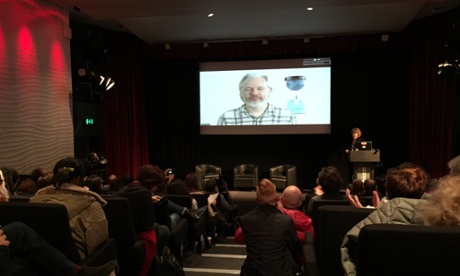
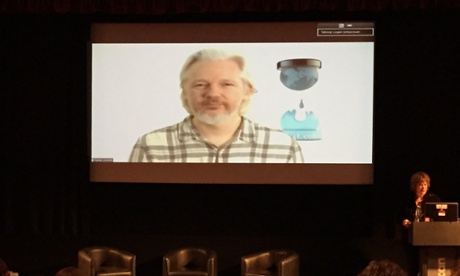
He begins by asking the audience:
- How many prisoners in the audience?
- How many Muslim journalists in the audience?
Assange then says that:
“What is happening to the Muslim population is a travesty to the human population.”
Appelbaum, 31, tells the audience: “you need to live in a free society”, if you want to use an iPhone. Which, “currently you don’t”. He explains how the UK government has access to Apple data. According to the cyber-security analyst, he says that people who have grown up post 9/11 only know a security state.
He adds that 1984 seems quite quaint now: Britain is a surveillance state.
Updated
Appelbaum, connected to Wikileaks, takes a dig at the Guardian saying that we take the security of our content management system (CMS) as seriously as we take the protection of our sources seriously.
I think the editors would have something to say about that...
Updated
He recommends using a cryptophone rather than a cell-phone. It works over Tor, and uses IP addresses from phone to phone.
Updated
We are joined by Jacob Appelbaum, an American independent computer security researcher and hacker. He was employed by the University of Washington, and is a core member of the Tor project, a free software network designed to provide online anonymity.
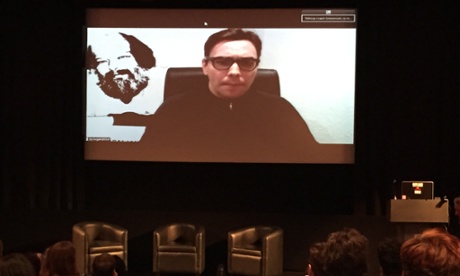
He says:
In Pakistan, a cell-phone is a drone magnet.”
Or if you’re using someone else’s phone regularly, maybe you can get them killed instead.”
He can’t be in London as he has concerns for his safety, so he’s on video-link but not on Skype, which he calls “absolutely f-ing garbage”:
@mensoh I'm not using Skype. I don't use Skype.
— Jacob Appelbaum (@ioerror) December 6, 2014
Updated
Annie Machon, former MI5 intelligence officer, says that currently under RIPA the product of electronic intercept cannot be used against you in the court of law. But a bugged device in your workstation for example, can be used.
Machon says that if intelligence security want to follow you, they won’t have a guy in a grubby coat – there will be around 20 guys following you in a very sophisticated way.
You have to be paranoid to escape surveillance, according to Machon. She says the most secure way is to write on a piece of paper and pass it under glass, then destroy the evidence.
Strategies for survival
We’re on the fourth session of the day and will have talks by:
- Annie Machon on operational security
- Sander Venema on security dilemmas in publishing leaks
- Jacob Appelbaum on anonymity
- and finally David Mirza Ahmad on adversary resistant computing
The veteran investigative journalist says that:
Electonic eavesdropping is not new.”
He explains how in the 1930’s:
The Supreme Court of the US was bugged by corporate America”
Here’s a round-up of tweets reacting to Bergman’s speech:
#LowellBergman at #LoganCIJ14 speaking about 'advocacy journalism' with #CharlesLewis. pic.twitter.com/XGEMSzEGzb
— Alice Harrold (@Alice_Harrold) December 6, 2014
Lowell Bergman says that investigating private power is more difficult than government agencies "because they can retaliate"#LoganCIJ14
— Peter Jukes (@peterjukes) December 6, 2014
Lowell Bergman advices to check again. And warns: docs can lie #LoganCIJ14 pic.twitter.com/WeRYyhv9pW
— Edouard Nguyen (@edouardng) December 6, 2014
Today’s Justice Dept is the friendliest to corporate America. #LoganCIJ14
— Naveen Srivatsav (@sumergoconicio) December 6, 2014
Lowell Bergman, who won the 2004 Pulitzer prize for public service and is the chair of investigative journalism at UC Berkeley, is now speaking.
He says:
- Always report against your story – see it from each side. The reason why a story isn’t picked up is if it hasn’t received sufficient due diligence – and it hasn’t persuaded the sceptics.
- Make sure you check your documents “documents can lie”
- Face to face is always best
Updated
Next up is Dutch photojournalist Kadir van Lohuizen.
He talks about his international projects - from Greenland to Bangladesh.
The auditorium is shown images from the Bangladesh project, a country which faces rising sea-levels, glacial meltwater from the Himalayan mountains to its north, and a wall is being built between Bangladesh and India. Kadir asks where will the people go?
He has set up the Noor agency to cover stories visually, around the world.
Lewis says, as he outlines in his book 935 Lies, that the “biggest lies in US history that cost the most lives” is actually the tobacco industry.
He says presidents, whether it was Jimmy Carter or Barack Obama, have helped facilitate its trade.
He adds that president Obama is spinning more than president Bush – there are fewer reporters in the White House now – and this is a worrying trend.
Charles Lewis makes parallels between the coverage of Vietnam war and Iraq invasion:
Journalist failures: 85% of Americans supported full Vietnam war initiated within 6 days of false invasion, Charles Lewis tells #LoganCIJ14
— Peter Jukes (@peterjukes) December 6, 2014
"I looked at great moments when journalists got it right — that wd not be Iraq" Chuck Lewis #LoganCIJ14
— CLARE SAMBROOK (@CLARESAMBROOK) December 6, 2014
Charles Lewis is a Washington-based investigative journalist and is the founder of the Center for Public Integrity in the US.
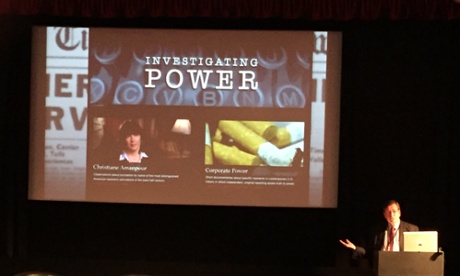
Lewis is speaking about the invasion of Iraq and asks “what if the public don’t actually want to accept the truth?”
“As late as 2012 60% of republicans still think WMD were found in Iraq.”
He adds that’s when he realised there was a crisis in journalism.
Vision of times to come
The auditorium is filling up again –
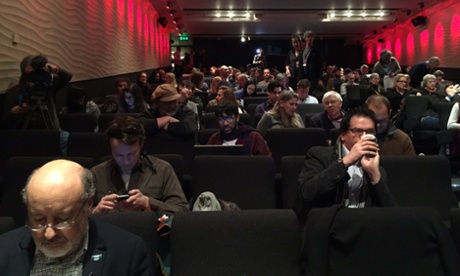
In this session we’ll hear from:
- Charles Lewis speaking “On truth”
- Kadir van Lohuizen on visual investigations
- and Lowell Bergman speaking on multinational companies
Afternoon session
Welcome back to the liveblog! I’m Aisha Gani, reporter on the Guardian’s news desk and I’ve been covering day 2 of the Logan Symposium – a conference on secrecy, surveillance and censorship. You can follow my tweets: @aishagani. The hashtag for the event is #LoganCIJ14.
So far, we have covered whistleblowing and methods for investigation. We also had a special speech from Pentagon papers whistleblower Daniel Ellsberg.
We’ve finished the morning sessions now, and I’ll be back liveblogging at 14:00.
A
Here are some reactions on twitter to Daniel Ellsberg’s speech:
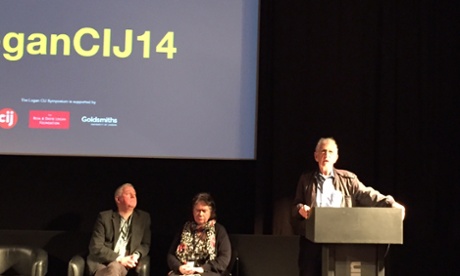
Ellsberg on #Manning readiness to be jailed/executed: "I felt the same... I've been waiting 40 yrs to hear someone say that" #LoganCIJ14
— David Blood (@davidbjourno) December 6, 2014
Official secrets game plan: keep it secret long enough that no one cares or can be implicated. #LoganCIJ14
— Naveen Srivatsav (@sumergoconicio) December 6, 2014
"Don't do what I did" says Daniel Ellsberg in closing speech to #LoganCIJ14 : "Don't wait. Do what I wish I'd done in 1965 or 1966"
— Peter Jukes (@peterjukes) December 6, 2014
Governments often get their way, says Ellsberg. "Their secrecy system works." No efficient leaks prior to Iraq war. #LoganCIJ14
— Christoph Scheuerman (@chrischeuermann) December 6, 2014
The US in Syria, bombing both sides of a civil war, is as crazy and murderous as a policy could be! - Ellsberg #logancij14
— Alex Pearlman (@lexikon1) December 6, 2014
Updated
Speech by Daniel Ellsberg – the Pentagon papers whistleblower
Daniel Ellsberg, Pentagon papers whistleblower, says:
I identified very much with Chelsea Manning”
Ellsberg says that three things matter when whistleblowing:
- It has to be in mass
- has to have documents
- timely
He says that Britain’s Katharine Gun is the only mass whisteblower who did it very timely, who leaked the tricks used during the UN Iraq war vote.
Updated
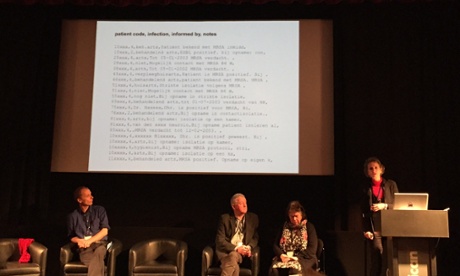
Dutch writer Karin Spaink is speaking about the mayhem and mishap of medical records in the Netherlands.
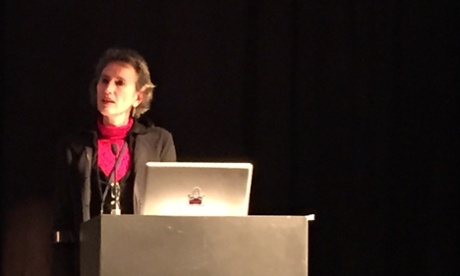
Spaink speaks about a case of how a hacker was able to access medical records, and was able to change data. She said some computers were still using Windows ‘97.
Some solutions include:
- Data hygiene
- Make data protected and encrypted
- medtronic pacemaker
Here’s a round-up of tweets on the Nicky Hager talk:
Investigative journalism is about focused work, strategizing, and luck... It's not just waiting for leakers. - Nicky Hager #LoganCIJ14
— Alex Pearlman (@lexikon1) December 6, 2014
Hager: thank god for Snowden and Manning, but investigative journalists can't wait for the next big thing #logancij14 pic.twitter.com/ePRiULzQgX
— Aisha S Gani (@aishagani) December 6, 2014
Nicky Hager on the "physics of secrets" - when 1 person is told many can follow so he puts a "ring fence" around him and source #LoganCIJ14
— RosieBeaumont-Thomas (@REJBT) December 6, 2014
Even in the age of mass surveillance, good sources will come forward - Hager #LoganCIJ14
— Wong Joon Ian (@joonian) December 6, 2014
Nicky Hager is an investigative journalist from New Zealand, and is the next speaker.
He says that the first thing police always look for in a search is your mobile phone.
He suggests that journalists and IT people need to work together more on projects.
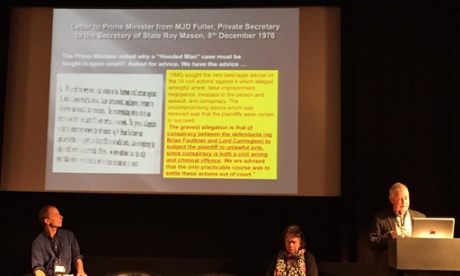
Speakers Anne Cadwallader and Paul O’Connor speak about the case of Patrick Finucane, who was a practising lawyer who frequently acted for prominent members of the IRA, and was murdered in his home in North Belfast by the loyalist paramilitary group, the Ulster Defence Association (UDA) on the evening of 12 February 1989.
Here’s the official report of the Patrick Finucane Review.
The report concluded that actions by employees of the State actively furthered and facilitated the murder of Patrick, and that in the aftermath there was relentless attempt to prevent justice and holding those responsible to account.
The speakers explain how there is much evidence in the National Archives and in security leak sources.
Methods for investigation
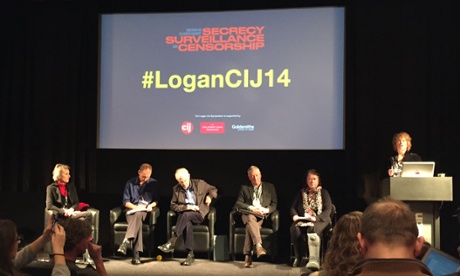
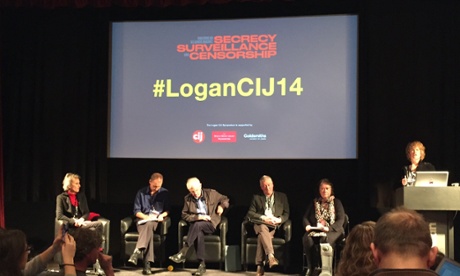
So here’s the panel for the “methods for investigation” session, with special guest Daniel Ellsberg (centre), who leaked the Pentagon Papers to the New York Times strengthening public opposition to the Vietnam War in 1971.
Updated
The coffee break is over and next up is a session on investigation methods.
- Anne Cadwallader and Paul O’Connor will talk about how “the truth is out there”
- Nicky Hager will speak about working with whistleblowers.
- And Karin Spaink is to speak about medical records.
“The best whistleblower is the one you don’t know about”, says Bea Edwards during the Q&A, and she explains that this shows organisations have protected the identity of the individual well.
Here’s a round up of tweets after the international defense of whistleblowers session:
Bea Edwards at #LoganCIJ14 is talking about whistleblowers. The subjects are not trivial, Massive corporate fraud or crimes against humanity
— Peter Jukes (@peterjukes) December 6, 2014
"We need credible ngos to work with the wistleblowers because no individual can go against big corporations and win" #LoganCIJ14
— E. Papavasileiou (@manosrev) December 6, 2014
The awful truth about Darfur and the NSA was only revealed by a whistleblower says Bea Edwards #LoganCIJ14 - retaliation can be ruinous
— Peter Jukes (@peterjukes) December 6, 2014
Bea Edwards: Problem for whistleblowers is that press want proof, but handing over documents can result in criminal charges #LoganCIJ14
— Elaine A (@el_by_) December 6, 2014
Bea Edwards says that: If we didn’t have whistleblowers in these various organisations we wouldn’t no they were happening.
Bea says that whistleblowers face incarceration and there are very few avenues for compensations or protection. She adds that it has been the press who have best protected Edward Snowden, or people like Ben-Artzi.
Bea says we need credible non-governmental organisations working together, the press and the public and to not just address the crimes exposed but to protect the whistleblower – such as the Government Accountability Project in the US.
Bea gives the case study of Eric Ben-Artzi, former analyst at Deutsche Bank, who was black-listed for whistleblowing on international financial crimes.
The Wall Street whistleblower wanted to know:
How does national law enforcement investigate multinational banking fraud?
Here are some tweets from the auditorium:
There is no legal apparatus for taking on the international crimes of financial institutions that caused the economic collapse #LoganCIJ14
— Alex Pearlman (@lexikon1) December 6, 2014
Bea Edwards "The espionage act is a very blunt tool to use against whistleblowers" #LoganCIJ14
— James Cropper (@JamesCropper95) December 6, 2014
Learning about real courage: whistleblowers risk everything in the public interest, with little, if any, protection. #LoganCIJ14
— Duncan Mortimer (@DuncanMortimer) December 6, 2014
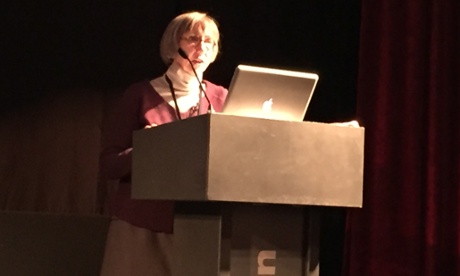
Bea Edwards, executive and international director of the US Government Accountability Project (GAP), which is the nation’s leading whistleblower protection organisation, now provides the international defense of whistleblowers.
Bea is responsible for the organisation’s actions defending whistleblowers through the Congress, the media and the courts.
Whistleblowing
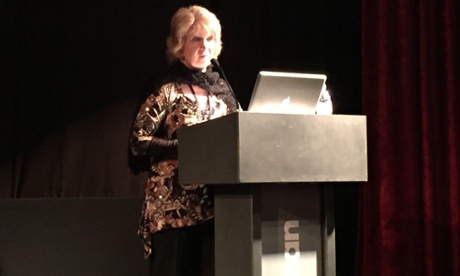
Whistleblower Eileen Chubb gives her testimony of what happens after she whistleblowed on the UK healthcare system.
Eileen says that:
Your work place becomes a nightmare. The fear of tomorrow is there.”
“The trust of the employer is bing lost and that is very hard to compensate.
Eileen says that if we don’t protect the protectors, nothing will change, and adds that,
next time, I wouldn’t dial “P” for police, but I’d dial “P” for Panorama.”
You can read more of her story here.
Updated
Introduction
Good morning!
Aisha Gani here liveblogging day two of The Logan Symposium, a gathering in London of journalists, hacktivists, legal and security experts and artists to discuss topics including secrecy, surveillance and censorship.
It’s organised by charity the Centre for Investigative Journalism and Goldsmiths, University of London. Over its three days, the event will host speakers including Seymour Hersh, Laura Poitras, John Pilger, Sarah Harrison, Julian Assange, Annie Machon and Jacob Applebaum.
The Guardian will be covering each day of the conference, starting with today’s lineup of talks covering journalism; surveillance systems; the Edward Snowden revelations and other leaks; and the past and future of hacking.
Expect updates throughout the day of the key points made by speakers, as well as links to any longer reports on the individual sessions.
Follow my tweets and vines at @aishagani
Updated