Finally, a roll call of “persecuted journalists and hackers” read by actor Francis Magee to finish off the day, and remind the audience that some of the people who couldn’t attend this event are facing the greatest risks.
Apologies, a Vine is just a six-second snapshot from a long, long list. But it’s a fitting way to bring the day to a close.
Harrison is asked about getting these messages across to the general public. “Just education, and keeping on that. I’ve had conversations with some people, it was actually a revelation that the internet is physically carried by cables across the world! In this age of Wi-Fi, people just think the internet is something magically in the air.” she says.
“It’s interesting being in Germany whilst these revelations are coming out, there’s still in living memory the history of surveillance here that was in a much more physical way. There’s a bit more of an understanding here that even if you can’t see it, the concept of this surveillance, the taking away of our rights, is hugely problematic... It’s important not to give up.”
Harrison says one good outcome from the NSA revelations has been more journalists understanding encryption technology – or if not understanding it yet, being open for the need for it – which she says makes it easier for WikiLeaks to work with them. “Now it’s quite easy when I say we’ll have to train you in some encryption methods, most journalists are actually quite pleased to have that training,” she says.
“The NSA revelations haven’t necessarily made a large impact on how we’ve had to work ourselves,” she adds. “People do get now that people like Julian and Jake [Jacob Appelbaum] are not actually paranoid, they’re just correct, which is nice.”
Could things get worse on the surveillance front? “It doesn’t mean that all is necessarily lost. Encryption does work. People do need to be trained to understand the technologies so they can protect themselves... It really is up to the technical community to help all members of the public find ways to protect themselves.”
Harrison has some advice for journalists, suggesting that they can follow Glenn Greenwald’s recent career path: “Do the work that you see as correct... and if you feel at any point that you’re being prevented... your pieces are being too editorialised, or you want to publish a piece that the media organisation doesn’t have the guts for, you should not only go it alone, but make some noise about it... make sure the public knows that the information is being filtered.”
Harrison is asked about the crackdown on press freedom being matched by a less-reported “civil rights crackdown” on the Muslim community by one audience member. Is that something she has views on? “I completely see what you’re referring to. One of the biggest issues is this: the government in the UK and the US as well, they like to use the rhetoric of national security, terrorism etc, basically as propaganda tools to give them the cover to operate in all sorts of abusive ways,” she says.
“I don’t think this is questioned enough. If you look at the statements that the US government said about us when we released the Iraq war logs and Afghan war logs, they tried to say we had blood on our hands. Which is quite extraordinary when we’re exposing the tens of thousands of deaths at the hands of the US... This is all done under this guise of national security, and it’s really created problems within the UK and US communities and media on how to deal with Muslim communities, and to understand that it’s not okay for anybody’s rights to be broken... The press in the UK really needs to grow some balls for the most part.”
She talks about the Courage Foundation, which spawned from WikiLeaks’ involvement in helping Edward Snowden travel from Hong Kong to Moscow.
“We saw that there was a need, and hence we started up Courage, which basically is a whistleblower support organisation. The unique part about Courage is it’s not only global, but it’s being set up specifically for these high-risk cases to help in some of the most dangerous circumstances of whistleblowers to get them the help that they need.”
But then it’s questions from the audience. First, John Pilger’s earlier speech about WikiLeaks being airbrushed out of the story of recent leaks in comparison to Snowden and Greenwald. “I think that there has been a lot of, and I don’t really see it as particularly helpful or correct, people like to try and draw these comparisons. Who’s better or who’s achieved more?” she says.
“If you look at the case of Snowden and Assange, they’re completely different beings. Edward Snowden is a whistleblower, Julian Assange is a journalist and a publisher. Snowden did a heroic act, and Julian’s life work – starting of WikiLeaks and also the work he did before then – shows great bravery. People who draw these comparisons, it’s about maybe their own misgivings, or they’re playing into the government rhetoric too much.”
The UK's "large crackdown on press freedoms"
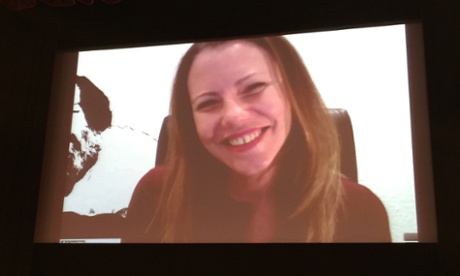
The last speaker at The Logan Symposium is WikiLeaks journalist Sarah Harrison, who is also acting director of the Courage Foundation, which raises money for the legal and public defence of journalistic sources. She’s now based in Berlin, and like Laura Poitras has been advised not to travel to the UK for legal reasons, so is Skypeing in her session.
“The UK is having what I think is a large crackdown on press freedoms. It’s under the Terrorism Act that the intelligence services went into the Guardian’s offices... it’s what they used to detain David Miranda, and it’s the reason my lawyers have advised me not to go home,” she says, calling for a campaign in the UK to demand that journalists not be muzzled by legislation intended for terrorists.
Finally, what has she learned in all her work about the consequences of what the NSA and GCHQ are doing? “I do think that in a strange way, being put on a watch list made me a bit resilient, and ready to handle the story,” she said. “And Snowden learned from other whistleblowers... I think that’s partly the good news. That people are willing to take risks to expose injustice or wrongdoing.”
Another question: the harshest reactions to the Snowden revelations seem to have come from the UK rather than the US – the detainment of Glenn Greenwald’s partner during an airport transfer, for example, and that hard-drive destroying Guardian incident. Why?
“Your analysis is clearly right... certainly the response has been the most anti-free-press, and really attacking the reporting in a way that we haven’t seen on the same level in the US,” she says, but declines to suggest why. “Perhaps someone in the room who is from the UK can answer that one.”
Finally, she’s asked about how she keeps the raw material for her films safe, after it’s been shot. When she flew to Hong Kong she had multiple, encrypted hard drives, and giving them to a local contact so they weren’t stored in her hotel room.
“I was very concerned that we could be raided, and that everything could be taken. I had everything backed up – I’m religious about backing up, it’s essential – and the film I shot there’s one copy in Hong Kong, and I travelled with the other.”
Updated
She’s asked about how she conveys “empowerment through technology” to her fellow journalists. “One of the effects of this story is probably a lot more journalists have learned to use encryption, because they care about source protection – which I hope they do! – but also to be prepared if they ever get a knock on the door.”
She admits that it can be difficult to get some of the tools required for her work – video editing, for example – that are free [secure] software. “At some point it becomes a case of what is your threat model versus what you want to accomplish. When it comes to protecting sources, we have an obligation to use technology that we believe to be secure,” she says, before addressing hackers directly:
“The challenge is on you right now to build tools that people like me can use. Although I did figure out how to get Tails running, it wasn’t easy: there was a learning curve. I had enough information to know that it was essential, but not every journalist does. So it’s important that we focus on building tools that are easy to use, and which don’t require such a steep learning curve.” Something Seymour Hersh also talked about earlier in the day.
Questions from the audience: one about the difference between the Guardian and the Washington Post, in their treatment of the Snowden leaks. She talks about her personal (and just as importantly, encrypted) connection with Bart Gellman from the Washington Post, which is why one story was given to him.
She talks about the effort she put into getting Glenn Greenwald, then of the Guardian, onto an encrypted connection, and then to meet her in New York ready to work on the story.
“The Post were going to go, and then they pulled out, and I was in this kind of limbo phase, when I couldn’t reach Glenn with encryption, and the Post had pulled out, and the Post’s lawyers were advising me not to go,” she says. But as soon as Greenwald got on an encrypted connection and heard Poitras’ story, he “jumped straight on a plane and we went to Hong Kong.”
What has this all been like for Poitras personally, and what is her life like in Berlin? “On the one hand, this has definitely been the scariest film I’ve ever made. I’m very aware of angering people who are really powerful, who operate in the shadows. I’ve felt a lot of fear working on this film,” she says.
“On the other hand, being in Berlin has been absolutely extraordinary... it’s been a joy. It’s a coming together of people who are willing to take risks, and form a community. And that’s a great thing.”
Why did Poitras share this story with journalist Glenn Greenwald, when she could have kept it to herself and bagged all the glory, wonders moderator Laura Flanders. She says it’s because she defines herself as a filmmaker – a visual storyteller. “This was clearly a print story. And it wasn’t just one journalist’s print story, it was a big story,” she says.
“It’s partly because I didn’t move up from a print newsroom background, so I didn’t feel proprietary relationship to breaking stories... I certainly felt an obligation to getting the information out, and for the security of the material.”
More on those suspicions of entrapment: Poitras talks about the story of Sabu, the Lulzsec leader who became an FBI informant, and says this is the environment she was working in. She even asked Snowden that: “How do I know you’re not crazy? How do I know you’re not trying to entrap me?” His reply: “You’ll know that I’m not trying to entrap you because I’m not going to be asking anything of you.” Poitras adds that “he appreciated my paranoia.”
'There was a lot of fear in these organisations'
Poitras talks about her conversations with various media organisations in the run-up to meeting Snowden in Hong Kong. “One thing I’d like to stress in all of this, I think in retrospect, journalists and media organisations think of this as a big story that any news organisation would wanna get, but in truth there was a lot of fear in these organisations. And the Washington Post decided in the end not to send Bart Gellman, because they were worried about some of the risks.”
She says there was also nervousness within the Guardian. “The decision to publish this information didn’t come without some risk-taking from a lot of people.” She is asked about her comment about a “freak out” in Hong Kong by a newspaper organisation, referred to earlier in the day.
“The Guardian, because it was the US intelligence agency that they were reporting on, maybe felt that it was less risky for them,” she says. But as GCHQ came into the story, she says that “when some of those documents made it to London, they had a bit of a freak-out... and there was a person who came to Hong Kong to help us with some technical things was instructed to destroy some material. But nothing was lost.”
Updated
A liveblogger’s eye view of a Skyped-in keynote:
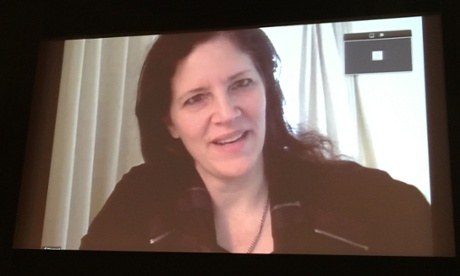
Next up is documentary-maker Laura Poitras, beaming in via Skype to talk about her work with NSA whistleblower Edward Snowden, including details of how she communicated with him, and some details of working with the press.
She corresponded with Snowden over the course of five months using encryption technology, including the Tails operating system, which Poitras hadn’t used before. The person who set it up for her asked “who’s your adversary”, and when being told it was the NSA, replied “Oh, that’s quite a serious adversary!” – this drew a laugh from the audience.
Poitras says she had a gut feeling early on in her communications with Snowden that he was a legitimate source with information to reveal that would have a great impact. “I was very concerned or cautious about the risk of there being potentially some kind of entrapment. And that wasn’t an unfounded risk,” she says. “I was very cautious to make sure there was nothing suspicious about our communication, because I was very aware it could be an elaborate entrapment attempt.”
So, Fix has some suggestions on how hackers can keep their value system from deteriorating. One rule: “Let us begin to appraise hacks no longer by their technical brilliance alone, but also by their usefulness to make the world a better place,” he says. “And us means everybody, not just hackers. In fact, especially not hackers... I would love people everywhere talking about the usefulness of a hack, as much as they do its technical details.”
Fix updates Karl Marx’s famous “religion is the opium of the people” quote (well, a paraphrasing). “Internet is opium for the people. Don’t get me wrong, I love the internet, I am convinced it can take an important role in the transformation of societies,” he says. “But the internet has one downside: people often use it as an escape from reality. Much cheaper than drugs too... It can lift the burden of caring for the real world... Who cares about the total surveillance that comes with it over the same cables? Well, we do.”
Fix wants hackers to act. “Nothing is more important than to get things done,” he says. “Only ask yourself is what you are doing legitimate. Don’t care about legality... And therefore we have to consider everything political. There is no escape from that. The time for the playfulness that was mentioned earlier? I think it is gone... This is about our future. Let us start hacking it.”
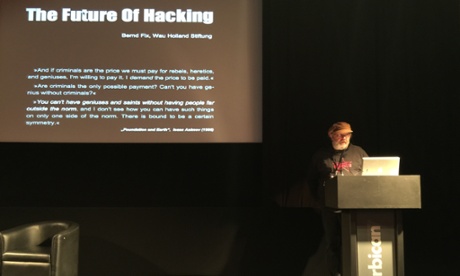
Finally, in this session, Bernd Fix – a German hacker and security expert – to talk about the future of hacking. But he started with its history: famous hacks by the Chaos Computer Club, warning the audience not to be taken in by the legends that have sprung up around them.
“But we as hackers did something right in the past... our aim was never the information society. What we struggled for was the informed society,” he says. “We should carry that into the future, and not all these fancy hacks that we talk about.”
He compares the fascinating with hackers by “the establishment” today to that shown towards foreigners as “noble savages” centuries ago, and warns of fragmentation and hierarchy among the current hacking community, which he worries are “neglecting solidarity with our own kind... but even worse is the influence of commercialisation.”
How so? “Believe it or not, there are so-called hackers with software patents. That’s like a non-smoker with a cigar! For me, that’s completely crazy. They start releasing software just as open source, but not as free software. And they think it’s fine to use Apple hardware ad Faceboogle [sic] services, and even worse, some think it’s okay to work for such companies!”
Updated
Next up: an academic history of “hacking Europe” by Ruth Oldenziel from Eindhoven University of Technology and Gerard Alberts from the University of Amsterdam, based on their book of the same name.
Alberts’ section of the presentation focuses on “the playfulness of hacking culture” in Europe, during the Cold War. “Play was a quintessential element to the culture of personal computing... hackers were the first to create the space to play in,” he says.
Oldenziel adds that the context of this play is very important, talking about the scene in 1989 a few months before the Berlin Wall came down, and criticising the “US-centric” story about how the internet came about. She talked about the role hackers played in the 1980s in Europe “filling the void” left by companies like IBM, who she suggests weren’t interested in Europe.
She talks about engineers tinkering with computers in Yugoslavia in 1983; the Greek computing community getting together in a football stadium in 1987; and the Computer Bus Dutch Housewives Association in 1985 – a photo of what looks like a bus full of older Dutch women learning to use computers is shown at this point – as well as the rise of hacker culture in Amsterdam between 1989 and 1993.
Oldenziel talks about Amsterdam hackers’ desire to rethink the internet as “a public place... a public square. We had a huge hacker culture that was on a par with the British”. And finally, she talks about the Czech RONJA community in the late 1980s and early 1990s, with its DIY wireless device that people could build themselves to get connected.
How many conferences mix a play in with the panel sessions? This one does. Wau-Pengo 1989 is based on the transcript of an encounter between a hacker caught spying for the KGB, and the founder of the hacking club who felt betrayed by his actions.
One quick additional comment from Ross Anderson, who was asked about Facebook-owned messaging app WhatsApp recently introducing encryption.
“The reaction of the tech industry to Snowden has been helpful,” says Anderson, who also describes Google’s engineers as “hitting the roof” at some of the Snowden revelations of backdoor access by the NSA.
“There’s a determination to see to it that the spooks only get stuff through the front door. The WhatsApp decision is part of it, as is the Apple move to encrypt the iPhone, as is Facebook becoming available through Tor.”
He talks about attempts by GCHQ in the UK to “bully” Facebook into making information available to the authorities. “If I were Mark Zuckerberg, the only rational reques to that would be for in the future, every request from GCHQ to go through our lawyers. And that will take six months.”
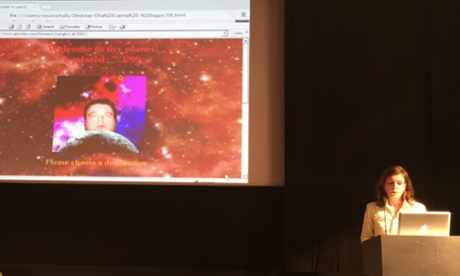
During the break, I wanted to come back to the talk just after John Pilger from Olia Lialina, an author, net artist and “animated GIF model” who talked about the digital art she’s making around topics such as censorship and technology access.
One of her projects is an archive of GeoCities websites, from the early days of mainstream access to the web. “It is supposed to be the most bad-taste of online productions,” she said.
“But these are not just funny pages made by amateurs. This is a tradition of working online where you are completely controlling the presentation, the look of what you do. It is a time that should be very dear for us... a lot of choices and decisions were made by users, not by the developers.”
Lialina also talked about language, and the move within the online design world to talk less about “users” and more about “people” – something she’s not a fan of. She showed a poster from Facebook’s headquarters with the word “users” crossed out in favour of “people”.
“Do you think people from Facebook see you as [more of] a real person, because they have it on the poster?” she asked. “User is not somebody who is dumb. It can be somebody who didn’t write the program, but it can be somebody that did.”
Lialina also talked about civil rights beyond privacy: “the right to log out” and “the right to undo”, which she sees as being eroded by modern internet services and devices like smartphones.
Finally, the environment. Anderson talked about news sites being encrypted, so it’s not obvious who read what, and it also makes targeted censorship harder: “Iran must block it all, or not at all,” he says, by way of example. “And as more and more people encrypt their website the choke point for most investigators – those without NSA-level powers – have to move through mutual legal assistance,” he says. Which is a slower process.
His conclusion: “It doesn’t make sense to build special systems to support investigative journalism, any more than gumshoes need special hotels or cars. It makes you stick out a mile... Remember this phrase: anonymity loves company.” He warns that journalists can’t just set a policy and technology and stick to it: they have to keep reassessing it in response to “what the spooks actually do”.
Which, Anderson noted, comes back down to tradecraft.
Anderson says that “many nuggets of information themselves are highly disclosive”, citing medical records as an example where even “anonymised” data can be surprisingly rich, when queried in detail. “Show me the medical records of all 48 year-old women with a nine year-old daughter both of whom have psoriasis”.
“If somebody at Whitehall leaks you some stuff, even if you use the most stringent security measures, you’ve got to think really hard about whether you’re going to burn your source,” he says, moving on to tradecraft. 20 years ago, a journalist would try not to compromise their sources by having a way for sources to “walk in”; meet them somewhere innocuous; make sure they weren’t being followed; and would try not to use phones that might be tapped.
And now, in the internet era? He says the main source of tradecraft is common sense, then a study of cases where the authorities have made a real effort to get access to data on sources. But also now the Snowden revelations, which he sees as a valuable source of information on how to protect journalistic sources from NSA snooping.
The next speaker is Ross Anderson, professor of security engineering at Cambridge University, talking about the systems that investigative journalists need post-Snowden, analysed at three levels: the science and engineering, the tradecraft and the environment.
On the first of those: he cited some of the problems of public key cryptography: man-in-the-middle attacks where “the NSA guy pretends to be you to your source, and pretends to you that he’s your source”, and also the fact that “if you’re the only guy in Burma using PGP, you’re going to be conspicuous!”
Anderson talks about anonymous technology Tor, and the fact that it “sucks” for GCHQ, but he warns that it’s not a solution everywhere – countries like China and Iran try to block it – and that it has some other limitations.
“Anonymity loves company: you can only hide in a crowd,” he notes. So some systems for secure communication don’t have enough users for general-purpose use. “The fact that you’ve got it on your phone is a dead giveaway.” Anderson says mass market tools like Skype and Gmail can be surprisingly good instead “if we get the tradecraft right”.
Anderson talks about censorship-resistant systems, including filesharing clients. Why them? “As Snowden tells us, the NSA throws all this stuff away... they take all the peer-to-peer stuff and they throw it in the bin bucket. There’s too much of it. Does that give anybody ideas?”
His fifth point: the technical complexity of reporting on leaks like the Snowden documents. It may make sense for journalists to focus on stories that are easier to understand for a mainstream audience, in this case, rather than the more complex aspects that need deep technical knowledge to understand.
Sixth: overcoming abstraction: in Germany, Angela Merkel’s phone calls being listened to caused a huge stir, but the monitoring of online activity by 80 million citizens was comparably uncontroversial. Müller-Maguhn says it’s key to make people understand the impact of global surveillance operations for their life, economy and country. And he wants more people to understand that “crypto and operational security can help you” is also important.
And finally, Müller-Maguhn talks about dealing with journalists in situations of confrontation: having to go to confront agencies like the NSA when a story is being worked on. And he warns of human aspects: some journalists might not want to “be rude to an NSA guy” who they see as a valuable contact.
He also criticises the idea of “balanced reporting” as an obstacle in some cases. “If we’d had this in Germany: ‘Oh, shouldn’t we ask the Nazis, and have a statement from them on the killing of the Jews? We have to make balanced reporting right?’... If we’re talking about massive violation of human rights worldwide, I’m not sure if this is a great point to discuss.”
So, that criticism for journalists. What “specific media mechanisms, limitations and implications” does he see in the Snowden leaked documents process? The first is titled simply “shitting in the pants”. What? He refers to the claim by Laura Poitras that one British newspaper had a “freak out” and started destroying some of the Snowden documents.
The second: legal considerations of the main actors. Snowden handed his materials to two American journalists, which in turn brought them to the attention of US lawyers, with some specific restrictions over how that material could then be used and distributed. “The judgement of what is public interest becomes the key of the whole thing: if the US audience and the US judge think it was not public interest, then from an American legal point of view, you’re fucked.”
His third point: that question of public interest. “Which audience are we talking about?” says Müller-Maguhn. The public interest for the Chinese population would be different to the US population, perhaps. “We de-prioritise the human rights of non-American people,” he says. “It’s sad to see that kind of attitude goes into this kind of publication process.”
Fourth: the perception of “legitimate action by the NSA” and whether reporters would have “blood on their hands” for publishing the leaked documents. The publication process has often been about this question: “The narrative of terrorism. The narrative of criminal activity... If we look at the war on drugs, the war on this, the war on that, the question of legitimate activity is a complex one, and also a political one I would say.” And this is why Snowden deliberately handed that decision over to the journalists that he worked with.
On the blood-on-the-hands theory: is there more blood on the hands of journalists and whistleblowers if they do publish, and intelligence agents suffer, or if they don’t publish, and activities their agencies are carrying out – Müller-Maguhn cites drone strikes on individuals – continue. “We are in the shit anyhow. It’s just a question of the depth of the shit that we’re in!”
Updated
Andy Müller-Maguhn of the German Chaos Computer Club is the next speaker – I’ve missed one, Olia Lialina, but will come back to the tablet notes on her talk in a bit. Müller-Maguhn is talking about “working with the Snowden revelations”, and is promising some more criticism for journalists.
But he starts by talking about a project called Treasuremap, which aims to build “a near real-time, interactive map of the global internet” tracking people and devices – and what it means in the context of the NSA structure, and the structure of that agency within the US government.
It’s a presentation that’s perhaps more understandable for a hacker or an expert on the NSA’s structure, just to warn you. But Müller-Maguhn moves on to how the data collected by the NSA is being used, using terminology from the east German Stasi – “Kompromat” – roughly translated as “that stuff you don’t want to have public” for any citizen. If the authorities get that data, they can change your behaviour.
He cites an example talked about by Snowden: CIA operatives trying to recruit a Swiss banker by getting him drunk, encouraging him to drive home, and then offering to help when he got arrested for drunk-driving.
The liveblog entries may dry up in about 20 minutes by the way. Not for “handmaiden of suppression” reasons, but for “laptop battery life of 24%” reasons. Will be switching to a tablet and collaborating with AutoCorrect to take notes and quotes that will be posted later.
Update: I’ve found the overspill room with plug sockets. #technology
Updated
Pilger finishes off by talking about WikiLeaks, suggesting that the organisation and its founder Julian Assange has not got the credit or support that it is due.
“People have made big money while WikiLeaks has struggled to survive,” says Pilger, attacking the Guardian, again, over the recent Swedish Right Livelihood award which was won by Edward Snowden, with Guardian editor Alan Rusbridger also one of the recipients.
“Assange and WikiLeaks were airbrushed. They didn’t exist. They were un-people. No one spoke up for the man who pioneered digital whistleblowing, and handed the Guardian one of the biggest scoops in its history.”
“In the news, whole countries are made to disappear,” says Pilger, suggesting that coverage of countries including Saudi Arabia and the Yemen is lacking, as well as developments in Latin America – Hugo Chavez’s Venezuela in particular, where he claims the same three publications’ reports have been “routine in their bad faith”. Then Pilger moves on to news in the UK.
“Why are millions of people in Britain convinced that a collective punishment known as austerity is necessary?” he says, harking back to the last financial crash. “For a split second, the banks were lined up as crooks with obligations to the public they’d betrayed, but within a few months... the message changed,” says Pilger.
“The mugshots of guilty bankers vanished from the tabloids, and something called austerity became the burden of millions of ordinary people. Was there ever a sleight of hand so brazen?... The economic crisis is pure propaganda. It’s a transfer of wealth from the bottom to the top. But who’s standing up for the majority?”
Updated
'The handmaidens of suppression, of fake objectivity...'
“The handmaidens of suppression, of fake objectivity, had done their job well,” says Pilger, about the media’s coverage of the war in Iraq. “The trail of blood that goes from Iraq to London has almost been scrubbed clean.”
He talks about the power of Rupert Murdoch’s newspapers and TV networks, but suggests that “the influence of Murdoch’s empire is no greater than its reflection of the wider media. The most effective propaganda is often not found in Murdoch’s Sun or Fox News, but beneath a liberal halo.”
He points to the New York Times, the Washington Post and the Guardian. “Both of which have played a critical role in conditioning their readers to accept a new and dangerous cold war” – referring to the current situation in Ukraine, which Pilger criticises these three newspapers for “misrepresenting” as a malign campaign by Russian leader Vladimir Putin.
Pilger says he also sees coverage of the crash of Malaysia Airlines flight MH17 as a situation where “again, supposedly liberal media are the most convincing censors... Sometimes it feels like a class reunion. The drum-beaters of the Washington Post beating the drum for isolating Russia are the very same editorial writers who quoted the facts about Saddam Hussein’s weapons of mass destruction to be – quote – hard fact.”
“Propaganda is no longer an invisible government. It is the government,” continues Pilger. “The information age that we refer to, in my opinion is principally a media age. We have war by media, censorship by media, retribution by media, demonology by media, diversion by media. A surreal assembly line of obedient cliches and false assumptions.”
Pilger talks about the possibility that if journalists in a free press had “done their job”, the US and UK might not have gone to war in Iraq, and says that’s backed up by his conversations with various mainstream journalists.
“Had journalists done their job: had they questioned and investigated the propaganda instead of amplifying it, hundreds of thousands of men, women and children might be alive today, and millions might not have fled their homes... and the infamous Islamic State might not now exist.”
Updated
The first speaker in the afternoon session is journalist John Pilger, who’s going to talk about “journalist as a craft, regardless of the means and regardless of the obstacles”. He kicks off with some questions.
“Why has so much journalism succumbed to propaganda? Why are censorship and distortion within the media almost standard practice? Why do great newspapers like the New York Times and the Washington Post deceive their readers?”
And he asks why young journalists aren’t taught to analyse media agendas, and decode what they read and see in the mainstream media: “not information, but power”.
Lunch, and Seymour Hersh again
By the way, here’s a standalone piece on the Seymour Hersh keynote, rounding up all those zingers. The conference is breaking for lunch, but I’ll be back with more updates from 2pm-ish.
“In India right now, there is currently no privacy legislation. They are building all these surveillance systems, yet there is no law which can protect citizens,” says Xynou. There is a draft privacy bill under discussion in 2014, though. “Of course, it’s not perfect... but still I think it’s definitely a very good first step.”
“But the main problem in India is a lot of these programs are carried out in secret. There’s no transparency whatsoever,” she finishes.”In order for us to be able to increase transparency in what’s going on in the biggest democracy in terms of population in the world, we definitely need people to leak more documents.”
Xynou has studied 50 companies who sell a range of technologies used for surveillance in India. She talks about some, including Kommlabs, which “looks out for cognitive and emotional stress in voice calls, then flags them”.
She also talks about the National Intelligence Grid (NATGRID) which links up various national databases of personal information in India, from vehicle registrations and mobile phone logs to bank account details, train reservations and passport data.
Linking these databases for a billion people risks errors, says Xynou. “The probability of errors is extremely high. And the main problem is there is no regulation behind this: no system of checks and balances to see if breaches can occur,” she said, before drawing attention to the UID biometric data collection scheme that recently launched in India.
“There’s a huge debate in India whether this violates privacy or not,” she says. For example, some contractors involved in providing devices and infrastructure for the scheme have ties to US intelligence agencies, which may be “problematic” for privacy to say the least.
Next to speak is Maria Xynou, a privacy and surveillance researcher at the Tactical Technology Collective in Berlin. She’s talking about surveillance in India.
“The majority of the population lives in rural areas and in really bad conditions. Often I feel that marginalised people on the margins of society are the guinea pigs for surveillance. It often affects them first,” she says.
Indian mobile operators are required to install lawful intercept and monitoring (LIM) systems to use on request from law enforcement authorities, but Xynou notes that the Indian government has its own system too, monitoring traffic through ISPs. The Network Traffic Analysis (NETRA) system only came to light in 2013.
“Essentially what it does: it intercepts and monitors almost all internet communications [looking for] suspicious words and suspicious phrases,” she says. And for anyone considering encryption as a way around this: “If authorities in India ask you to disclose your private encryption keys, you have to.”
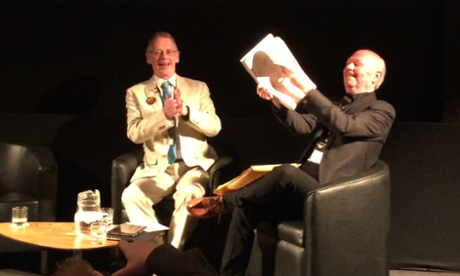
That document the NSA was so keen to get hold of? It’s here today! Duncan Campbell has hidden a copy under Bamford’s chair, which gets a big laugh from the audience.
'Have the Justice Department begin a criminal investigation of the NSA...'
“I have a great deal of respect for whistleblowers,” says Bamford. “I have a lot of admiration for their courage.” He spent three days in Moscow with Edward Snowden last year, to write a profile piece for Wired.
“The key thing for him was encryption. And the key thing for most people these days becoming whistleblowers, they have to trust the person they’re gonna deal with... the more we get involved in encryption, the better it is,” he says, before returning to the theme of the NSA’s capabilities.
“This is an agency that has this enormous capability to eavesdrop on everybody. And Ed Snowden for a year is taking what the NSA says is 1.7 million documents out, and they didn’t even know about it until he announced it.”
Bamford calls for a new Justice Department investigation into the NSA focusing on lawbreakers within government, like one that followed the Rockefeller Report in 1975 – which he wrote about in a recent article, including threats from the current-day NSA if he published its details.
“They can have the Justice Department begin a criminal investigation of the NSA. There’s a precedent for it. Instead of putting whistleblowers in jail, we should be prosecuting the people committing crimes who are in the government,” he says.
Updated
Bamford is talking about how President Nixon got the NSA to eavesdrop on celebrities: Jane Fonda, Dr. Benjamin Spock and Muhammad Ali, for example. Then he moves on to Senator Frank Church and his Senate Select Committee on Intelligence in 1975, which was one of the first such committees to study the NSA’s capabilities and activities.
Bamford also talks about his personal history, working for two weeks of active duty in the Navy Reserve at an NSA facility, and his growing realisation that the agency may have been violating the law by eavesdropping on Americans, not just foreign nationals. Bamford turned whistleblower for the Church Committee.
“The NSA had told them they’d stopped a year earlier. Well, I said ‘I’ve just been down there, and I know English when I hear it!’,” he says. “They were eavesdropping on Americans and that made Frank Church very angry. They lied. Before that I didn’t know government actually lied. Nobody told me that!”
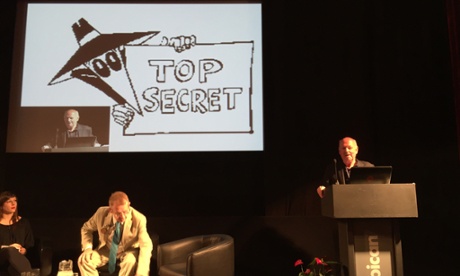
Next up: journalist and documentary maker James Bamford to talk about the NSA. “I appreciate following Duncan. All I’ve done in my life is follow Duncan!” he says, graciously.
Bamford’s first book about the NSA came out two years before Edward Snowden was even born, so he’s giving another veteran’s perspective on surveillance. “This didn’t just happen a week ago or a year ago when Snowden came out. It’s been going on a long time, and that’s one of the problems,” says Bamford.
He notes that it’s the only agency in the US that wasn’t created through the usual process of Congress – it was the creation of President Truman in 1952. “Congress wasn’t even notified about it. Even its name was top secret!” he says, noting that it was also created “outside of normal laws... NSA doesn’t have to follow any other rules unless NSA is specifically mentioned.”
For example, if a president says “all domestic agencies must cease domestic eavesdropping”, the NSA would not be included in that. Bamford suggests that the Snowden revelations have since showed “what happens when you have a totally secret agency and you let them operate without any laws.”
Updated
“All sorts of countries have been co-opted,” says Campbell. Denmark, Spain, Sweden – “hugely important” – and he shows a map of a “massive, global, integrated system with third parties playing a major role in feeding in just what NSA wants”.
He says the story about the NSA subverting the internet – “a story that is starting to flood out” – is going to be much more prominent in the coming years, and compares this to what’s happening with ECHELON.
“Even in the face of this massively expanding empire of surveillance, they want to collect it all,” he continues. “This is also true of the ECHELON program... The greed to take all our data has no end. But it never had. You saw it in the sixties.”
Updated
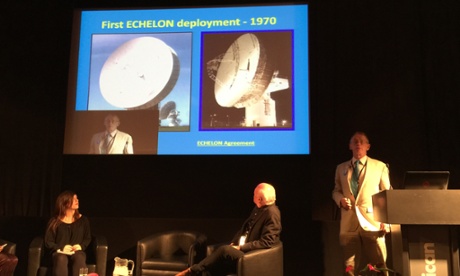
It’s a fascinating talk, going back to 1970, when Campbell says “American money paid for the equipment” to be used for ECHELON. “This was driven, at the height of the Cold War, a project of equal priority, to spy on the population of the United States, United Kingdom and western Europe,” says Campbell, who promises a big feature on this to be published imminently on The Intercept.
“So many people turned it into the Panopticon that does everything... It doesn’t access television cameras, it doesn’t sneak into your house. It doesn’t do many of the things you may read in the looser articles,” he says, stressing the specific use for ECHELON. “It intercepts communication satellites.”
Campbell recommends a book by Nicky Hager outlining New Zealand’s role in ECHELON, putting the program into perspective. “The template for what we now see on a scale of... I don’t know, a billion times larger? A thousand billion times larger?”
Updated
The next speaker at the conference is another investigative journalist, Duncan Campbell, talking about revelations of surveillance long before Edward Snowden. Back to 1976, in fact, and his articles about the Menwith Hill Station eavesdropping base.
He’s talking about a 1980 investigation that was commissioned by the Sunday Times, but was then blocked. “We’ve flushed out what we think was the real way that story was blocked, and hopefully we’ll have that story within a week,” he says.
But the main subject of his talk is ECHELON, the “global electronic spy system” that he first reported on in 1988 in the New Statesman, which he says the more recent Snowden revelations have backed up. “We got it right!” he says.
Hersh on the NSA again: “Snowden shook up the community, big-time. How many Snowdens are there, they don’t know? They worry about it, because they’re very, very sloppy… They don’t even know what they’ve done wrong. They can’t find out,” he says.
“It’s a completely dysfunctional place. And I think we can’t get to it because of secrecy… It’s an agency that needs to be cleaned up. It’s a menace to itself because they’re incompetent, but if somebody competent got in there…”
And he finishes off with a rousing call to fellow journalists on their role in holding power to account. “We are here to keep them in check, to keep the powers that be in check. That’s the only thing between them, and chaos – fascism if you like. Because they lie. They are frigging liars, because it’s so easy to lie,” he says.
“We have a role to play. We can at least keep them afraid of us.”
Hersh has a message for encryption experts, calling for them to continue working with journalists – especially those whose technology skills may not be top-tier.
“You guys who know an awful lot about computers, you have to do more for the dummies! You aren’t doing enough for the dummies… I know you all think encryption is easy, but it’s not for a lot of people… When I have trouble with my computer, I wait for some 10 year-old kid to walk by! There has to be some way to really get it going...”
But he also says that being a “dummy” remains important in protecting his sources. “I don’t put anything into a computer, and I like it that way. You pick up my iPhone, and I’ve got my wife and kids, but you won’t find anyone who even comes close to being a source. That’s how I protect people, I keep them off the internet.”
Updated
The NSA: 'They can’t get anything right!'
On governments and conspiracy theories: “Usually it’s about ignorance and stupidity and cowardice rather than any plot,” he says, before moving on to the US’ National Security Agency (NSA).
“The single most overrated agency in the United States is the NSA... It is so fucked up. They can’t get anything right! It’s just the most useless unproductive agency. It doesn’t get much. Yes, any given day if they decide to go after you, they can do a helluva job. But they always could. But it’s also a question of how do they retrieve it?,” he says.
Hersh addresses the journalists and hackers in the audience: “I’m not worried about them. I know you guys should be, and you are. I’m going to let you worry about them. I got other things to worry about!”
Updated
Hersh says young journalists shouldn’t be focused on getting a job at a major outlet if they want to do important investigative journalism.
“You don’t have to be in the New York Times or something like that. The New York Times is narrative. You want to be counter-narrative,” he says. “Mostly I’m embarrassed for the paper these days, having worked there. And that doesn’t mean it isn’t the best there is.”
Updated
Hersh on leaked documents: “Let me say this to you real simple: when you have something like these stolen documents, and you decide you’re only going to publish part of it. We’re not breaking the law. We’re not the guys that are violating the rights around the world… we’re not cheating, we’re not violating the fourth amendment, and also the fifth amendment I would tell you – the right to self-defence,” he says.
“So why be afraid? Why not write everything? Do it. As the Guardian guy did, why let some thugs come into your office and destroy some documents that you know don’t exist elsewhere?… We shouldn’t hesitate. The guys who should worry are the guys who are violating the laws.”
Hersh is asked what makes a great story for him, and refers to news this week that Iran had flown some missions against the Islamic State, and the suggestion that this means the US is working with Iran – and possibly even Syria.
“Here’s the reality: we, the Americans have been working, obviously, with the Iranians and the Syrians… We’re working together. Clearly we have been helping Syria with tactical intelligence for a long time, probably through the Germans… I just think this is a rich story. I’m not going to do it because I’m doing other things, but it’s a rich story not being told.”

The next speaker today is investigative journalist Seymour Hersh, interviewed on-stage by author and broadcaster Laura Flanders. With his history of reporting including the My Lai massacre in south Vietnam, various Nixon administration controversies and the Abu Ghraib prison in Iraq, Hersh is providing the conference’s opening keynote.
“He has been the bad news bear of half a dozen or more administrations in Washington,” says Flanders, by way of introduction, before Hersh kicks off with a mini-speech.
“My view is very simple: the world since I have been old enough to read has basically been run by idiots, nincompoops, thieves... and unfortunately the solution is the idiots who run most of the mainstream media!”
He continues, on the purpose of journalism and hacktivism: “The only purpose I see, what all of us here whether in journalism or in trying to protect information, the whole purpose of what I think we should be doing is counter-narrative. They have their narrative, and we have to show there is another narrative.”
Updated
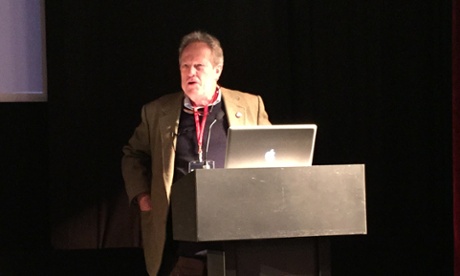
Gavin MacFadyen, director and founder of the Centre for Investigative Journalism, speaks first, introducing the event.
He talks about the three groups attending the event: investigative reporters; hackers; and their friends, supporters and sponsors. “Given the extraordinary dilemmas confronting journalists and hackers both, there is a natural community of interest between all of them,” he said.
“The attacks on journalists have increased… 150 or so killed in the last immediate or so while, and a very large and growing number of hackers being imprisoned, some for astonishingly long sentences, which is horrific especially given that some of them are only teenagers.”
MacFadyen outlined the key principles behind the conference: “There is a free internet, there is a free press, and there is free speech, and we share all of those things together.”
Updated
'A single goal — the defence of freedom and democracy'
Today is day one of The Logan Symposium, a gathering in London of journalists, hacktivists, legal and security experts and artists to discuss topics including secrecy, surveillance and censorship.
It’s organised by charity the Centre for Investigative Journalism and Goldsmiths, University of London. Over its three days, the event will host speakers including Seymour Hersh, Laura Poitras, John Pilger, Sarah Harrison, Julian Assange, Annie Machon and Jacob Applebaum.
The Guardian will be covering each day of the conference, starting with today’s lineup of talks covering journalism; surveillance systems; the Edward Snowden revelations and other leaks; and the past and future of hacking.
Expect updates throughout the day of the key points made by speakers, as well as links to any longer reports on the individual sessions.
Updated