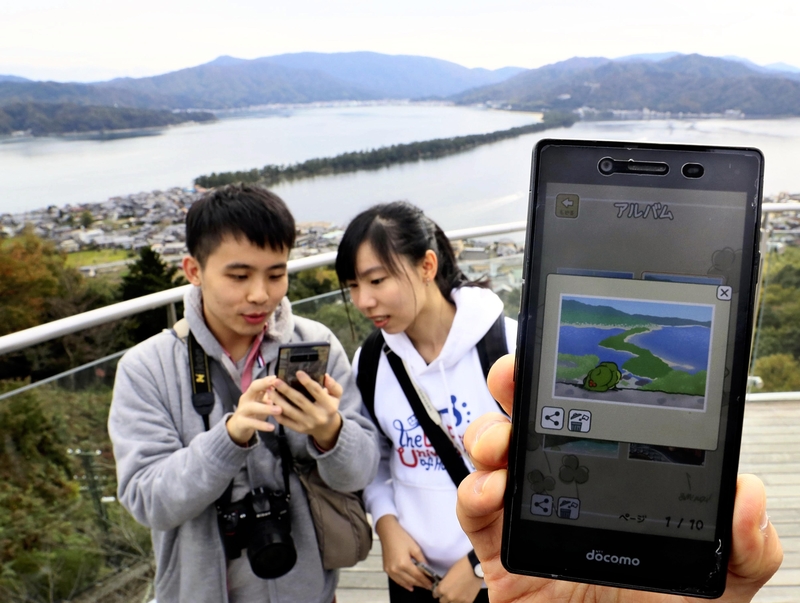
MIYAZU, Kyoto -- "It looks just like in the game," says Chen Da Long, a 25-year-old teacher from China, as he stands holding up his smartphone.
Chen is comparing the actual view of Amanohashidate, an isthmus across Miyazu Bay in Kyoto Prefecture, listed as one of the three most scenic spots of Japan, with an image on his phone.
The image is from a simple game for smartphones in Japan, in which the user sends a frog off on a journey, then waits for him to return.
But "Tabi-kaeru" ("tabi" means "travel," while "kaeru" can mean both "return" and "frog") has unexpectedly become a catalyst for drawing tourists from mainly China and Taiwan, where it has become a huge hit.
In the game, images of tourist spots that the frog has visited appear. That has motivated Chinese and users in other countries to think, "I want to see that place for myself" and to make the trip to Japan.
One of the best views of Amanohashidate can be taken in from Kasamatsu Park in Miyazu, Kyoto Prefecture. That is where Chen gleefully makes his comparison.
"It has an unusual shape, and the view is spectacular," says Chen, who adds he first became aware of Amanohashidate by playing Tabi-kaeru. "I want to go to the other places in the game."
Tabi-kaeru was first put online in November 2017 by Nagoya-based game development company Hit-Point Co. The user prepares the frog for its travels, then waits for its arrival home. The frog takes photos of and brings back souvenirs from the scenic places it visits.
Word about the game, downloaded for free, first started spreading last year in China on social media. According to Hit-Point, through November 2018, the game had been downloaded about 38 million times -- with over 90 percent by users in China and Taiwan.
There are over 20 tourist spots that appear in the game, such as Amanohashidate and Ise Jingu shrine. The name of the place is not displayed and the scenic photo is actually a drawing, but there is a website in Chinese providing details on the locations. "I want to go to Japan to have a look" continuously appears in the comments.
Zhang Ying, 28, a graduate student from China at Ritsumeikan University, explains the appeal by saying, "The emotional attachment to the single frog is much like child-rearing in China under the 'One Child Policy.'"
Says Mayuko Uemura, 27, the game's developer: "The response from overseas was totally unexpected. It makes me glad that it helps inspire interest in Japan."
Read more from The Japan News at https://japannews.yomiuri.co.jp/