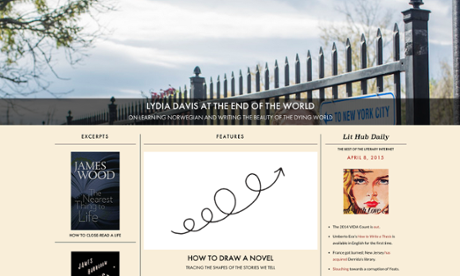
Reading no longer needs to be a solitary activity. As we know from this site, many book lovers are keen to share their thoughts on what they are reading, their opinions about authors and their take on literary topics in general. The latest entrant to this tower of babble is Literary Hub, a new website created by independent publisher Grove Atlantic and American books site Electric Literature, which launched today with the motto: “Read to live.”
The site relies on an agreement with more than 100 partners from across the literary spectrum, ranging from behemoths of publishing (Penguin/ Random House, Knopf/Vintage), to small presses, literary journals (the Paris Review, Fence) and booksellers.
These partners will provide the bulk of the site’s editorial content, both original and curated from around the internet. “No single literary site could afford that kind of content model, nor would anyone think it profitable,” says editor Jonny Diamond.
The site is not looking to fund itself with online book sales: “One of our core missions,” says Diamond, “is to celebrate and highlight the vitality of bricks-and-mortar bookstores, which have undergone a resurgence in the last few years.”
While the project and the majority of its participants are US-based, it has one partner in Australia – literary magazine The Lifted Brow – and three in Canada, with further international expansion planned. One of the first lead features is a profile of Lydia Davis that first appeared in Morgenbladet, the oldest newspaper in Norway (“translated for us by the writer”). “Next on my list is Mexico and the UK,” said Diamond.
Literary Hub will showcase one feature a day – which could be an essay, interview or treasure from the archives – and an excerpt from a forthcoming title. In the first month, there’s writing from Teju Cole, Russell Banks, Tracy K Smith and others; conversations with authors including Laura van den Berg and Catherine Dunne, and a bi-weekly podcast. Among the first features are a letter from the editor (“In Praise of Bookstores”), a guide to (literally) drawing a novel by Mexican writer Martín Solares, and A Brief History of the Future of Reading by former editor of Granta, John Freeman.
The site will also curate “LitHub Daily”, a round-up of the 10 literary stories of the day gleaned from around the web, which will also be sent out as a newsletter.
The business model , explains Diamond, is to exchange content for advertising on the site: “The very basic quid pro quo is an ad in exchange for a feature or excerpt. With booksellers, we’ll be doing curated reading lists (old, new, iconic, obscure), digital staff recommendation shelves (“my first stop at any new bookstore”) and more. Our hope is that by creating a smart, engaging site devoted to literary culture, we’ll be able to catalyse the kinds of conversations about books that are good for the entire literary community.”