Liquors with a high alcohol content have drawn attention as an alternative for disinfectant amid the spread of the new coronavirus.
Breweries and distillers across the nation have begun manufacturing such products one after another. They even include products with the aroma of herbs or that use beer, a beverage whose consumption has declined following requests for people to refrain from going out.
Demand for products with high alcohol content for disinfection is expected to increase further after economic activities resume and people become more active. Companies that make conventional antiseptics are also accelerating their efforts to boost production.
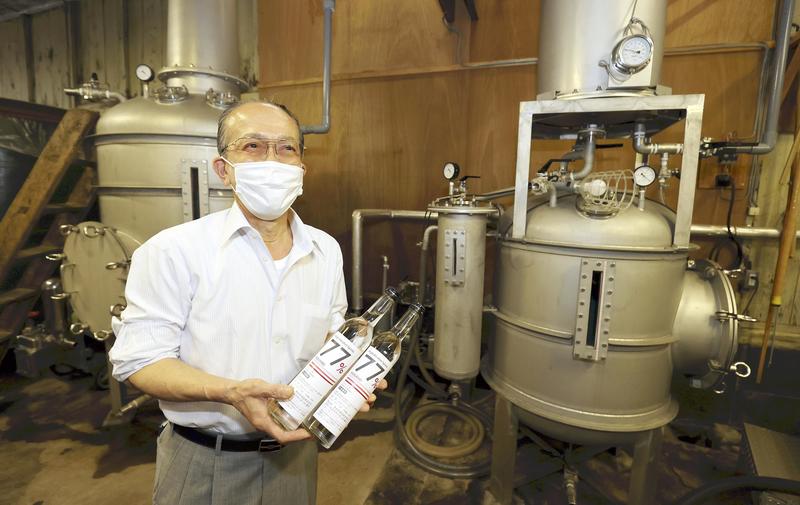
Koganei Shuzo, a maker in Atsugi, Kanagawa Prefecture, with a history dating back 200 years, in April developed a distilled liquor with an alcohol content of 77% that can also be used as a disinfectant for medical institutions.
Koganei Shuzo President Yasumi Koganei, 66, also runs a clinic near the company as an orthopedic surgeon. As nearby hospitals have been running short of disinfectant solutions since around March, Koganei took action to make "the kind of social contribution that can be performed by a doctor who also produces alcoholic drinks."
The liquor maker began production of the liquor for disinfection without considering any profit. So far, it has sold about 4,000 bottles to medical institutions, the Atsugi city government and other entities. The company on Monday also began selling a 500-milliliter product for general customers, available by reservation for 1,650 yen.
"Helping people in need is my great desire," Koganei said.
Antiseptic solutions are made by adding water and chemical substances to distilled liquor that is purified after fermenting sugar cane and other items. According to the Health, Labor and Welfare Ministry, the appropriate alcohol content for distilled liquor is about 70% to 80% if the liquor is used for disinfection. The higher the alcohol content is, the more effective it is for disinfection. But if the content is too high, the liquor will vaporize before viruses are removed.
Shochu for sword wounds
Antiseptic solutions have been out of stock since around February, when the coronavirus began spreading. In March and April, the ministry notified prefectural governments and other entities that liquors with an alcohol content of 70% to 83% would be allowed to be used as an alternative for antiseptics.
Since this month, the National Tax Agency also has exempted alcohol beverages used exclusively for disinfection from the liquor tax, which is about 700 yen per liter, to encourage liquor makers to produce items for that purpose.
Liquor has a long history of being used as a disinfectant. It is said that shochu distilled liquor was used on sword wounds and other injuries from ancient times. During the Seinan War in 1877, the Satsuma domain forces led by Takamori Saigo are said to have used shochu.
Shirakane Shuzou Co., a distiller in Aira, Kagoshima Prefecture, from which Saigo is said to have procured its shochu, has developed a spirit of 70% distilled from barley shochu. Shirakane donated 600 bottles of the 500-milliliter product, priced at 1,500, yen to the Aira city government. It has also sold about 300 bottles to general customers by reservation.
"I'm very happy, as our shochu has attracted attention as a disinfectant for the first time in 140 years," said Yohei Kawada, the 39-year-old managing director of the distiller. "But I hope the day will soon come when people can enjoy it for its original purpose."
Add twists
Twists have been added to some distilled liquor products for disinfection.
In April, Echigo Yakuso Co., a manufacturer of products using wild grasses in Joetsu, Niigata Prefecture, developed its Craft Gin with an alcohol content of 70%. Sold at 1,100 yen for a 500-milliliter bottle, Craft Gin is made by fermenting 80 kinds of wild grasses, including yomogi mugwort, a local specialty item. The company donated 120 bottles to the municipal government.
"I hope people will refresh themselves with the nice aroma of the herbs [used in the product]," said President Kazushi Tsukada.
Takata Shuzojo Co., a shochu maker in Asagiri, Kumamoto Prefecture, has also developed a gin product for disinfection with an alcoholic proof of 77%. Its 500-milliliter bottle, costing 1,557, yen carries an illustration of Amabie, a yokai spirit believed to be able to suppress outbreaks of plague.
"It has a nice smell of alcohol, and people's hands won't dry out," said an official at a social welfare organization in the town to which the distiller has donated the product. "[The donation] is really helpful because we didn't have much antiseptic solution left."
In one case, a liquid designed for disinfection has been produced using beer that was not shipped due to a sharp drop in demand as a result of the epidemic.
Earlier this month, Kiuchi Brewery Inc. in Naka, Ibaraki Prefecture, donated 1,260 liters of liquid with an alcohol content of 70% to the prefectural government and local municipalities. The liquid was produced using 24,000 liters of beer provided by major breweries.
Makers of regular antiseptic solutions are also racing to increase their production capacity. According to the Economy, Trade and Industry Ministry, the domestic output of such products totaled about 1.7 million liters in February, nearly double the same month last year. The total amount increased to 2.2 million liters in March and reached 4.5 million liters last month.
Kenei Pharmaceutical Co., a major maker of ethanol for disinfection in Chuo Ward, Osaka, has been producing 130,000 bottles a day since April, more than triple its level in the same period last year. Production usually peaks in February, when the flu is prevalent.
"We're operating our plants at full capacity, even overnight and on holidays," a company official said.
The Yomiuri Shimbun
Koganei Shuzo President Yasumi Koganei shows sake products that the brewing company developed for disinfection in Atsugi, Kanagawa Prefecture, on Tuesday.
Read more from The Japan News at https://japannews.yomiuri.co.jp/