Dublin-based company Dead Centre’s Lippy staggers under the imaginative weight of its own lively ideas. Bush Moukarzel, its dynamo playwright, and Mark O’Halloran who contributed the monologue, are names to watch.
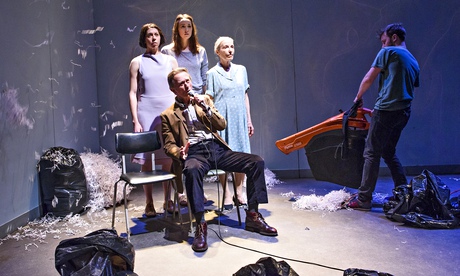
The show begins with a meta-theatrical flourish and the pretence that we are all gathered at the end of the play for an aftershow Q&A with the actors. David Heap reveals himself as a shrewd lip-reader, and there follows a playfully theatrical exploration of what it means to put words into someone else’s mouth and take them out again. Who owns the words? Not always, we start to see, the speaker. Heap is interviewed by Bush Moukarzel (who co-directs with zestful Ben Kidd) and is an entertaining mix of smooth and tentative. And there is wonderful singing from “the technician” (Adam Welsh).
What begins as topsy-turvy comedy skids into the terrible and true story of the Mulrooneys, an aunt and three nieces who went on mysterious hunger strike in a small Irish town and starved to death. The link with the play’s opening section is tenuous: CCTV footage of the women was studied by a lip-reader after their deaths. Some of the script is verbatim, although the invention continues and there are moments when Heap is the voice of the women, speaking as if he has taken possession of them. “Why is it that the devil is always a man?” his voice asks. The women (Eileen Walsh, Caitríona Ní Mhurchú, Liv O’Donoghue and Joanna Banks) are played with pale, desolating power.
At the end, one of them becomes a talking mouth on screen, like Beckett’s Not I. And that is when something extraordinary happens: you see that a lip’s every movement – curl, quiver, bite – has emotional impact. Lip-reading emerges as something we all do, and Lippy proves the perfect companion to Beckett’s Happy Days currently playing at the Young Vic alongside it. Two plays about living death in which words are everything yet not enough – and where lip service is about to be suspended.
• Lippy is at the Young Vic, London until 14 March
• This article was amended on 9 March 2015 to credit Bush Moukarzel as the playwright.