
The Hunters Are Female
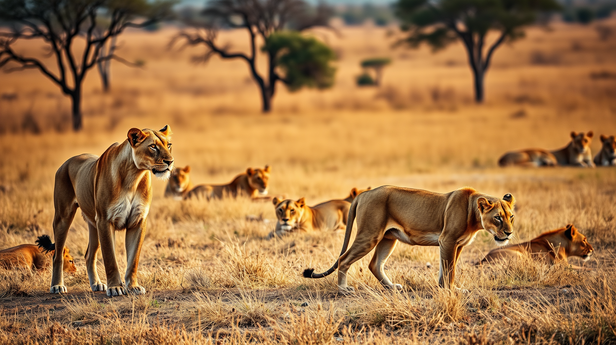
Lionesses make roughly 90 percent of a pride's kills. That figure comes from decades of field observation in the Serengeti, including the long-running lion research project led by Craig Packer at the University of Minnesota, one of the most comprehensive predator studies ever conducted. The male is physically capable of hunting, he simply does it far less often, partly because the mane raises his body temperature and makes sustained pursuit harder in open savanna heat, and partly because the pride's hunting structure does not require him to.
Lionesses hunt as a coordinated unit. They read terrain, assign positions without any visible signal, and close on prey from multiple angles. A lone lioness can take down a wildebeest. A group of five can bring down a Cape buffalo weighing close to 800 kilograms. This is not opportunistic scavenging. It is applied strategy, refined across years of hunting together.
Female Coalitions Hold the Structure Together
A pride is, at its core, a coalition of related females. Mothers, daughters, sisters, aunts, lionesses in a pride are almost always kin, and they stay together for life. Males cycle through. Females do not leave.
This matters because the stability of the pride, its territorial knowledge, its hunting patterns, its cub-rearing, lives in the female group. When a new coalition of males takes over a pride, the females remain. The territory's memory stays with them. They know where the zebra herds move in the dry season, which waterholes hold longest, which routes keep cubs away from hyenas. That knowledge is not transferred. It is held by the lionesses who have lived there.
Cubs are raised communally. A female will nurse cubs that are not her own. Lionesses in the same pride synchronise births when possible, so cubs grow up in cohorts and are defended collectively. A single lioness separated from the group is vulnerable. Together, they are the most socially organised of the big cats.
What the Male Actually Does
The male lion's job is territorial. A lion's roar carries up to eight kilometres across open ground. Males patrol and scent-mark the pride's range constantly, and that acoustic and olfactory presence is a genuine deterrent, rival male coalitions avoid ranges where a resident male is active.
The more critical function is protection against infanticide. When a new male coalition displaces the resident males, the first thing they do is kill existing cubs. This ends the females' lactation, brings them into oestrus faster, and ensures the new males' genes are the ones the pride raises. Resident males prevent this. Their presence is not decorative, it is the specific mechanism that keeps the cubs alive long enough to reach independence.
Male coalitions are also a serious fighting force. Two or three males holding a territory together can defend it against larger rival groups and against the spotted hyena clans that pressure lion prides across Africa. The male's contribution is perimeter defence. The female's contribution is everything inside the perimeter.
The Mane Is a Signal, Not a Crown
Research by Peyton West, published in the journal Science, established that a lion's mane communicates specific information to other lions. Darker, fuller manes correlate with higher testosterone and better nutritional condition. Females prefer males with darker manes. Rival males avoid them.
The mane is not ornamental in the way a peacock's tail is ornamental, it also provides some protection to the neck and throat during fights between males, which is where most serious injuries occur. But its primary function is signalling. It tells rivals how costly a fight will be before the fight starts, and it tells females something about the male's genetic quality before mating begins.
The mane made the male lion the visual symbol of power in human culture. That association is understandable and almost entirely backwards.
The male's authority inside a pride is limited. Lionesses have been documented chasing males off kills. A coalition of lionesses can and does discipline individual males. The social hierarchy within the pride is not male-dominant in any straightforward sense. The females set the terms.
Why the Misreading Stuck
Early wildlife observation was done by people who brought their own social assumptions to what they saw. A large, visually striking animal that roared and appeared to preside over a group of females looked like a king. The females moving quietly, hunting at dusk, nursing cubs, that looked like support work.
What those observers were watching was a female-run social predator with a specialised male guard function. The male is not decorative and not useless. Territorial defence and infanticide prevention are consequential jobs. But they are perimeter jobs. The pride's daily life, the hunting, the cub-rearing, the social bonds that keep the group coherent across years, runs on female labour and female relationships.
The lion became the symbol of kingship in cultures from ancient Egypt to medieval Europe to the British crown. The animal that actually holds the pride together has no crown. She has kills.