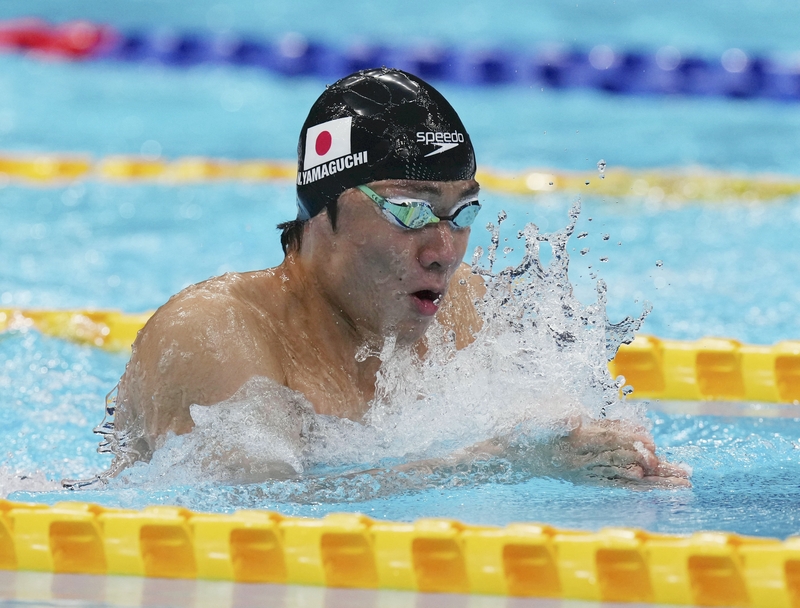
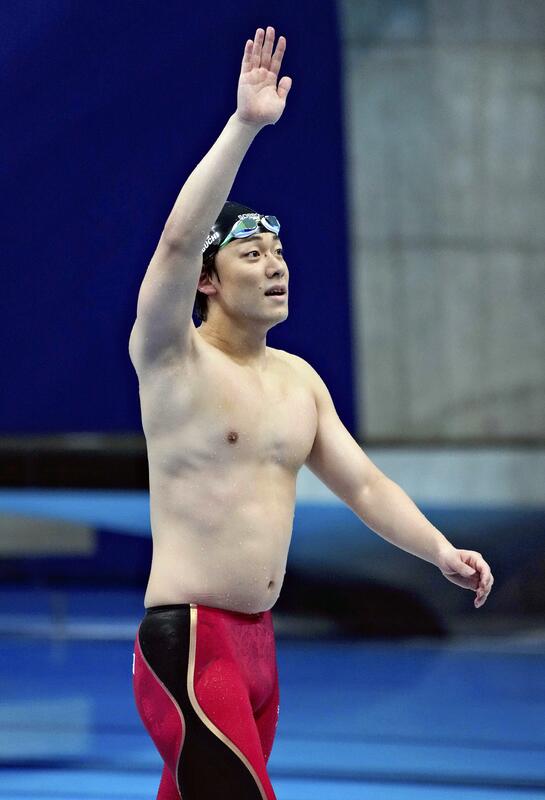
Naohide Yamaguchi swam a breathtaking final race Sunday at the Paralympics, earning a gold medal in the men's 100-meter breaststroke in the SB14 category, a class for those with intellectual impairment.
Immediately after the competition ended, Yamaguchi stared up at the signboard displaying his time of 1 minute 3.77 seconds. Not only had Yamaguchi won gold, but he had rewritten his own world record by .23 seconds.
Yamaguchi finished in first place in the morning qualifying round that day.
In the final, he stayed ahead of Australian Jake Michel, who was swimming in second place. When Yamaguchi switched directions at the 50-meter mark, he was just .10 second ahead of Michel. Yamaguchi dug deep in the final 20 meters and stretched his lead to .51 seconds in the end.
Yamaguchi compares his swimming style to a hybrid car powered by both a motor and a gasoline engine. With dual thrusters, Yamaguchi was confident he would have enough strength when he could use his other power source in the second half of the race.
Diving into swimming seriously in 2017, he is an up-and-coming athlete. Yamaguchi quickly made his mark with a kick powered by his 30-centimeter-long feet. He won the 2019 world championship in the same event, setting a new world record and becoming the first Japanese swimmer to qualify for the Tokyo Paralympics.
Yamaguchi was born in 2000, the year Naoko Takahashi won the women's marathon gold medal at the Sydney Olympics and Hideki Matsui was one of the strongest hitters in Japanese professional baseball. Yamaguchi's first name is derived from two of the kanji characters in these famous athletes' given names.
At the age of 3, Yamaguchi was diagnosed with autism and intellectual impairment. Even after becoming a swimmer so he could compete in races, Yamaguchi would sometimes skip training sessions. However, after notching the world record in 2019, his athletic spirit drove him to stay one step ahead of the competitors and not be defeated by them.
"I have to make the best effort in the world," Yamaguchi said at the time.
To remain on top, the swimmer bulked up, increasing his daily diet to four meals and focusing his efforts on weight training. He practices six times a week, swimming up to 6,000 meters a day.
As a result, Yamaguchi sped up in the second half of the final race, which was one of his goals going into the Tokyo Games.
His efforts paid off in gold.
Read more from The Japan News at https://japannews.yomiuri.co.jp/