Summary
As negotiators haggle and night descends on Lima, we’re going to wind the blog down for now. Here’s a summary of the key events as talks ran into overtime.
- Talks are expected to continue long into the night, although the summit’s president says he’s “optimistic” a climate deal will be struck today. Some negotiators expect no resolution until sometime Saturday.
- Key passages, pertaining to renewable energy commitments and how developing and wealthy nations will split the cost of climate change action, exposed deep rifts among negotiators.
- An influential NGO advocating for developing countries has called the current draft text “a disaster for the planet and the poor”.
- Germany’s environment minister, Barbara Hendricks, says that bilateral meetings with countries including the US and China leave her hopeful that stumbling blocks can be overcome between now and a crunch summit in Paris next year.
- A draft text revealed what Oxfam called a “choose your own adventure” of climate change action.
- US secretary of state, John Kerry, has warned that countries must take action because climate science is “screaming” at the world.
Updated
Oxfam press officer Ben Grossman-Cohen has released a brief statement with its assessment of the talks’ major debates:
Separate discussions are proceeding to overcome sticking points on the approach to finance in the time pre-2020, which is oddly referred to as ‘long-term finance’. Compromise proposals are floating around among negotiators but these have yet to be made public. The current state of play is that the outcome will likely be very weak.
Proposals to create a roadmap for reaching the $100bn promise have been watered down to merely “inviting” developed countries to provide further information on this goal. This makes it very unlikely that developing countries will get the clarity, predictability and support they need to boost climate action in the next few years.”
Deep distrust rankles some representatives at the talks, especially among small nations and the US and China.
Ahmed Sareer, negotiator for the Maldives, has succinctly expressed to my colleague Suzanne Goldenberg (@suzyji):
“How many CoPs will it take for us to really see any tangible results? We have been going from CoP to CoP and every time we are given so many assurances, and expectations are raised, but the gaps are getting wider,” he said.
“There has been a clear commitment of $100bn a year but how are we really being offered? Even when they make those pledges how do we know how much is going to materialise? There is no point of knowing that behind the wall there is a big source of funds available unless we can reach it,” he said.
“We are told it is there in a nice showcase, but we don’t get to meet it. We don’t get to access it. These are difficult issues for us.”
Check out the Suzanne’s full piece on the state of the talks here.
“Ridiculously low” commitments from rich nations to help pay for climate change efforts are frustrating powerful players such as India, my colleague Suzanne Goldenberg (@suzyji) reports from Lima.
It was also unclear how industrialised countries could be held to an earlier promise to mobilise $100bn a year for climate finance by 2020, negotiators from developing countries said. “We are disappointed,” said India’s Prakash Javadekar. “It is ridiculous. It is ridiculously low.” Javadekar said the pledges to the green climate fund amounted to backsliding.
“We are upset that 2011, 2012, 2013 – three consecutive years – the developed world provided $10bn each year for climate action support to the developing world, but now they have reduced it. Now they are saying $10bn is for four years, so it is $2.5bn,” he said.
You can read the full piece here.
Several Latin American have chosen to dramatically increase oil production recently, putting them in the crosshairs of other nations and environmental groups at the summit, Reuters reports.
Brazil is going full speed with investments in areas off its coast that could hold up to 35bn barrels of oil.
Scrambling for energy as a severe drought depletes hydro power plants’ reservoirs, the country has just approved new coal-fired plants that would be partially financed by the government.
Mexico has recently approved new legislation that would allow foreign investments in oil production, breaking up local company Pemex’s monopoly. The country estimates it has some 27bn barrels of unexplored oil.
Ecuador, Colombia and Peru all have similar plans in place.
Mexico and Peru are in controversial junctures. The former simultaneously “approved an ambitious climate change law [and] reformed energy legislation to increase oil investment,” Gabriela Nino, a coordinator at the Mexican Center for Environmental Rights told Reuters.

Peru’s government is debating whether to exempt certain oil companies from environmental reviews, a decision that would accelerate exploration projects.
Guy Edwards, a climate expert at Brown University called the countries out to the news wire: “If you take the domestic policies of many of these countries, the rhetoric is still much ahead of the action.”
Vidal’s update on the state of the talks has had a predictable effect on journalists covering the summit, which looks poised to keep up its marathon pace late through the night and into the morning.
Time for #COP20 BINGO. When's it gonna end? I'm picking 7am (Saturday) @MattMcGrathBBC @pilitaclark @LeoHickman @LFFriedman @gerardfwynn
— Edward King (@rtcc_edking) December 12, 2014
Vidal concludes by saying he won’t open the floor: “We need to work.”
“I will probably reconvene some time tonight a new stocktaking plenary, and [say] how we’re going to move this process forward … Thank you very much, let’s go to work.”
Vidal, the summit chief, says that today’s talks have been productive, but his optimism is tempered.
“We still need more time. We don’t want to create a process that won’t allow all the parties to express their position on the document that the co-chairs released last evening.”
He asks the ADP chairs to continue talks for two hours, and adds that he’ll personally help mediate negotiations.
“We are almost there. We just need to make a final effort. … We are almost there. There is no reason to stop this process, there is no reason to postpone our decision. … We will find solutions.”
“What do we expect? We want to have a very clear decision, here in Lima as part of the strong outcome of the COP20 text. … We want to have the Lima draft text with the elements of the negotiating text as a way to give input to this process, but also as a way to show to the world that we are building this process step by step.”
Updated
The co-chair of the ADP just gave a few brief remarks.
“Some parties indicated where their red lines were, what were their preferred options, and assured their indication where their flexibilities may lie.
“We continued till 1pm as you instructed this morning, but then learning you had been further flexible … we continued our negotiations.
He says that at 3pm there were at least 20 parties still on the floor trying to raise concerns when they finally convened, but that they’ll have a chance yet.
Summit leaders give update on draft
The summit update is finally underway, with Pulgar Vidal, the president, beginning:
“As you remember, I instructed [last event for everyone] to produce a new text. That text was released at 10.30pm, so the co-chairs produced a text first that was shorter than the text producer before that one.
“Second, [it is] a more focused text, mainly on the issues that we need to go [for] more deeply.
“Third, the text [will be based] on confidence and seek consensus.”
“Also, this is a text I am sure will move us forward to a very strong outcome by the end of this meeting, I hope today.
“So please, I want to give the floor to the co-chairs to brief on the discussion that they have begun on that text. After that, I will give further instruction on the way to go forward.”
Negotiators have been asked to choose between three options on almost all of the draft’s major issues, most of which are divided by one question: how will developing and wealthy nations split the bill?
My colleague Suzanne Goldenberg (@suzyji) explains a bit of the UN-NGO-climate change jargon:
In addition to finance, one of the biggest areas of contentious is “differentiation” in UN parlance – which countries should bear the burden of cutting emissions that cause climate change.
Countries are also divided over the initial commitments countries are expected to make on fighting climate change – known as “intended nationally determined contributions”.
Meanwhile the nations are also debating just what the draft will set out. The US and other industrialised countries want all countries to cut greenhouse gas emissions. Back to Suzy for what that means:
That would be a departure from the original UN classification of the 1990s – which absolved China, India and other developing countries which are now major carbon polluters – of cutting their emissions.
Developing countries are suspicious that the text being developed in Lima is an attempt to rewrite those old guidelines.
“I am certain that developing countries the majority of them will have a problem with the way they framed responsibility. Most developing countries will be concerned about that,” said Tasneem Essop, head of strategy for WWF.
Rich countries, the US among them, only want to commit to carbon cuts. Developing countries want them also to commit financing for climate adaptation, eg renewable energy investment.
Friends of the Earth campaigner Asad Rehman has harsh words for the political actors involved.
"crazy thing about #cop20 negotiations is we have solutions to climate, we have the tech & $ - we simply lack politicians with backbone'
— asad rehman (@chilledasad100) December 12, 2014
And also an explanation for why this stocktaking session has yet to begin as scheduled: lunch.
'if you wondered whats happening #COP20 - its lunchtime - followed by stocktaking session'
— asad rehman (@chilledasad100) December 12, 2014
I’ll be bringing updates in live, but you can watch summit president Pulgar Vidal’s “informal stocktaking” speech online here, via the UNFCCC’s stream.
As my colleague Suzy Goldenberg reported earlier, Vidal’s speech was postponed from 1pm to 3pm – after the original plan fell through to announce a deal at 12pm.
These signs, along with the history of talks in Doha and Warsaw, all suggest that talks will stretch into the night, with a new goal of reaching a deal sometime this weekend.
The auditorium where the speech will take place is just now filling up with reporters, so one more indeterminate delay is already in action …
Updated
“We’re out of time,” Samantha Smith of the WWF has just told reporters at a press conference, framing the talks in dire – but not impossible – terms.
There is a solution to climate change, this is the thing that’s almost unbelievable about these negotiations. There are solution to fossil fuels, which are the main [cause of climate change], in a shift to clean renewable energy.”
“It’s just that we’re out of time. Emissions need to peak within the transition and the transition has started. Emissions need to peak within the next five to 10 years, ideally within the next five.
“So this is a space where we cannot sit and wait for change to happen, it needs to happen here, it needs to happen in the 12 months to Paris, it needs to happen in Paris.”
Sandeep Chamling Rai places the dangers in the context of human lives: “This is an issue of life and death for millions of people in vulnerable countries, like Nepal.”
The summit president is scheduled to to deliver an “informal stocktaking” speech in a few minutes, 3pm local time.
Updated
Peru’s indigenous people want a voice in the conversation, David Hill writes from Lima.
Over in the “Indigenous Pavilion” at the Voces del Clima event Roberto Espinoza, from indigenous federations AIDESEP and COICA, is lamenting the lack of indigenous peoples’ participation at the formal negotiations.
He told an audience at the pavilion that the original idea was to have it in the COP20 itself, but this was the best they could do.
“They’re feeling the pressure of indigenous peoples,” he says, “but want to manage us from a distance. We want to be inside.”
Peru’s indigenous groups don’t have an official say in the talks other than indirectly, through the government. The nation is in the midst of a protracted fight over natural resources and protection for its extraordinary range of rare ecosystems where many groups live.
Five main issues still need resolving, a negotiator at the summit told Dan Collyns (@yachay_dc) on condition of anonymity.
- The legal status of the elements draft.
- The scope of INDCs
- Information on INDCs.
- Ex-ante considerations
- Ex-post assessments of existing commitments
Translated (slightly): INDCs are the pledges countries are expected to make by end of next year’s first quarter on a climate deal. Ex-ante considerations are the gritty details concerns; the ex-post assessments mean analyzing how current plans are working out.
The negotiator added that the second point, the scope of the INDCs, was proving the biggest sticking point.
Updated

“We shouldn’t be worried about the window if we’re still building the foundations,” summit president Pulgar Vidal has told Dan Collyns, who’s just filed a bit more from his conversation with Peru’s environment minister.
Pulgar said that he has asked delegates to reduce the text from 47 pages to seven pages last night (Thursday) to speed along the process.
This is a process which we are building brick by brick we shouldn’t be worried about the window if we are still building the foundations.
“I think by assessing the INDCs we are going to know exactly how we are, so that is the next step and then we’re going to move to Paris to try to alleviate the current consequences of climate change.
“We have begun this COP with a good atmosphere, we have launched it with the spirit of Lima; it’s not only good weather and good Pisco – it is that Peruvian spirit - but with a good outcome.”
Updated
Summary
- Talks are expected to run into overtime tonight. The summit’s president says he’s “optimistic” a climate deal will be struck today but some negotiators expect talks to continue on Saturday
- An influential NGO advocating for developing countries has called the current draft text “a disaster for the planet and the poor”
- Germany’s environment minister, Barbara Hendricks, says that bilateral meetings with countries including the US and China leave her hopeful that stumbling blocks can be overcome between now and a crunch summit in Paris next year
- A draft text shows that negotiators are still yet to agree on key passages of a deal
- US secretary of state, John Kerry, has warned that countries must take action because climate science is “screaming” at the world
I’m handing over the live blog reins to my colleague Alan Yuhas (@AlanYuhas) in the US, so keep this page open for the latest news from Lima.
Dan Collyns has just caught up with the summit’s president, Peru’s Manuel Pulgar Vidal.
Despite what some negotiators are saying about the talks rolling into Saturday (see 17:32 update), he is still hopeful a deal will come today. He told Collyns:
The parties agree that we are not going to leave this COP [Conference of the Parties, the name for the annual UN climate summits] with empty hands, that by of the end of this COP we are going to have a good outcome… and the agreement of a new global text.
I am completely optimistic that we can deal with some of the objections and that by the end of today we are going to have a strong outcome, we should avoid for the future, for the next year, a sense of frustration, a sense of anxiety and anguish which we have already suffered in the past, so the best way to do that is to take a decision today.
Pulgar Vidal reportedly said earlier in the week that he was looking forward to sipping a pisco sour with delegates at 6pm (Lima time) on Friday night. As the BBC’s Matt McGrath notes, “few believe that the deadline will be met. Mr Pulgar-Vidal may well be sipping his drink alone.”
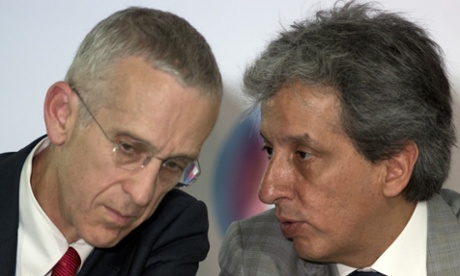
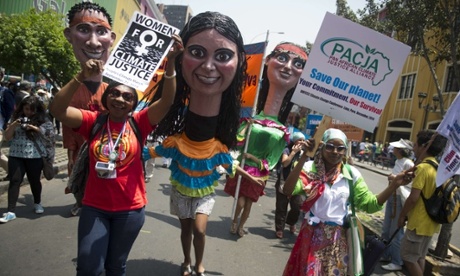
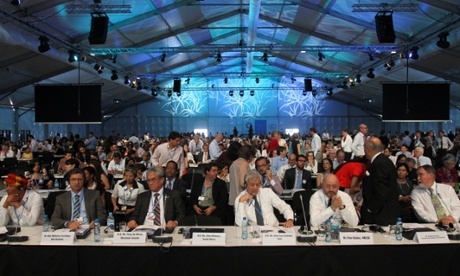
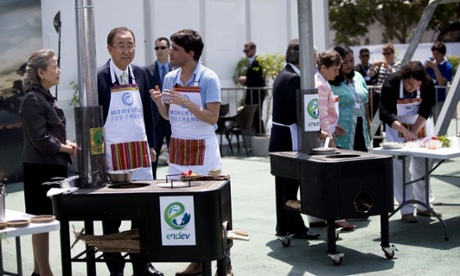
We’ve just published a gallery of photos from week two at Lima. Here’s a taster, but the full thing is worth a look.
Further delays. An “informal stock-taking” by the president of the talks, Peruvian environment minister Manuel Pulgar Vidal, has been moved back to 3pm (local time).
Updated
A “mixed bag” is how WWF describes the current draft text.
The head of its delegation, Tasneem Essop, says in a statement:
Negotiators are out of time here in Lima and everything is still up in the air. The current draft text contains a mixed bag of options – the good, the bad, and the ‘good enough.’ So we can’t call the outcome quite yet.
We are really concerned that the current draft lacks specific actions to address pre-2020 emissions necessary to limit warming to 1.5-2C. It seems that governments in Lima are happy to leave hard decisions on climate change to the governments of tomorrow. This is a recipe for a climate nightmare.
We are happy that the current text contains the recognition for elements of a draft negotiating text for Paris and we need to ensure that remains. The text also rightly includes up front information requirements for national contributions due in 2015, but these must be strengthened, especially with regard to review, finance and adaptation.
Meena Raman from the influential NGO the Third World Network said at a press conference in Lima: “This bottom-up process [of countries setting their own pledges] which is trying to be locked in at Lima would be a disaster for the planet and the poor.”
She added: “We don’t see Lima outcome as fair, equitable, or even balanced.”
A deal in Lima today looks unlikely, says our correspondent Suzanne Goldenberg:
ETA for @LimaCop20 deal now Sat night, according to negotiators arriving this AM. We'll see
— Suzanne Goldenberg (@suzyji) December 12, 2014
And some speculation on what the Lima deal will be called (following such previous hits as the Durban Action Platform, the Copenhagen Accord, and the Doha Climate Gateway)
Talk now of a Lima Action Platform which I for one think will lead to a lot of unfortunate acronyms & jokes @LimaCop20
— Suzanne Goldenberg (@suzyji) December 12, 2014
At a daily briefing, Ban Ki-moon’s spokesman is asked about the UN secretary general’s view on Greenpeace’s climate talks stunt at the Nazca lines in Peru earlier this week, which it later apologised for.
The spokesman said:
The preservation of world heritage sites is critically important for the world as its name implies.
People who feel they need to demonstrate a particular point need to do so in a peaceful fashion.
*This post has been amended; it erroneously included a reference to an errant cellphone ringer not relevant to the spokesman’s other comments.
Updated
Barbara Hendricks, German minister for the environment, has been giving a press conference. One of the sticking points after Lima, she said, would be the legal form of the climate pact to be agreed in Paris next year (more on that in this story here).
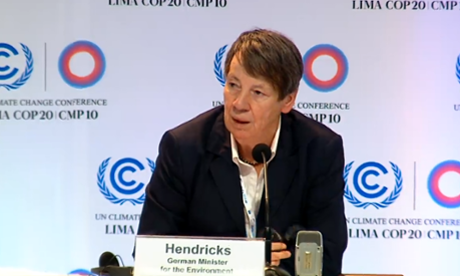
On our way to Paris there are still many stumbling blocks remaining. I mention only three of them.
Differentiation. How will common but differentiated responsibilities be addressed under the new agreement? Do we continue to divide world into two parts, or will there be a continuum for commitments, both for mitigation and for finance. [see 13:09 update]
Balance. How will relationship between the expected mitigation commitments of all countries and of financial support in the new agreement.
Legal form. How far do we reach legal bindingness in Paris for the rules applying to our contributions and for the contributions themselves.
In addition to the negotiations, I had several bilateral discussions... I gained the impression that there is a great willignness to overcome the stumbling blocks, and find ambitious solutions together that are acceptable to all states. That leaves me confident for the next year but I still think we need more effort and more speed.
Lima noon summary
- US secretary of state, John Kerry, says climate science is “screaming at us” and calls on negotiators to set aside old differences between rich and poor countries
- A draft text released overnight sparks criticism from developing countries that ambition has been watered-down
- A leaked briefing note from a bloc of countries with a history of ‘blocking’ at the talks says that no climate deal is better than a bad one
One of the blocs at the talks, the Like-Minded Development Group, is reportedly saying in private (and now pretty publicly via a leak) that no deal is better than a bad one. The group includes several big oil producers – Venezuela, Iran, Saudi Arabia – and India.
“If in the end, no consensus can be reached in time, it is possible to transmit the relevant documents for further work to the next meeting We do not consider this a failure at all. Instead, it is a mark of progress, especially progress in the process,” says a briefing note for the bloc, published by climate news site RTCC.
More from the countries on the sharp end of the talks. Suzanne Goldenberg reports from Lima:
I’ve been talking to Ahmed Sareer, the Maldivian diplomat who will take over leadership of the Alliance of Small Island States, early next year. It’s a good reminder of what’s at stake for some countries – and of how frustrating they must find the slow pace of these negotiations.
As a low-lying string of islands, the Maldives is dealing with multiple effects of climate change – dying coral reefs, ocean acidification, sea level rise and contamination of its water supply, Sareer said.
On 4 December, the country’s desalination plane caught fire, knocking out the country’s only source of safe drinking water. It’s still not up and running yet.
“How many CoPs [Conference of the Parties] will it take for us to really see any tangible results? We have been going from CoP to CoP and every time we are given so many assurances, and expectations are raised, but the gaps are getting wider,” said Sareer.
“Even if you look at the finance, there has been a clear commitment of $100bn a year, but how much are we really being offered? Even when they make those pledges how do we know how much is going to materialise? There is no point of knowing that behind the wall there is a big source of funds available unless we can reach it,” he said.
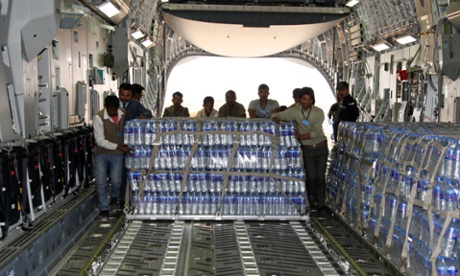
Karl Mathiesen has been talking with the Marshall Islands president, Christopher Loeak. The Pacific island state’s president says that although the Lima talks are tense and difficult, “there is a deal to be done and everyone is getting on board”.
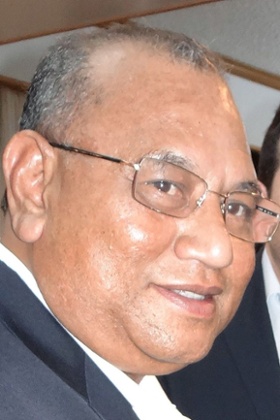
What is your reaction to the reports that progress in Lima has stalled?
“My team in Lima is reporting that negotiations are tense and difficult, with too much time being spent on procedural haggling. This is disappointing but I am expecting the positive momentum we have seen from Leaders this year to translate into a strong outcome in Lima. It seems that some of those blocking progress have failed to make the leap to seeing climate action not as a threat but as a great opportunity. This is a new world where everyone needs to contribute to the global effort on climate change.”
What is your message to countries blocking progress?
“Enough is enough: my country’s future is at stake. We expect the world’s biggest emitters to take my peoples’ plight as seriously as they would their own. How can they expect us to leave Lima without a decision to require countries to explain the targets they put on the table next year? Do they expect us to sign an agreement in Paris without knowing what it all adds up to? This is ultimately what will determine my country’s future.”
How will the situation in Lima affect the Paris talks?
“As my foreign minister said yesterday, Lima must plant the seeds for success in Paris. Following the UN Climate Summit in September, the People’s Climate March in New York, and the most alarming scientific reports we have ever seen, there has never been a stronger mandate for aggressive climate action.”
“Paris won’t be another Copenhagen [the 2009 climate summit that floppped] – the world has changed too much. The world’s two biggest emitters – China and the US – are now on the same page and understand the need to act. There is a deal to be done and everyone is getting on board.”
Updated
Here’s a quick round-up of reaction from Twitter. The current draft text comes in for more flak but gets some credit for progress.
Elizabeth May is a Canadian MP who regularly attends the talks – she says developing countries are angry:
#COP20 pres Pulgar-Vidal addressed working group urging working thru text by 1 pm stock-taking. But dev'g countries angry w text. #climate
— Elizabeth May MP (@ElizabethMay) December 12, 2014
And here’s Friends of the Earth:
Lowdown on #COP20 Lima outcome. fails the ppl & doesnt protect food sovereignty. Here's y 1)text has no option requiring a finance commitmnt
— asad rehman (@chilledasad100) December 12, 2014
Lowdown on #COP20 Lima outcome. fails the ppl & doesnt protect food sovereignty. Here's y 1)text has no option requiring a finance commitmnt
— asad rehman (@chilledasad100) December 12, 2014
3/4 Loss and damage is not addressed as a part of countries' contributions #COP20 #adp
— asad rehman (@chilledasad100) December 12, 2014
(for more on what “loss and damage” is, see 13.29 update).
Here’s the view from the US NGO, the National Resources Defence Council, a regular UN talks watcher:
Irregardless of decision at #COP20 countries know: (1) they have to come forward w/ bold & ambitious mitigation commitments next yr
— Jake Schmidt - NRDC (@jschmidtnrdc) December 12, 2014
And that of Joss Garman of UK thinktank IPPR:
Final day of #COP20. New cleaned up text contains some good strong rules. If they survive these last hours, Lima will have been a success.
— Joss Garman (@jossgarman) December 12, 2014
The World Bank’s climate expert isn’t impressed, calling the current wording “vapid”.
Whiplash! Real movement and action in partnerships around #COP20…and then just read the draft ADP text. Vapid. Come on everyone
— Rachel Kyte (@rkyte365) December 12, 2014
Updated
Dan Collyns, one of our reporters at the summit, has an update on India’s thoughts and where the divisions lie:
Splits remains on the principle of common but differentiated responsibilities. While the US Secretary of State, John Kerry, called on Thursday for developing nations not to repeat the mistakes of the past, countries like India, a prominent member of the Like Minded Developing Countries (LMDC) group on Climate Change argue they have the right to lift their people out of poverty.
“If I have to change my current technology, if I have to look to futuristic things, it is going to cost, and someone has to pay this cost,” Ashok Lavasa, of the Indian government delegation, told the Guardian.
“The cost should be born by everybody...but more so by people who have also enjoyed the fruits of their development, and historically have occupied a lot of space with the carbon emissions; this space has to be left for other people to grow.”
Despite the criticism of the latest draft text at the summit, Nobel Peace Price winner and former US vice-president Al Gore is pretty boosterish about prospects at Lima. In a video with the conference organisers, he says:
I hope when the gavel falls, it will be seen as a truly historic success, in setting the stage for a successful agreement in Paris one year from this week.
Already so much progress has been made that it’s obvious that the spirit of Lima has been extremely powerful in bringing people together from every continent, every income group, from every culture and every national background.
One of our journalists, Karl Mathiesen, is currently travelling in the Pacific island states, Kiribati and the Marshall Islands. He reports on the view of Lima from there, a region threatened by rising sea levels:
“Some people know, but I don’t care,” reckons my taxi driver about the Lima climate talks.
Everyone in the Marshall Islands capital Majuro knows about climate change. Every destructive weather event, from drought to king tide, is blamed on carbon emissions. Major inundations in March and October have ensured people are worried about the threat to their homes.
Most of the Marshallese who have Facebook have watched videos of Kathy Jetnil-Kijiner, the poet who spoke at the UN Climate Summit in New York in September. There is immense pride in her standing up and speaking for them.
But crises here tend to be more immediate - like where the next bag of rice is coming from.
“I just don’t see climate change as a daily point of conversation here. The whole issue is generally new to people,” says Giff Johnson, the editor of the Marshall Islands Journal. “It’s just in the last couple of years that people are starting to become aware of it.”
Many of the same people who laud Jetnil-Kijiner complain that Tony de Brum, the foreign minister so prominent in international climate circles, is a jetsetter who spends public money on overseas trips. There is little recognition of his advocacy, the UN climate process or its relevance to these islands.
You can read more from Karl in Kiribati here.
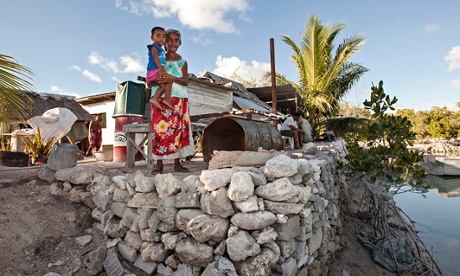
The BBC’s Matt McGrath, in Lima, reports on developing country concerns over the draft text.
Some countries are suspicious that the text being developed here in Lima is an attempt to get round the concept of differentiation [see 13.09 update], which is embedded in 1992’s UN framework convention on climate change.
The issue has become critical as the chairs of the talks introduced a new draft text that many felt watered down the original commitment [see 12.07 update].
A large group of developing nations known as the G77 objected.
“This whole exercise is not meant to rewrite the convention, this is a firm basic position of the G77,” said Antonio Marcondes, Brazil’s representative at the talks.
“We stand behind the differentiation, we stand behind ‘common but differentiated responsibilities’, these are issues we hold very strong and these are definite red lines.”
Even the trade unions, who are usually very supportive of the talks, are not happy with the latest version of the text. The TUC notes that a line from previous climate summit texts, about countries “implementing their policies and measures to promote a just transition of the workforce and the creation of decent work and quality jobs”, doesn’t appear in the current Lima document.
Frances O’Grady, the union’s general secretary, says:
The labour movement is increasingly mobilising to support an ambitious UN climate change treaty in Paris next year. We are conscious that all jobs are at risk without a commitment to emission reductions, adaptation, finance and technology. This is why we have always supported the UN process.
However, the lack of thought being given to the possible effect on workers, added to the absence of references for the need for a just transition, has raised major concerns among the international trade union delegation in Lima.
I just caught up with Philip Pearson, senior policy officer at the TUC. He stressed that unions are right behind the efforts for a climate pact, but the TUC is “really brassed-off” at the lack of a reference at the moment to the dialogue, safety nets for workers and investments that’ll be required as high carbon industries (oil, coal, gas, and attendant mining) theoretically shrink and low carbon ones (renewable energy and nuclear power) grow.
“Trade unions are really up for this whole UN climate treaty but we are deeply frustrated by the lack of reference to the effort required,” he said.
Updated
India’s Down To Earth magazine, which is reporting from Lima, says it looks like the final text will not include the principle of “loss and damage”. This is the idea pushed by some developing countries that they should receive financial compensation for the damage caused by extreme weather which has been exacerbated by rich countries’ historical emissions.
Developed countries are unsurprisingly not keen on it, and will point to their $10bn contributions to the separate Green Climate Fund, designed to help poor countries cope with global warming. Karl Mathiesen wrote a good guide for us on loss and damage during the Warsaw talks last year.
Some reaction to Kerry’s speech.
Samantha Smith, leader of WWF International’s Global Climate and Energy Initiative, seems pleased at his intervention:
Negotiators in Lima must not forget that we are facing a planetary emergency. Secretary Kerry is correct in highlighting the science that tells us we are already facing unprecedented impacts from climate change, and that to steer the world’s climate to stay below 2C global warming, we have to act now.
We need countries to step up financial commitments and to ensure that we have a strong negotiating text to discuss in Paris. We cannot afford to fail the vulnerable people of the world who are depending on us to ensure that they have a world worth living in.
While Friends of the Earth US is unimpressed with what it perceives as the gap between Kerry’s rhetoric and US action. Senior analyst Karen Orenstein said:
It is past time to put words into action. The emissions cuts the US has put forward put us on a path for a global temperature increase well beyond the already dangerous 2C level. Secretary Kerry said, ‘If you’re a big developed nation and you are not helping to lead, then you’re part of the problem.’ Regrettably, the US is a tremendous part of the problem, and as the hundreds of thousands of people on the streets of Lima and New York have demanded, this must change immediately.
The marches she’s referring to are the thousands who marched in Lima on Wednesday, and the hundreds of thousands of people who marched in New York and around the world in September.
UK-based blog, Carbon Brief, has compiled a very good jargon-buster explaining the acronym soup that is served up at all the climate negotiations. For example, one of the key principles bandied around is “common but differentiated responsibility”. Mat Hope explains it succinctly thus:
Developing countries often talk about ensuring any new global deal respects the principle of common but differentiated responsibility. This basically means designing a deal where those with the greatest historical responsibility for climate change and the means to implement low carbon policies take the biggest and earliest steps to cut emissions.
This principle was enshrined in the UNFCCC, which separated countries into three groups: Annex I, Annex II, and non-Annex I.
And yes, it even explains what UNFCCC stands for too.
Suzanne Goldenberg has been analysing the detail of Kerry’s speech yesterday (see 11.34 update). She writes:
John Kerry, in his speech to the meeting on Thursday afternoon, inserted some pointed language that reads as if it were a last-minute addition intended to try and get the talks moving.
He called on negotiators to set aside the old divisions between rich and poor countries and recognise that it would take a global effort to fight climate change. “No single country including the United States can solve this problem or foot this bill alone,” he said. “If we somehow eliminated all of our carbon pollution, guess what? That still wouldn’t be enough.”
Nor would it be enough if China or India cut all their emissions, Kerry went on. “If even one or two major economies fail to respond to the threat, it will counter-act much of the good work that the rest of the world does.”
In a slight at countries such as Australia and Canada which have backtracked on climate promises, Kerry said said industrialised countries in particular had to step up. “If you are a big developed nation and you are not helping to lead then you are part of the problem,” he said.
Kerry also said countries should be heartened by the example set by the US and China which jointly agreed last month to cut carbon pollution.
“That is a historic milestone and it should send a message to all of us that the road blocks we have had for decades can be removed from our path.”
The ‘Adopt a Negotiator’ project has posted a line-by-line analysis of the latest draft deal, which they brand “a lowest common denominator text”. Among other criticisms, they say the text is too vague in its language and the level of ambition too low.
According to the UN’s latest timetable, Lima should be all wrapped up by 2pm today. Don’t hold your breath though. The 2011 talks, in Durban, ran nearly two days over...
Suzanne Goldenberg reports on the overnight negotiations:
Late last night, the heads of the working group went to Manuel Pulgar Vidal and admitted they were stuck. He then instructed them to go back, and give him some kind of text he could work with. They produced the seven-page draft, and they will go on from here trying to produce some kind of outcome. There are “stocktakings” at 10am and 1pm local time that should give a sense of where negotiations are heading.
AP has a bit more on the splits behind exactly what a pledge on climate action looks like (see my earlier update about the latest draft text):
Rich countries insist the pledges should focus on efforts to control emissions and are resisting demands to include promises of financing to help poor countries tackle climate change.
Top carbon polluter China and other major developing countries oppose plans for a review process so the pledges can be compared against each other before Paris.
Brazil’s top negotiator, Antonio Marcondes, called the review an “unnecessary effort” that would detract from the main goal of reaching an agreement next year.
France, which as host for the crucial summit in Paris next year has a huge vested interest in the success of Lima, has said it’s quite possible some of the key issues will get bumped until 2015.
Laurence Tubiana, the top French climate ambassador, told climate news site RTCC: “Some issues will not be resolved here, but it’s fair enough, if they are too big it’s about changing the real ambition of the whole world. But we can have clarity.”
RTCC also notes that the atmosphere at the talks so far has been “remarkably happy”, in contrast to Warsaw last year, which saw walk-outs by NGOs and furious clashes between blocs of countries.
The UN Framework Convention on Climate Change, the body which runs the talks with the Peruvian hosts, has published the latest version of the draft text. A quick look shows huge sections still up for grabs, with multiple options listed for key paragraphs.
I’ll try not to bore you too much with excerpts from the text, but take for example this passage.
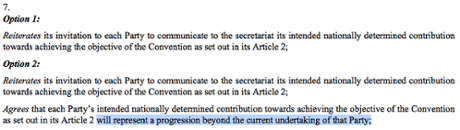
Negotiators are still haggling over just what a pledge to tackle climate change should constitute. In the jargon, a pledge is an ‘intended nationally determined contribution’.
Option two is the modestly more progressive one, where countries agree to actually do more than they’re doing already to cut emissions.
But there’s also a third, stronger option which some countries are pushing, to have more than just cutting emissions count as a pledge – they want climate financing and adapting to warmer temperatures to also count as a pledge.

Oxfam’s not too impressed by the current state of the text. Its policy adviser, Jan Kowalzig, says:
This text needs significant improvement. The options presented are like a choose your own adventure novel, some could put us on a barely workable path heading into Paris, while others may doom us to a dangerous future. The ingredients for some progress in Lima are on the table, but negotiators need to have the courage to use them. Unless the text improves, whatever options negotiators choose over the next day will leave many very difficult issues unresolved and keep the world headed down a treacherous road towards extreme warming.
Looking through the draft text, it appears the options 1-3 throughout on a scale from 1 being weakest to 3 being strongest.
Updated
UN climate talks enter final hours
Behind a Peruvian army base near Lima, ministers and officials from nearly two hundred countries are trying today to agree on a draft text to avoid dangerous global warming.
The hosts, led by Peru’s environment minister Manuel Pulgar Vidal, say that officially there will be a deal by noon local time (5pm GMT – I’ll use local times from here on in). But judging from previous Conferences of the Parties, as the annual UN climate summits are called, the climate talks could run late into the evening, and quite likely continue on Saturday.
As our reporter on the ground, Suzanne Goldenberg, noted last night, progress has been slow. At the time of publishing, negotiators had agreed just a single paragraph of the text, which is to form the basis of climate pact to be formally signed at Paris next year. From our story:
“We are going backwards,” said Alden Meyer, who monitors the climate negotiations for the Union of Concerned Scientists.
Those at the talks still have every expectation that Lima will produce some kind of agreement by Friday evening, or more likely early Saturday morning – but the paralysis is in stark contrast to the upbeat backdrop to the summit’s opening.
“I am not really sure that we will see a clear outcome coming here in Lima,” said the former Mexican president, Felipe Calderón, who addressed the meeting.
By Thursday morning the text, which had started at a reasonable six pages, had ballooned to about 50, with negotiators throwing in their objections to almost every single clause. Just one section, paragraph 34, on countries intensifying engagement in the years up to 2020, has been agreed by negotiators.
In a successful negotiation, observers say that by this point officials would be whittling down to the final text to a manageable size.
“We have seen the laggards throwing in language of all kinds into the negotiating document,” said Tony de Brum, the foreign minister of the Marshall Islands.
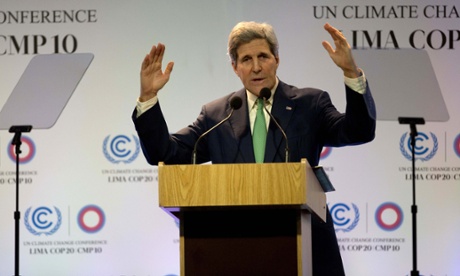
Thursday also saw John Kerry, the US secretary of state, address the meeting. He didn’t announce any new measures or financing, but told delegates the science of climate change was “screaming” at them to act on carbon emissions. Here’s the full speech, and an excerpt:
Rest assured, if we fail, future generations will not and should not forgive those who ignore this moment, no matter their reasoning. Future generations will judge our effort not just as a policy failure, but as a massive, collective moral failure of historic consequence, particularly if we’re just bogged down in abstract debates. They will want to know how we together could possibly have been so blind, so ideological, so dysfunctional, and frankly, so stubborn that we failed to act on knowledge that was confirmed by so many scientists in so many studies over such a long period of time and documented by so much evidence.
The truth is we will have no excuse worth using. The science of climate change is science, and it is screaming at us, warning us, compelling us – hopefully – to act. Ninety-seven percent of peer- reviewed climate studies have confirmed that climate change is happening and that human activity is responsible. And I’ve been involved, as many of you have, in public policy debates for a long time. It’s pretty rare to get a simple majority or a supermajority of studies to say the same thing, but 97 percent over 20-plus years – that is a dramatic statement of fact that no one of good conscience or good faith should be able to ignore.
Now you only have to look at the most recent reports to see in all too vivid detail the stark reality that we are faced with. Scientists agree that the emission of climate pollutants like carbon dioxide, methane, soot, hydrofluorocarbons all contribute to climate change. In fact, basic science tells us that life on earth wouldn’t exist at the heretofore 57 degrees average temperature Fahrenheit which allows life to exist. Without a greenhouse effect, life wouldn’t exist, and if the greenhouse effect is good enough to provide you with life itself, obviously, logic suggests that it’s also going to act like a greenhouse if you add more gases and they’re trapped and you heat up the earth. This is pretty logical stuff, and it’s astounding to me that even in the United States Senate and elsewhere, we have people who doubt it.
And here’s the video:
As the New York Times notes, a deal announced by China and the US last month on tackling emissions has generated a lot of warmth towards the US at the talks, where it is often painted as the pantomime villain:
When it comes to global warming, the United States has long been viewed as one of the world’s worst actors. American officials have been booed and hissed during international climate talks, bestowed with mock “Fossil of the Day” awards for resisting treaties, and widely condemned for demanding that other nations cut their fossil fuel emissions while refusing, year after year, to take action at home.
Suddenly, all that has changed.
At the global climate change negotiations now wrapping up in Peru, American negotiators are being met with something wildly unfamiliar: cheers, applause, thanks and praise.
...
The U.S. is now credible on climate change,” said Laurence Tubiana, the French climate change ambassador to the United Nations, who is leading efforts to broker a new agreement to be signed by world leaders in Paris next year.
Veterans of two decades of climate change negotiations called the turnaround in America’s image profound.
“Countries got weary of negotiations with the U.S.; it got tough in negotiations, but it didn’t deliver,” said Yvo de Boer, the former executive secretary of the United Nations Framework Convention on Climate Change. “Now the U.S. has policies in place to deliver on its word.”
Stay tuned here for the latest news and developments from Lima. You can email me at adam.vaughan@theguardian.com and tweet me @adamvaughan_uk.
Updated