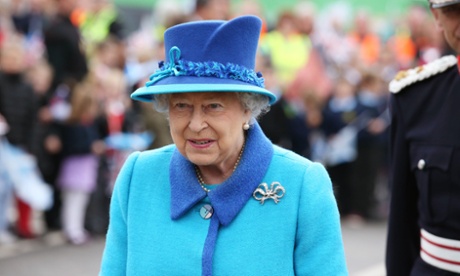
Her governess, Marion Crawford, once said of the young queen that “Lilibet never cared a fig” for clothes. And insofar as we can deduce anything about a public but unknowable person, this still feels true. In 63 years of appearances as a monarch, personal vanity has never seemed to take up much bandwidth; what the Queen cares about, instead, is the art and science of being Queen. But she understands perfectly how clothes pay a key role in this. As she once put it: “I have to be seen to be believed.”
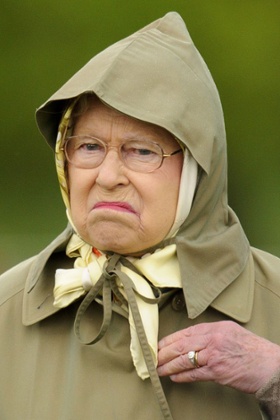
The Queen is as instantly recognisable as Coco Chanel. Writing about her style around the diamond kubilee of 2012, the New York Times noted that “the pastel rectangle of her customary coat and the bright disk of a matching hat, the black oblong of her handbag and the generic low-heeled pumps are almost Warholian in their pop simplicity”. She appears on Vanity Fair’s international best-dressed list. In 2008, Dolce & Gabbana created an entire collection in homage to her August-in-Balmoral look, complete with kilts and silk headscarves. Donatella Versace calls her a style icon; Stella McCartney is on record saying that she would love to design for her. (“If she would have me, absolutely, I’d love to.”)
Her silhouette is Lego-brick boxy, rather than willowy or elegant; the rainbow palette is too matchy-matchy for true sophistication. Sir Hardy Amies, her dressmaker for many years, was known to despise the Launer handbags she insisted on carrying, which he felt ruined the flow of the outfits he had designed. (He had a point.) Yet the Queen’s wardrobe works, because it is less about fashion than it is about theatre. There is a particular shade of eggy yellow that she often chooses for special occasions – Prince William’s wedding, for instance – which is too sunny to be chic, but has a crayon-brightness that makes her look a little like a storybook character come to life. The Easter bunny, say, or a minor superhero from a forgotten comic; someone you hadn’t quite believed was real.

Other star characters around her on the royal stage – Princess Diana, the Duchess of Cambridge, and before them, Princess Margaret – have made their own physical beauty, personal glamour and fashionable status a key part of their public image. The Queen, by contrast, uses clothes, hats and colour to make rather formal public statements, instead of using fashion or feminine wiles to make an emotional impression. (There is an echo here of the sweet, feminine public image of her mother, the late Queen Mother, an image that was adopted at least in part in opposition to the skinny, feline, racy fashionability of Wallis Simpson.) The strategy behind the Queen’s wardrobe is effective because it is simple and unencumbered by vanity: head-to-toe colour to ensure she stands out in a crowd. She must provide a ceremonial focal point, like the star on a Christmas tree.
Her clothes are constructed like stage outfits. The armholes are cut extra deep, so that the royal wave does not cause her coat or jacket to ride up and spoil the line. Weights are sewn into the hems of dresses if a wayward breeze is even a remote possibility. (In 63 years, the Queen has never had a wardrobe malfunction.) Backdrop is taken into account, by the team led by longtime royal dresser Angela Kelly: if an occasion is to take place on a lawn, she will wear a colour that contrasts with green. If she is visiting a school or children’s centre, the hat will feature flowers or stiffened silk twirls, as these help keep the children’s attention.

“I don’t think she feels chic clothes are friendly,” Amies once said. “There is something cold and cruel about chic clothes, that she wants to avoid.” The handbags which he so hated serve no apparent practical purpose, for a woman never more than a few paces from a lackey. Any handbag bigger than an iPhone 6 is a glam-killer of the first order, and would never, ever be spotted on the red carpet. By carrying one, the Queen adds a tiny hint of ordinary-Nana to her image. (Royals have always done this, specifically in order to mess with our heads. One minute they are special, the next they are just like us. It’s a time-honoured anti-republican strategy.) The handbag and those comfy low pumps remind us that being Queen is, in its own way, a job, and that it is hard work.
Elizabeth II is unlikely ever to match up to the best of queenly image-makers, Elizabeth I. Her image, as captured in portraits and poetry, was almost magical, a queen as semi-divine. Elizabeth’s sensuous, Botticelli Venus colouring was grandly wrapped in velvet, her pale skin given the gleam of a pearl or a unicorn. That school of image-management is impractical, in the era of the cameraphone, so Elizabeth II has devised a more practical image with just the right amount of theatre, and a shrewdly upbeat tone. (She may have only just shaded her on length of reign, but Elizabeth surpassed Queen Victoria on the style front some time ago. Despite the success and expansion over which she presided, our lasting images of Victoria express just a sombre power, and very little of the glory. We picture Victoria in profile, as if stamped on a coin; a bleak forcefield of sadness emanates even through the grain of late 19th-century photography.)

The look that Elizabeth II has forged during the past three decades is so indelibly inked on our minds that it is easy to forget the years in which she was something of a fashion plate. At a visit to Liverpool Street station in 1958, a chartreuse coat with matching hat and leopard print stole is positively Mad Men. In the 1960s, she was fond of hats made up entirely of tiny silk blooms that sat snugly over her hair, a style also favoured by Liz Taylor at the time. A state visit to Mexico in 1975 saw her in a startling yellow polka-dot turban.
As she matured into the role of monarch, her outfits for public appearances became more formulaic. These days, the occasions on which the Queen looks most glamorous are the ceremonial ones. A white cashmere, fur-trimmed throw, huge pearl earrings, bracelet and glittering tiara at the state opening of parliament, for instance: this is an outfit to remind those in the audience who might think themselves powerful what true grandeur looks like. When on display to the ordinary people, by contrast, she dresses with deliberate modesty. Compare her clothes at the Order of the Garter – velvet and feathers, navy and scarlet – with the simple pastel coat and dress (and handbag) she chose for William and Kate’s wedding, and it is clear the image of the cheery, working queen is an entirely deliberate one.