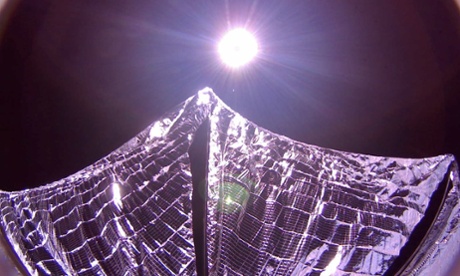
A privately funded space advocacy group has deployed a “solar sail” in orbit. Such spacecraft could open up cheap space travel and provide ways to drag space debris out of orbit.
LightSail uses no fuel. Instead it relies on a large reflective sail to capture the momentum inherent in sunlight.
The Planetary Society has a history of championing such devices. In 2005, it attempted to launch one using a converted ICBM from a Russian naval submarine in the Barents Sea. However, it failed to separate from the rocket.
Their new mission has not been without troubles. Two days after the 20 May launch, LightSail fell silent because of a bug in the communications software. Luckily a passing cosmic ray, a high-energy particle probably generated hundreds of thousands of light years away by an exploding star, forced the computer to reboot about a week later.
Then a battery glitch silenced the probe. The ground team had to wait for it to drift into a sunnier orbit to generate more power. Finally, on 7 June, the probe awoke and the sails deployed.
It is just possible to see the shiny surfaces with the naked eye. It will be a faint, fast moving target. Upcoming passes can be found by visiting the Planetary Society’s control centre.
But be quick – LightSail is not high enough to actually sail. Instead, the 32 square metre sail will drag the craft down out of orbit early next week.
LightSail is not the first solar sail. The Japanese Aerospace Exploration Agency (Jaxa) has been sailing Ikaros in interplanetary spacebetween Earth and Venus since 2010.