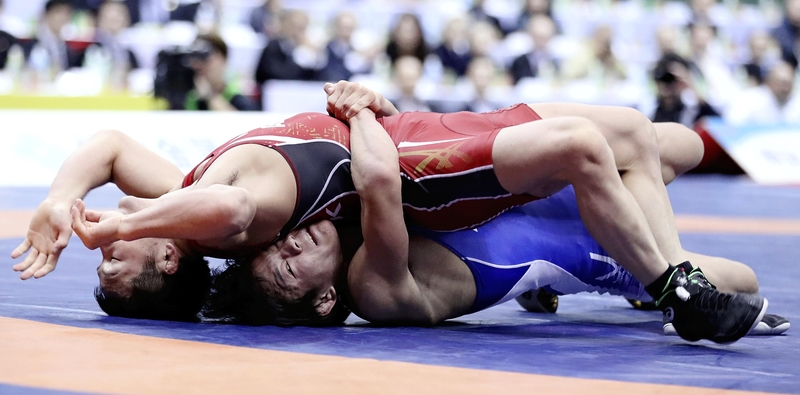
The choices left for Rei Higuchi were far from appealing, but desperate times called for desperate measures.
In trying to stay alive in the qualifying process for the 2020 Tokyo Olympics, Higuchi could try again to unseat the former world champion -- who had beaten him in four of their five previous matches -- and would have to defeat him twice to do it. Or he could drop 11 kilograms down to 57 kilograms, the weight class that he has not competed in since winning the silver medal at the 2016 Rio Olympics.
The pangs of hunger, he could endure; the stings of defeat, not so much.
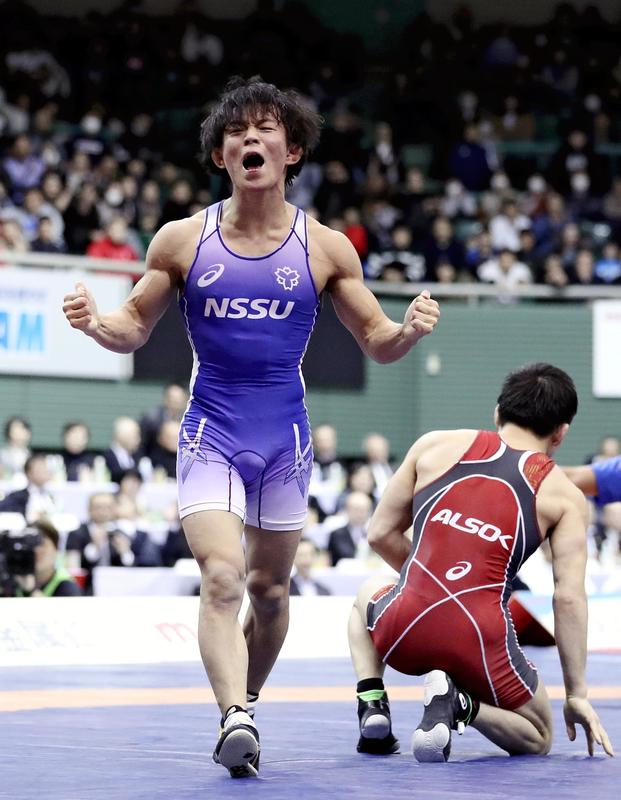
Fueled by a vegetable-heavy diet, Higuchi revived his Olympic hopes with a nail-biting 7-6 victory over three-time defending champion Yuki Takahashi in the freestyle 57-kg final at the All-Japan Championships (Emperor's Cup) last Sunday at Tokyo's Komazawa Olympic Park Gym.
"Thinking about what would get me closest to winning the gold medal in Tokyo, the answer I came up with was to put it all on the line at 57 [kg]," said Higuchi, who had originally made his challenge two weight classes higher at 65 kg.
"It was hard [losing the weight], but not as tough as it was for Rio, and I was able to get down smoothly. I brought the skills and power that I gained at 65 [kg] with me down to 57 [kg], and everything went well."
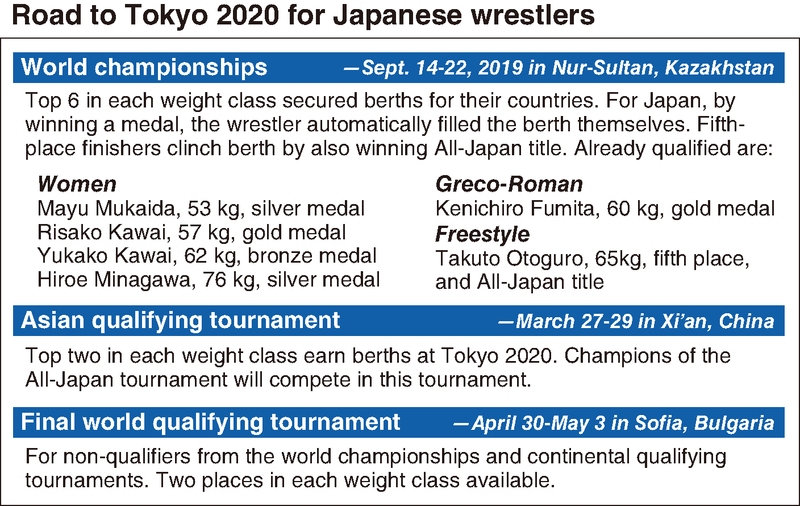
With the victory, the 23-year-old Higuchi earned a ticket to the Asian Olympic qualifying tournament in Xi'an, China, in March, where two spots at the Tokyo Games per weight class will be up for grabs.
The Suita, Osaka Prefecture, native had missed the first chance to qualify, which would have been at the world championships in September in the Kazakh capital of Nur-Sultan. He lost a playoff with 2018 world champion Takuto Otoguro for the place on Japan's team at 65 kg.
While there are 10 weight classes in each style of wrestling, only six are competed at the Olympics, which led to a mad scramble among Japanese wrestlers into higher or lower divisions.
The stakes were high. The top six finishers in each weight class -- the two finalists and the four who make the bronze-medal matches -- in Nur-Sultan secured a spot for their country at the Tokyo Olympics. The Japan Wrestling Federation sweetened the pot by decreeing that any wrestler winning a medal in an Olympic weight class automatically secured the Tokyo spot themselves.
Five wrestlers fulfilled that criteria: Mayu Mukaida (53 kg); Rio Olympic champion Risako Kawai (57 kg), who had famously beaten four-time Olympic champion Kaori Icho for the world team place; Yukako Kawai (62 kg) and Hiroe Minagawa (76 kg) among the women; and Kenichiro Fumita, who won the Greco-Roman 60-kg gold.
Otoguro finished fifth, meaning he could clinch the spot himself with a victory at the Emperor's Cup; a loss would send him to a playoff with the champion. Higuchi, considering taking another shot at the 65-kg berth, may have been influenced by the fact that his first and only win over Otoguro came at the All-Japan Invitational Championships last June, when Otoguro was hampered by knee problems.
Although Otoguro came up short of winning the Olympic spot outright by placing fifth, that result -- which meant Higuchi would need two wins over Otoguro -- convinced Higuchi that he would need to take another route.
"If Otoguro hadn't earned the ticket to the Olympics, I would have stayed at 65 kg," Higuchi said. "To beat him twice would be really difficult. He's a really smart wrestler, and even if you beat him once, he's not the type that will let you beat him again."
Thus began the Big Diet. After the playoff loss, Higuchi's weight had ballooned up to 68 kg, and he only had a few months to make 57 kg in time for the Emperor's Cup.
"The struggle was to maintain nutrition," Higuchi said. "For three or four months, I stuck mainly to eating vegetables. That was more severe than the training. But I got down to the weight, and, while it wasn't a perfect performance, I would give myself a passing mark."
Takahashi, the 2017 world champion and 2018 world bronze medalist, has long been motivated by the sting of missing out on the Rio Olympics in the weight class that Higuchi filled. Takahashi had a chance to secure his ticket to Tokyo in Nur-Sultan, but his tournament ended with a 6-1 loss in the quarterfinals to India's Kumar Ravi.
In the Emperor's Cup final, Higuchi came out aggressively, and scored two single-leg takedowns while fighting off Takahashi's attempts to turn him over with counter-lifts. After the second takedown, Higuchi added a gut-wrench roll to take a 7-1 lead midway through the second period.
But Takahashi, with a reputation for comebacks, started an impressive one. In a 40-second span, he forced Higuchi out of the circle three straight times for single-point step-outs, then scored a takedown to pull within 7-6 with :31 left.
Instead of being defensive and risking another forceout, which would mean a loss by last-point criteria, Higuchi went on the attack. While he was unable to finish off a single-leg tackle, it ate up precious time, and he was able to hold on for the win.
"When I saw there was 30 seconds on the clock, to keep the lead I thought I had to use my style of attack and put pressure on him," Higuchi said. "In the end, it seemed to work."
National freestyle coach Shogo Maeda, a two-time world team member and fellow Nippon Sport Science University alumnus, was as intrigued as anyone about Higuchi's quest to drop down to 57 kg.
"It was in the realm of the unknown for everyone, including [Higuchi] himself," Maeda said.
"From my own experience and looking at is as a coach, I think the athletes who can get to the Olympics are limited, and most of those who make it are the ones who have shown they should be there. From that standpoint, he has what it takes, and keeping his focus on the target, came out as the winner in the end."
Maeda added that Higuchi's ability to keep his composure in big matches and his fluid wrestling style made the difference, even as he and other coaches had some doubts that Higuchi could actually pull it off. By doing so, "I could get a sense of just how strong he is," Maeda said.
Higuchi started wrestling at age 3, after his parents signed him up at a local wrestling school in Suita, despite not having a background in that or any other sport themselves.
"I was really small, and my parents were worried I would get bullied if nothing changed," Higuchi said. "From as far back as I can remember, that's when I started at a nearby wrestling school. It wasn't my idea, and I had started before I knew it."
His small stature and somewhat stubborn personality made wrestling the ideal sport. He also played basketball, but admits that team sports weren't really for him.
"I was uncooperative and a bit of a sourpuss," Higuchi said with a smile. "I was the type who would say, 'We lost because that guy stinks.' In that way, wrestling is great. Everything depends on you. If you lose, it's your own fault. I think that is why it suits me."
It didn't take Higuchi long to find success. In 2002, he finished second among first-graders at the national boys and girls championships, then won his age group every year for the next five years. Over the six years, he rose in weight class from 20 kg to 34 kg.
But that initial loss left a lifetime impression on him, and solidified his distaste for losing that would drive him throughout his career.
"I can still remember that," he said. "I felt so bad. I hated losing, and by continuing to carry that feeling with me even now, I think that is one of my strengths."
A three-time bronze medalist at the national junior high school championships while at Osaka's Seiryo Junior High School, he made his international debut in 2012 by capturing the gold medal at 54 kg at the Asian cadet championships.
In 2013, three weeks after winning a second straight national high school title while at Kasumigaura High School, he placed eighth at the world cadet championships at 58 kg -- a heavier weight class than his current one.
His big breakthrough came at the 2015 Emperor's Cup, when he won his first senior national title at 57 kg with an 8-1 win in the final over Yosuke Kawano, who had ousted favorite Takahashi 12-10 in the quarterfinals. That earned Higuchi a trip to the Asian qualifying tournament for the Rio Olympics, which he won.
At the Olympics, Higuchi defeated 2013 world champion Hassan Rahimi of Iran to advance to the final, where he suffered a heart-breaking loss to Georgia's reigning world champion Vladimir Khinchegashvili.
Higuchi led 3-0 when Khinchegashvili scored 2 points with a counter-lift late in the first period. Late in the second period, Higuchi was warned for passivity and put on the activity clock, in which he has 30 seconds to score or his opponent gets a point.
The frustration could be clearly seen on Higuchi's face as the Georgian latched onto his arm to prevent him from making any kind of attack, a form of stalling that drew loud cries from the Japanese side for the Georgian to be cautioned. Instead, Khinchegashvili got the point that tied the match at 3-3 and a victory on last-point criteria.
"I won a medal, but the feeling of disappointment was huge," he said.
From that point on, his sole focus was to get back to the Olympics and make amends by winning a gold. In the lead-up, wins and losses became secondary to doing what he needed to make himself a better wrestler.
He moved up to the 61-kg class after the Olympics, and won the Emperor's Cup title to earn a spot at the Asian championships in New Delhi the following May. While touted as an Olympic medalist, he was dealt a surprising loss in the semifinals to North Korea's Kim Han Song and ended up with a bronze medal.
"Before that tournament, I took some time off and didn't practice at all," Higuchi said. "I went back home for two or three months, and my heart never really got into it. I was picked for the team and feel like I didn't live up to my responsibility."
The jump to 65 kg, with eyes firmly on Tokyo 2020, came at the Emperor's Cup in December 2017, where he lost 8-5 to Otoguro in the second round (Otoguro was injured during the match and had to pull out of the tournament).
Until last weekend, he remained at that weight, and showed he could handle it by winning the gold medal at the 2018 world U-23 championships.
For now, nothing matters beyond what goes down in February in Xi'an, the Silk Road city famous for its 2,000-year-old terracotta warriors.
On paper, Higuchi's chances of a top-two finish are good. At the world championships, wrestlers from three Asian countries -- Iran, India and Kazakhstan -- placed in the top six at 57 kg to clinch places at Tokyo 2020. That thins the field a bit for Higuchi.
No matter who shows up on the other side of the mat, Higuchi will compete with a single-minded focus.
As he said about the strong will he needed in preparing for this year's Emperor's Cup, when it comes to the Olympics, it's all or nothing.
"One has no choice but to be desperate," he said. "I went into this thinking that if I lose here, I will die tomorrow."
In such a case, the choice is obvious.
Read more from The Japan News at https://japannews.yomiuri.co.jp/