Mornings and evenings are becoming chillier, a sure sign that winter is approaching. How should we prepare for the coming season?
Inspecting and maintaining heating devices now can increase their efficiency, as well as prevent trouble and accidents. Nobody wants to turn on a heater only for it not to work.
"Take care of it now, because you won't feel like doing it when it gets colder," said housework adviser Shoko Maida. Maida lectures at workshops and other events to demonstrate effective ways of doing work at home that can be done without a lot of effort.
Wash filters with water
Dust accumulates in the filters of air conditioners when they are used for cooling during the summer. Condensation can also lead to mold.
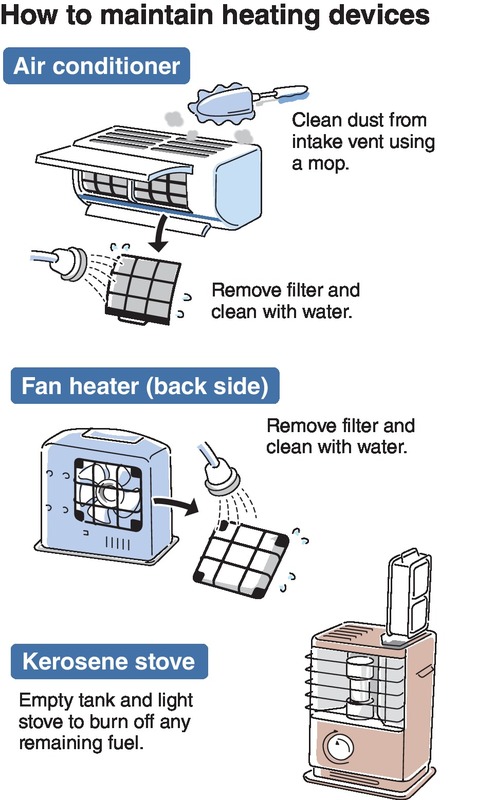
Cleaning the inside of an air conditioner requires a specialist, but anyone can take care of the filter and intake duct.
To be safe, make sure to unplug the unit first.
Remove the filter and use a vacuum to remove the dust. If you take it to the shower and wash it, it will become cleaner. When there is a lot of dust, scrub it gently using a sponge, taking care not to damage the mesh. Wet dust can harden and plug the drain.
New devices often have self-cleaning functions, but sometimes they have to be cleaned manually.
The intake duct is usually on top. Use a long-handled mop to remove any dust. When finished, turn it on and check for any abnormal smells, unusual noises or leaks of water.
"Be sure to check if the outdoor unit isn't plugged with dust," Maida said.
Burn off kerosene
Dust is also the enemy of fan heaters. Clean the filter and intake duct as described above to maintain the airflow volume.
Check the cord for damage, too. The cord could have been internally damaged while being stored with other appliances and furniture in the closet. It might have been stored with heavy items on top of it.
For kerosene stoves, it is effective to empty the tank and burn off any kerosene that remains on the wick. This removes any impurities from the wick and makes the stove easier to light.
Many people use kerosene left over from last winter, but this should be discarded because the deteriorated kerosene can damage the stove.
Fans and other appliances that were used during the summer should be put in storage.
"If you store your summer and winter appliances in the same place, it's easy to replace one with the other," Maida said.
Don't beat down quilt
As it chills at night, you want to sleep in comfortable thick futons, don't you? But winter futons have been kept for months in the closet. Some people worry about the smell or that they might have bacteria. Ensure they are placed in the sun before you use them for a good night's sleep.
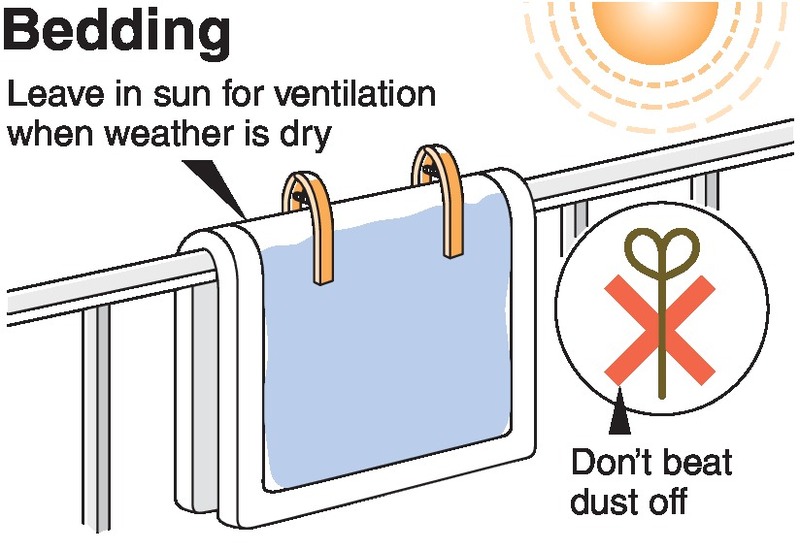
Take the futon outside to a balcony or into the yard in the day when the weather is fine and not humid, and expose it to sunlight and fresh air.
The appropriate amount of time for drying varies, depending on the materials used for the futon. Leave it for one or two hours for one side if it's made of cotton, wool or polyester, and for about an hour if it's a down quilt. Turn it over to dry both sides.
"It's good to dry between 10 a.m. to 2 p.m. when the sun is high," Maida said.
She recommends putting a cover over the futon, as the textiles may be damaged due to ultraviolet rays. A futon drier is an alternative if it can't be dried in the sun.
Down quilts are delicate, and removing dust with a futon beater would damage it, so it is better to vacuum the dust or brush it off using a special brush.
Summer futons should be dried enough to prevent mold or mites before putting in storage. Because they include moisture, ensure that dehumidifying agents are stored with futons in the closet.
Keep your home insulated
Don't forget to take measures for your feet and at the windows.
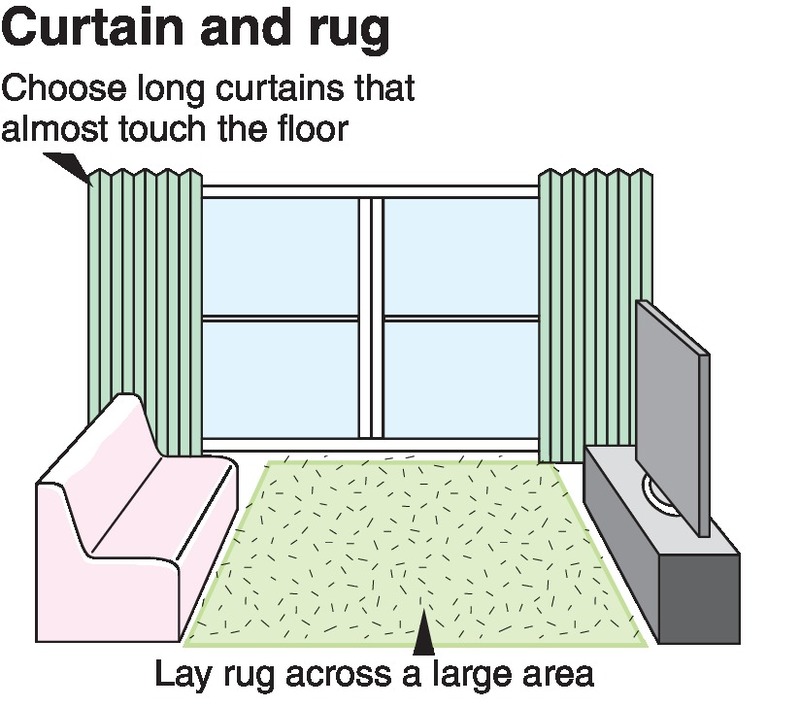
Laying a rug across a broad area provides good insulation. Maida recommends picking a thick textile so that it protects the floor when setting up kotatsu (an electric heater attached to the underside of a table) or other furniture.
She also recommends changing curtains to thick, cold-proof ones. They will block cold air from coming in through the windows and also retain warm air inside rooms, leading to saving on energy costs.
A gap between the end of the curtains and floor also allows cold air in. Before buying new curtains, check the size of the window and buy ones that almost touch the floor.
"Cold air comes in from not only windows, but also the entrance and stairway. Cold-proof items such as partitions are available at the shops, so I recommend using them, along with what you already have at home," Maida said.
Read more from The Japan News at https://japannews.yomiuri.co.jp/