Separate items into groups
As many food items are in the kitchen, a refrigerator is a place that tends to be untidy. Kazumi Fukuda, an expert on "refrigerator storage" who offers techniques to organize refrigerators, gave tips on how to store foodstuffs in the fridge.
Fukuda proposes dividing refrigerated food into two groups: "regular" and "temporary." She also recommends you choose a specific place to store each kind.
Regular items refer to daily foodstuffs that are replaced after being used up. They are consumed every day and play a central role in your diet.
"At my house, those falling under the category of regular items include yogurt, natto fermented soybeans, eggs, milk and seasonings," Fukuda said. Some families might have tsukemono Japanese pickles, tsukudani food boiled in soy sauce and other items on their list of regulars.
On the other hand, temporary items are things not repeatedly stored in the refrigerator -- a list that includes certain leftovers, meal prep items, edibles received as gifts and seasonal dishes.
Regular items like milk and seasonings are generally stored in door pockets. Aside from them, items can be subdivided further.
"Each family should decide their own rules on categorizing, keeping in mind issues such as frequency of use, 'Japanese and Western foods' and 'dairy products and processed foods,'" Fukuda said.
After separating food items into groups, store them by type on trays that are available at 100 yen shops and other stores.
"In this way, it's easy to remove, use and return food items," Fukuda said.
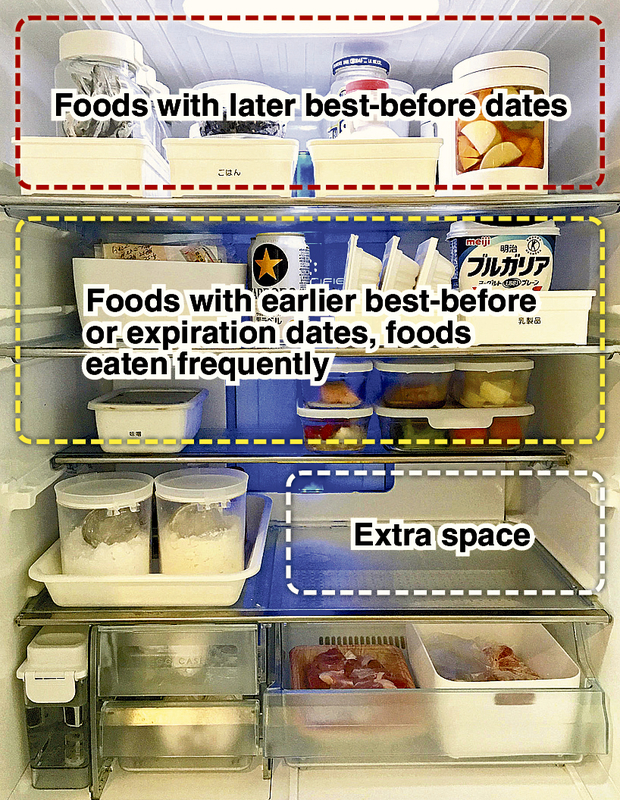
Arrangement is also an important factor. Place food items with longer best-before dates on an upper shelf of the refrigerator, those with short best-before dates or use-by dates on a middle shelf where it is easy to take out and put back.
Place each tray in lengthwise so that one does not block out another, something that also prevents food placed in the back from being forgotten and going bad.
If a tray empties out, do not place other items in it -- try to maintain the organization, and identify what should be purchased.
For temporary items, create a space on a lower shelf of the refrigerator.
"It doesn't matter if it is a little messy. Please keep in mind that this is a space for storing food that should be eaten right away," she said.
Make full use of veggie compartment
The vegetable compartment tends to be messier than the main refrigerator. Since vegetables and fruits that are stored in the drawer are commonly cut before use, the amounts and sizes change accordingly. Therefore, storage methods are subject to daily change.
Since vegetable drawers are deep, one tends to cram various items into it or put one thing on top of another. As a result, the compartment becomes a "black box."
"It's important to make it possible to visually identify instantly what is being stored from above. You should not put one thing on top of another. Effective use of space is also important," Fukuda said.
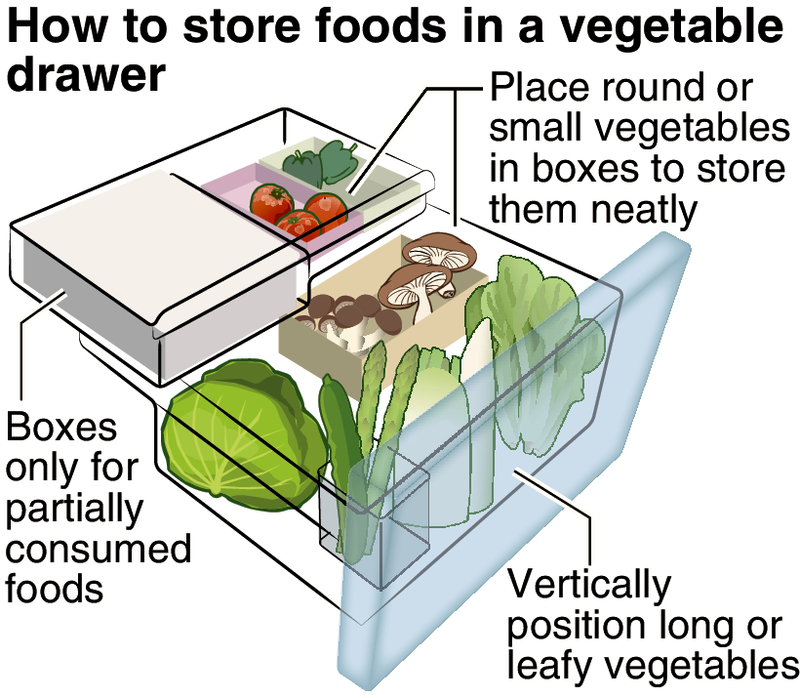
Vegetables and fruits differ in size and shape. Fukuda recommends you separate them according to shape -- for instance, "long vegetables" and "round ones."
To make full use of the space, long food items such as daikon Japanese radish and burdock roots should be placed vertically, setting them along the side. If it's impossible to place them in the compartment, cut them to fit the height of the drawer.
Leafy vegetables such as spinach and komatsuna Japanese spinach should be placed vertically, too. If it is difficult to do so, cut empty plastic bottles to be used as containers.
Once vegetables are cut, wrap them in paper towels or newspaper or put them in food storage bags to prevent cut surfaces from becoming dry.
Round or small food items such as tomatoes, green peppers and mushrooms should be placed in uncovered storage boxes at a height that everyone can find and easily remove. Putting one box on top of another should be avoided because it becomes impossible to see the contents of the items on the bottom.
"Please consider the vegetable compartment a space to store food items temporarily and try not to cram things into it. It is fundamental that you buy only what you need and use it in a timely fashion," she added.
Use containers, labels
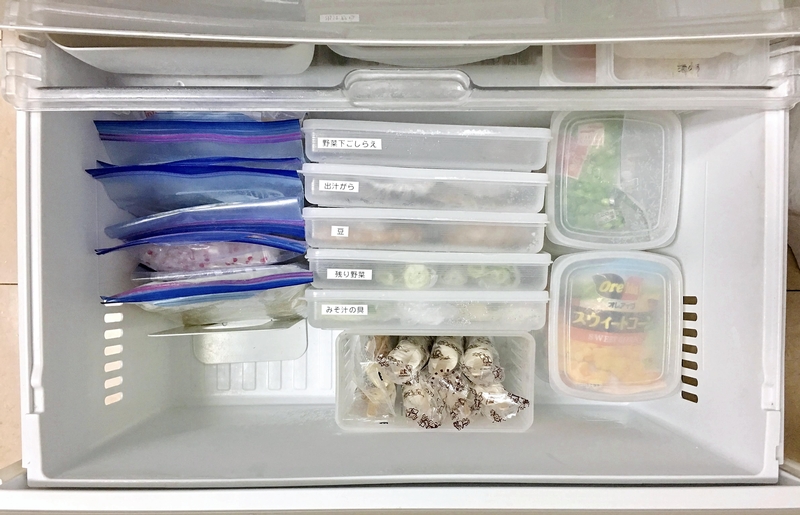
As for the freezer section, drawer-type compartments are common. Fukuda recommends you store items in a manner that leaves them visible from above.
"Place food ingredients in closed containers or zippered storage bags, and arrange them neatly in the freezer section," she said. "You can save space by placing them vertically, just like books."
Prepare multiple closed containers according to size and amount, separate foodstuffs by item and put each in an appropriate container. Put meal prep items in a shallow closed container because it will be easier to use them later.
High-volume frozen food products, such as mixed vegetables and potatoes, should be placed in deep containers after opening without taking the contents out of the bags. Affix labels to all the containers to make their contents identifiable. Since ice cream containers take up space, transfer them to a basket.
"It's hard to organize a refrigerator all at once. Please do as much as you can when time allows, and try to make your refrigerator one that can store food and not lead to waste," Fukuda said.
Read more from The Japan News at https://japannews.yomiuri.co.jp/