On a small block in the East Gippsland village of W Tree, Kay Schieren ducks under the branches of a small gumtree, pushing aside the singed leaves.
“I’ll just pose here with the autumnal colours,” he jokes.
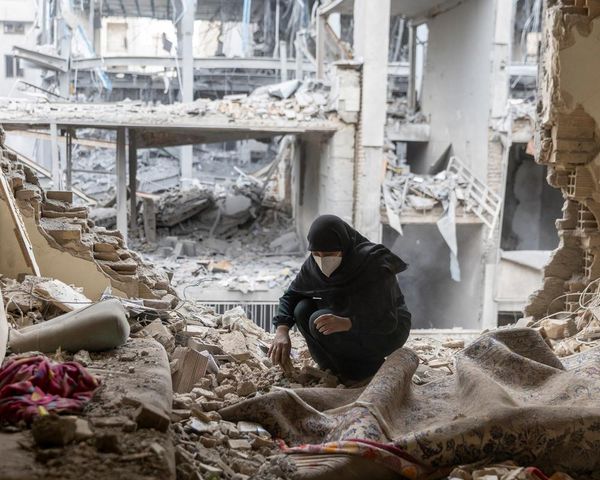
The tree, with its fire-browned leaves, sits between two piles of rubble. One was the 71-year-old’s mud-brick home. The other was a log cabin used by his daughter and her partner. Both are on the western edge of his two-acre block in the Sunshine Farm sustainable settlement.

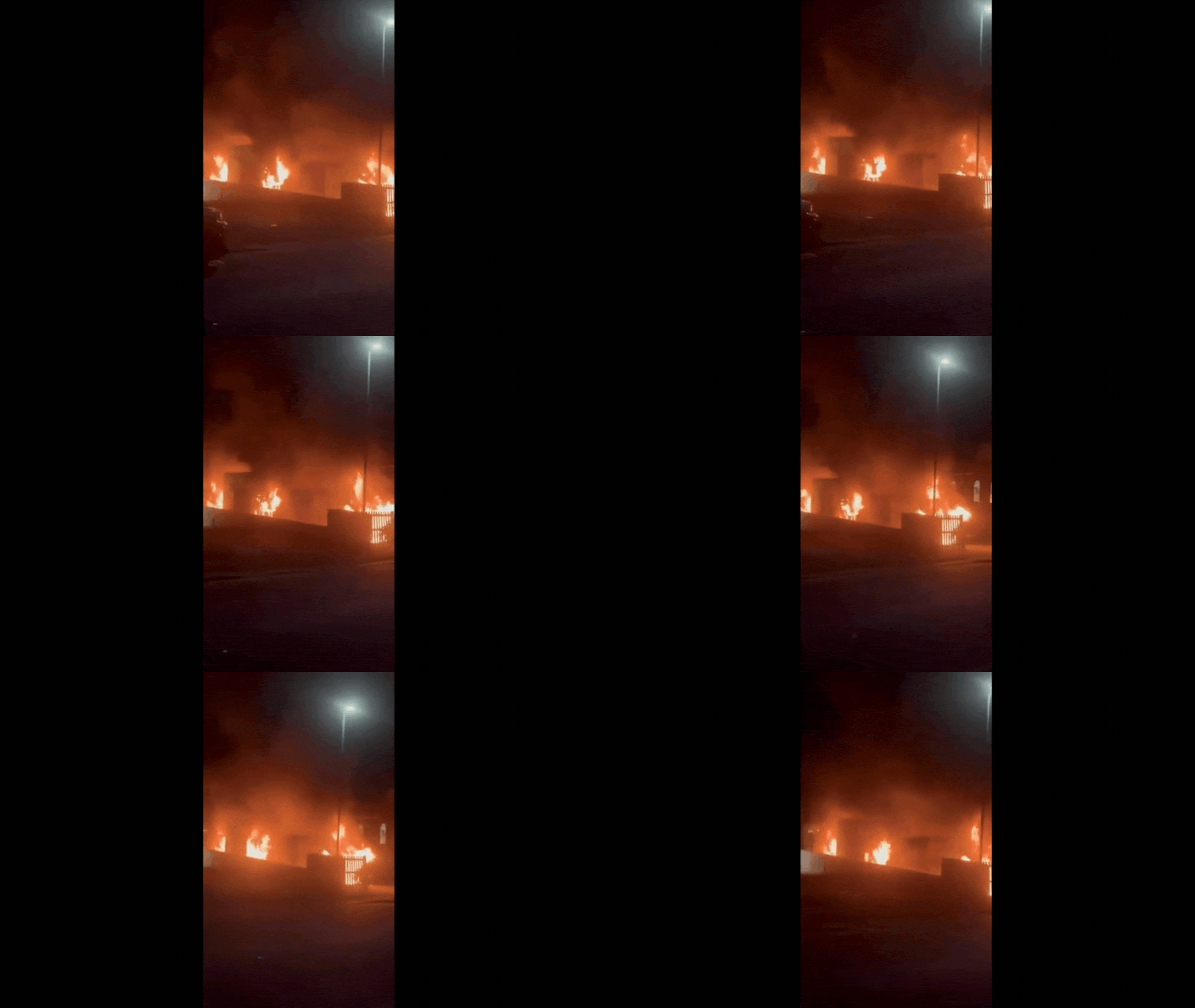
On New Year’s Eve, the fire that had blown past the day before doubled back under a southerly wind and burned just far enough into his property to take out the houses and a selection of Morris Majors, which he was selling for parts. The most valuable bit is the windscreen – they exploded in the heat.
“I sort of never had much, so to me this was amazing,” Schieren says.
He pauses the tour to look bitterly at an agapanthus, which has already sprouted green shoots. “I really wanted to get rid of that.”
‘I am very lucky’
W Tree is 100km north of Bairnsdale and 27km north of Buchan, in the heart of East Gippsland. It sits on the overlap between the Tambo fire complex and the Snowy River fire complex, the two largest fires in a season when more than 1.5m hectares of Victoria have burned, destroying 405 homes and 653 other structures.

Schieren evacuated to Buchan on 30 December, the worst fire day of the summer. He has greeted the loss of his house with the stoicism of a person who has never had much and expected even less.
Now a single age pensioner, Schieren had spent some time on a disability pension after work left him with a bad back. When he bought his home he had $189 a fortnight after tax and was paying $130 on his mortgage. So the thought of starting again with very little – he was insured, but that only goes so far – does not distress him as much as some who had a more comfortable life.
“I developed a habit of doing everything myself out of necessity,” he says. “You have to use your imagination and go to the tip a fair bit.”

There are three old caravans of dubious liveability on the unburned half of the block, next to his overstuffed shed and two handmade solar-electric tricycles. He will stay in one of them.
“A place, a property, owning something, is work. Once I got this cleared up a bit I would be content with this,” he says, gesturing at the old caravan. “But I have to build something legal so the shire don’t kick me out. I would be perfectly happy if my daughter and her young man came to move up here, and leave me to piss off on my trike as often as I can.”
The low-riding tricycle is Schieren’s pride and joy: he has travelled 20,000km on it and, according to his neighbours, raised the blood pressure of every log truck driver in the area who has suddenly come upon Schieren on the steep and windy Gelantipy Road, reclining six inches off the bitumen with a jaunty orange flag above him.
“I get on it feeling my age and at the end of the day I feel about 30 or 17,” he says. “And you can’t beat that, you can’t buy it.
“I am very lucky. I can eat, I can sleep. When you think of all the poor bastards around the world who can’t do that … it’s almost embarrassing how they want to throw money at me at the moment.”

Schieren has been staying in the Buchan Motel for the past month, with his insurance company footing the $140-a-night bill.
Before heavy rain turned the black paddocks green, you could look out the window and see how close the fire got to the centre of town. Schieren spent the night of the fire on the football oval with other residents who remained, listening to the bangs of gas bottles and pops of stockpiled bullets in burning houses.
“Suddenly it was like an atomic explosion; the whole town went up,” he says.
The community lost 26 homes and one person: 67-year-old Mick Roberts, who died trying to defend his farm.
Buchan is welcoming to visitors, but true acceptance takes longer. Schieren, who has lived in Buchan and W Tree for 35 years, is not yet a local, but says he has been overwhelmed with community support. “It’s pretty Buchan good,” he says.
Nowhere else to go
On the oval near the neighbourhood centre, another ring-in, Wayne Watson, is camped in a borrowed Winnebago.
Watson has lived in W Tree, just down the road from Schieren, for five years.

His house was also lost, and he hasn’t the means to rebuild or the inclination to move. Without insurance, and on a disability pension, options are limited.
“I am 58 already, where am I going to go?” he says.
As we talk, the manager of the neighbourhood centre comes by to offer a donated caravan. Watson will live in that and put together two shipping containers to make a large workshop.
“It’s just me on my own,” he says. “I don’t need a fancy house, I don’t need a fancy kitchen. I just need a good workshop.”
Watson left home when the fire got within 5km of his property. The bush had been drying before his eyes for years. He expected the whole village to burn.
“There’s moments where I get overwhelmed with it all, but I have just got to put myself straight,” he says. “At the end of the day I am still alive. Life will go on.”
The rolling hills north of Bairnsdale are lush with grass and topped with brown-leaved trees. There’s a crispness to the air and the fluff of new buds lining the charred eucalyptus trees, adding to a feeling that the risk has passed.
But February is traditionally the hottest and most dangerous month of the year. In the hills north of Buchan, some trees are still smouldering. It would take just one more hot day with a strong northerly wind for the nightmare to begin again.
This is a community that won’t breathe out until winter. And the winter here falls swift and cold. Too cold to sit in an unheated caravan, relying on a diesel generator or solar-powered batteries for warmth.
‘You can’t blame anyone’
At Julie and Bruce Coster’s farm in Sarsfield, 120mm of rain and potash from the fires have produced the thickest grass they have seen in years.

Julie Coster sits in the kitchen of her miraculously unburned house with a fat cat at her feet. The fire burned to the edge of the house paddock, then jumped across and burned down the other side, destroying three sheds and almost 300 bales of hay and silage but leaving the house and garden untouched.
She and her animals evacuated as the trees on their driveway were burning, although Coster does not remember that. She was driving a car with two kelpies and the cat loose in the cabin, towing a float with two nervous horses on board.
“It was like I was just fixed on one thing,” she says. “Someone said to me ‘did you hear the roar?’ and I said I didn’t. I didn’t hear the roar, I didn’t feel the heat. I just said ‘I am out of here!’”
It was a scary experience, one she says people are not prepared for – even if they think they are. “That’s the worst sensation, when you can’t catch your breath,” she says. “I did not like that at all.”
Neil Triggs has spent the day bottling the pale ale at his brewery in Bruthen. “It keeps my mind off things,” he says.
Triggs lost his home and four holiday cottages when the fire roared through Sarsfield, a hamlet 20km north of Bairnsdale and 5km south of Bruthen. Like the Costers, he drove out as the fire hit when it became clear that plans to stay and defend did not account for the ferocity of the fire.

“Within a matter of four or five minutes it just erupted,” he says. “And I said to Carl [a tenant of one of the cottages] ‘we have got to get out of here,’ and we took off.”
Lois Triggs is a cheerful contrast to her worried husband. She evacuated at 12pm on the day of the fire and says she has been “all right from the start”.
“They say men don’t seem to cope with these things as well as the females,” she says.
In between bottling, Triggs fights with his insurance company, which he says is trying to value the house after it has been turned to ash, and meets a volunteer coordinator from Blaze Aid about getting his fencing replaced.
BlazeAid set up a volunteer camp at Bruthen, and coordinator Bruce Savage says they will be in the area for up to nine months rebuilding fences and helping out. Ex-military volunteer group Team Rubicon is also helping with the recovery, but the emotional damage of bushfire is less easily repaired.
“You can’t blame anyone,” Neil Triggs says. “You live in the bush and you have to expect these things. We knew that the fire was coming. Maybe we relied on a wind change, but it didn’t come … and after 3.5 years of drought this place was as dry as a chip.”
Watson, seated on the step of his Winnebago, was more succinct: “Mother nature always wins.”