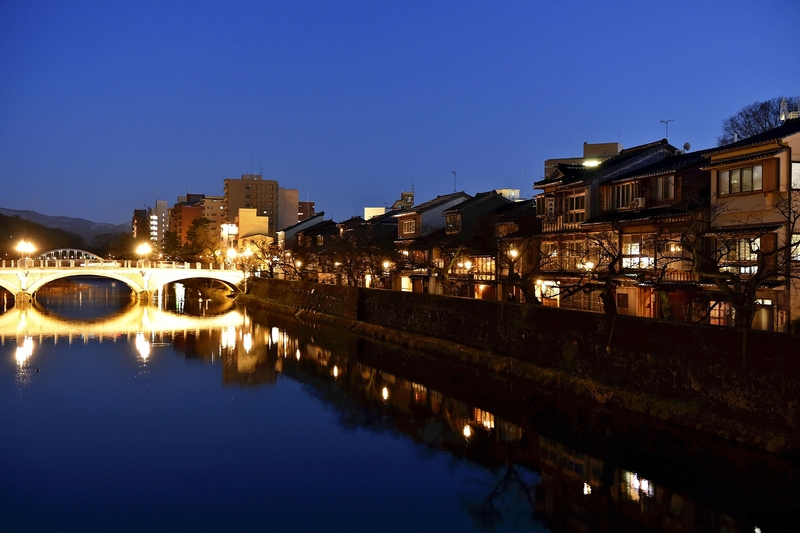
KANAZAWA -- On the left bank of the Asano River, which gently flows through the center of Kanazawa, stand the tightly packed, old-fashioned town houses of the Kazuemachi Chayagai pleasure district. The wooden houses include geisha houses, called okiya, that accommodate geiko, and chaya teahouses, which rent out rooms for banquets attended by geiko, as well as eateries.
I visited Kazuemachi, where writer Hiroyuki Itsuki, now 87, often walked when he lived in Kanazawa when he was young. Compared with the Higashi Chayagai pleasure district on the other side of the river with its crowds of tourists, the Kazuemachi district feels like it is full of hideaways. When the sun sets, the lights from shops and streetlights shine on the river, creating an atmosphere of romance.
Itsuki's 2008 novel "Kanazawa Akari-zaka" (Slope of lights) is set in the town and centers on Rin Takagi, who breaks up with her boyfriend after he chooses work rather than love. She goes through days of disappointment before eventually becoming a geiko.
In the novel, some establishments are depicted under their real names, such as the teahouse Hitoha, where the main character works. The proprietress of Hitoha who speaks politely in the book is modeled on Takako Tsukazaki, 77, who is close to Itsuki. It is not easy to maintain teahouses with times changing, but Tsukazaki said, "I think Mr. Itsuki rooted for [my teahouse] by using the name Hitoha" in his book.
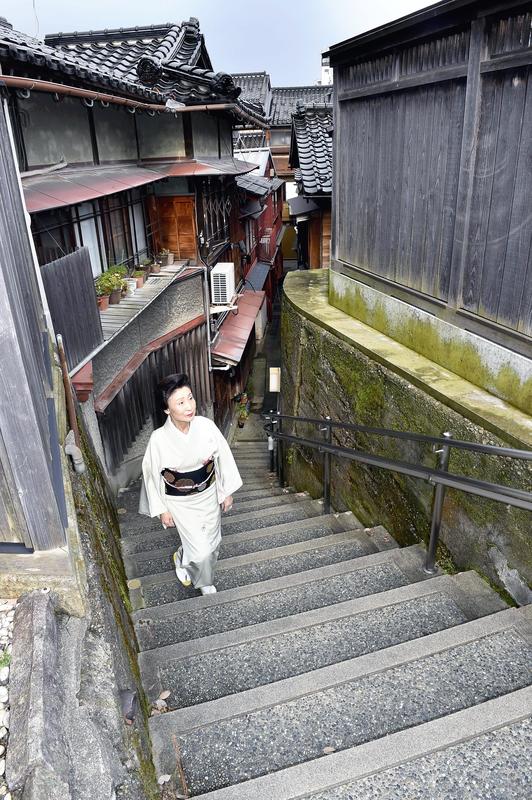
In the town, there are two stone slopes -- one is called Kuragari-zaka (the dark slope), a name is said to have been coined by Izumi Kyoka (1873-1939), a great writer who was born nearby. Another slope initially had no name, but Itsuki named it "Akari-zaka" at the request of local residents.
A monument stands at the slope inscribed with the reason for its naming that reads: "To remember Kyoka, who wrote pieces that are beautiful, like a light in a dark night." This suggests Itsuki wrote the novel because he was fascinated by the world of the great writer.
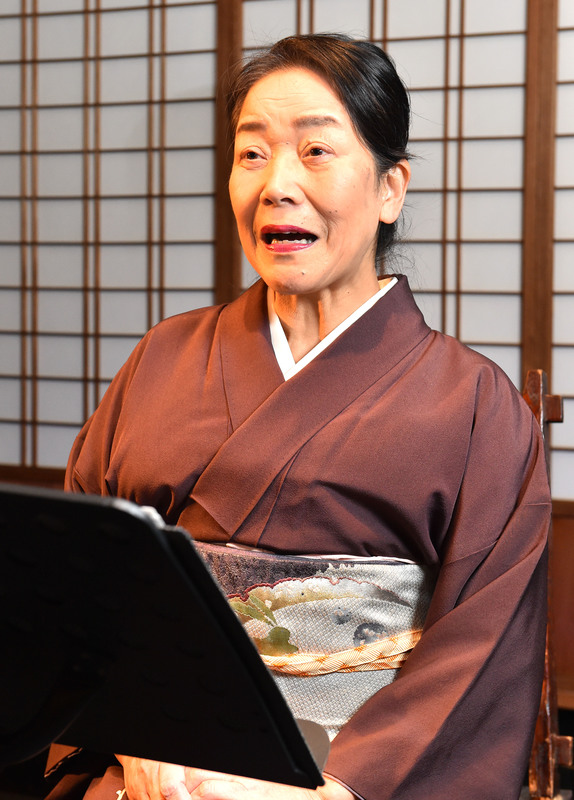
I also visited the Asanogawa Club, a place where local literary works are introduced through recitation, near the district. Machiko Takanawa, 69, who heads the club, has used Itsuki's novel many times for recitation events.
The novel's main character, who is good at playing the flute for wild festival music, confronts an artist who calls himself a flute player beside Asano River on a snowy winter night. In their competition, Takagi gives a powerful performance, helping her dispel the sadness she experienced in the past. The novel ends with Takagi climbing the Akari-zaka slope with a positive attitude about life.
"I sense the inner strength of a woman in a snowy country," Takanawa said of the main character.
When I visited the slope, I could picture Takagi, who lives with a positive attitude, climbing the stone steps. It was just a small slope, but it was full of mysterious charm.
Read more from The Japan News at https://japannews.yomiuri.co.jp/