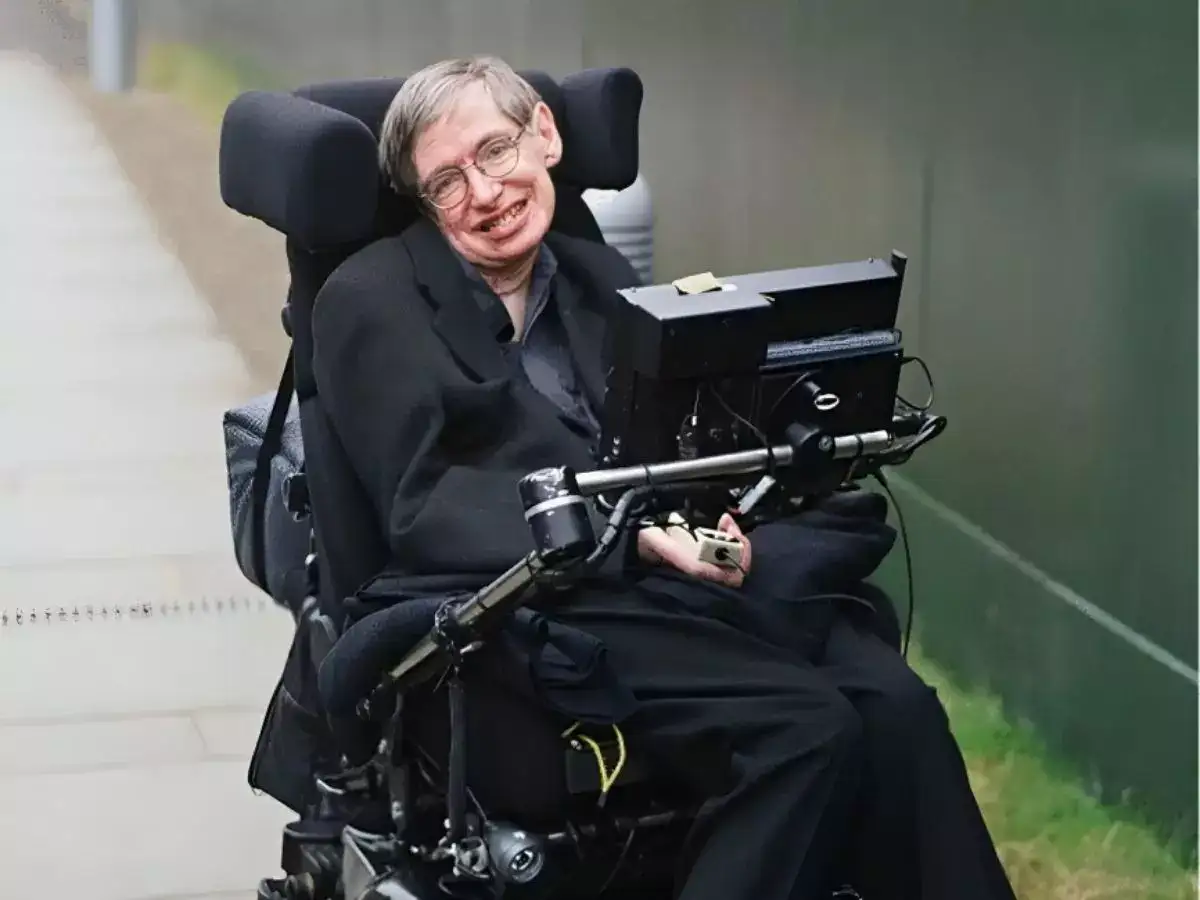
Stephen Hawking’s life lesson, “Intelligence is the ability to adapt to change,” has survived decades because it speaks to a challenge every generation faces. Most people think intelligence is about knowledge, grades, or talent. Hawking believed something different. He believed that the people who thrive are often those who learn, adjust, and keep moving when life refuses to follow their plans.
That belief was not a theory for him. It was his reality. At 21, Hawking was diagnosed with ALS, a disease that gradually took away his ability to walk, write, and speak. Doctors expected him to live only a few more years. Yet the young physics student who was told his future was shrinking went on to transform modern science. He wrote bestselling books, explored the mysteries of black holes, changed how people think about the universe, and became one of the most recognized scientists in history.
Stephen Hawking’s Life Lesson Was Forged Through Extraordinary Adversity
The most remarkable part of the Stephen Hawking life lesson is that it emerged from immense hardship. When ALS entered his life, many would have accepted defeat. Hawking chose a different path. He adjusted his expectations without abandoning his ambitions.
Instead of focusing on what he could no longer do, he concentrated on what remained possible. That mindset reflects a principle found throughout history. The old Japanese proverb says, “Fall seven times, stand up eight.” The wisdom is simple. Resilience is not avoiding failure. Resilience is adapting after it.
Psychologists today call this psychological flexibility. Research consistently shows that people who adapt to changing circumstances experience greater well-being and long-term success. They are not necessarily stronger or smarter. They are simply more willing to change their approach when reality changes around them.
Hawking embodied that principle. As his condition progressed, technology became his voice. As physical limitations increased, intellectual curiosity expanded. Every obstacle became a new problem to solve rather than a final verdict.
His famous book, The Universe in a Nutshell, and his global bestseller, A Brief History of Time, emerged from that relentless adaptability. His life quietly proved another truth often attributed to Charles Darwin: survival belongs not to the strongest but to those most responsive to change.
Why Modern Psychology Supports Stephen Hawking’s Life Lesson
The Stephen Hawking life lesson aligns closely with what psychologists have discovered about growth and achievement. For decades, success was often linked to IQ scores and natural ability. Today, researchers increasingly emphasize adaptability, learning, and resilience.
Psychologist Carol Dweck’s work on growth mindset revealed that people who believe abilities can develop tend to outperform those who view talent as fixed. In other words, adaptability creates opportunity.
This helps explain why some highly gifted individuals struggle while others with ordinary beginnings achieve extraordinary outcomes. The difference is often their response to setbacks.
Consider how businesses, careers, and technologies evolve. Entire industries disappear. New professions emerge. Skills become outdated. Knowledge alone is no longer enough. The ability to learn, unlearn, and relearn has become a competitive advantage.
Hawking understood this long before it became a workplace buzzword. His scientific breakthroughs came from challenging established assumptions. He adapted his thinking when evidence changed. He welcomed uncertainty instead of fearing it.
As another old proverb reminds us, “The bamboo that bends is stronger than the oak that resists.” Adaptability is not weakness. It is strength expressed differently.
What Stephen Hawking’s Life Lesson Means in Everyday Life
Many people read the Stephen Hawking life lesson and immediately think about science. Yet its greatest value may be found in ordinary life.
Relationships change. Careers evolve. Health conditions emerge unexpectedly. Financial circumstances fluctuate. The future rarely unfolds according to a script.
When change arrives, people often ask, “Why is this happening to me?” Hawking’s life encourages a different question: “How can I respond to this?”
That shift changes everything.
History offers countless examples. Abraham Lincoln faced repeated political defeats before reaching the White House. Nelson Mandela spent decades in prison before leading a nation toward reconciliation. Their achievements were not products of smooth journeys. They emerged through adaptation.
Even small daily decisions reflect the same principle. A failed project can become a lesson. A career setback can become a new direction. A personal disappointment can become unexpected growth.
As Winston Churchill once observed, “Success is not final, failure is not fatal: it is the courage to continue that counts.” Hawking’s life adds another dimension: the wisdom to adapt while continuing.
The Lasting Wisdom Behind Stephen Hawking’s Most Famous Quote
The enduring power of the Stephen Hawking life lesson comes from its practicality. It does not promise an easy life. It does not guarantee success. Instead, it offers a realistic framework for navigating uncertainty.
Hawking never defeated ALS. He never escaped difficulty. What he did was adapt continuously for more than five decades. That choice transformed what could have been a tragic story into one of humanity’s most inspiring examples of resilience.
In many ways, intelligence today may matter less as a measure of what we know and more as a measure of how we respond when what we know is no longer enough.
The world will continue changing. Technology will evolve. Challenges will appear without warning. The people who flourish may not be the most talented or the most fortunate. They may simply be the most adaptable.
That is why the Stephen Hawking life lesson continues to resonate across generations. It reminds us that strength is not found in resisting reality but in learning how to move with it.
Similar quotes that echo this message:
“Life is what happens when you’re busy making other plans.” — John Lennon
“The measure of intelligence is the ability to change.” — Albert Einstein
“Difficulties strengthen the mind, as labor does the body.” — Seneca
“It is not the mountain we conquer, but ourselves.” — Edmund Hillary
“What lies behind us and what lies before us are tiny matters compared to what lies within us.” — Ralph Waldo Emerson
“You cannot direct the wind, but you can adjust the sails.” — Dolly Parton
“The oak fought the wind and was broken; the willow bent when it must and survived.” — Robert Jordan
“Every adversity carries with it the seed of an equal or greater benefit.” — Napoleon Hill
“The world breaks everyone, and afterward many are strong at the broken places.” — Ernest Hemingway
“When we are no longer able to change a situation, we are challenged to change ourselves.” — Viktor Frankl
Perhaps that is the deepest lesson Hawking left behind. Intelligence is not merely knowing more. It is becoming more. And every meaningful transformation begins with the courage to adapt.