Life expectancy in the UK has stalled for the first time on record, government statistics show, with the age men and women are expected to reach actually falling in Scotland and Wales.
Data from the Office for National Statistics (ONS) shows that on average a girl born between 2015 and 2017 is will live until she is 82.9 years old, and a boy until he is 79.2 years – no change on the previous figure for 2014-16.
However, in Scotland and Wales, life expectancy has fallen by around six weeks.
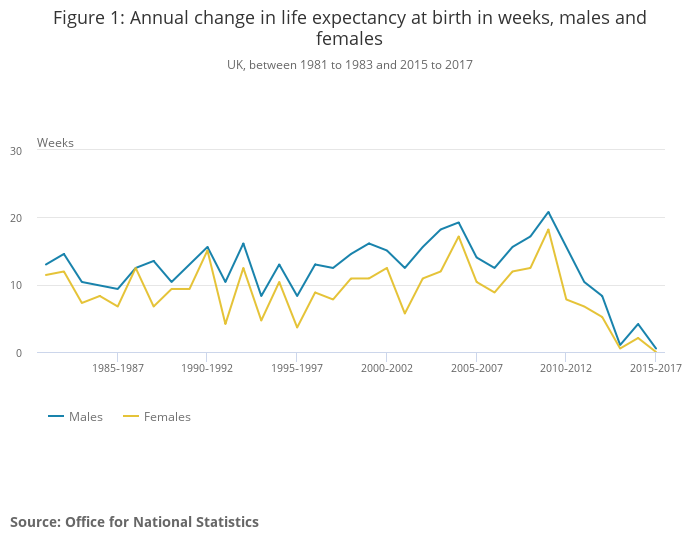
After decades of steady improvements in life expectancy in the UK, figures have shown a slowdown in increases since 2011, remaining consistently lower than in many comparable countries.
Experts said that while the reasons behind the figures were complex, it was clear that income and wealth played a role, and called for "urgent action to loosen poverty’s grip on the health of our nation".
It comes after figures published earlier this year showed that the gap in life expectancy between the poorest and most advantaged females in England had reached a record high, at seven years and five months.
Previous data shows that the highest annual improvements in life expectancy at birth in the UK were in 2009 to 2011, at 21 weeks for males and 18 weeks for females.
Prior to this, the improvements were typically between 10 and 15 weeks per year for men and seven and 12 weeks per year for women
But after the period 2009-2011, there was a sharp drop in annual improvements and the most recent 2015 to 2017 tables show improvements close to zero; the smallest gains in life expectancy since records began.
There have been slight annual decreases in life expectancy in Scotland, Northern Ireland and Wales in recent years, but until 2015-2017, these had been very small at less than two weeks.
The new figures show that in the period 2015-2017, decreases in life expectancy at birth observed around the UK were the largest since the start of the series in 1980, ranging from two-and-a-half-weeks to almost six weeks.
David Leese, policy analysis manager at the independent Joseph Rowntree Foundation (JRF), told The Independent : “The reasons behind the latest figures for life expectancy may be complex but they have to be a wake-up call, especially when it comes to those areas where life expectancy has started to fall.
“Healthy life expectancy for women born in the poorest areas was recently shown to be 20 years lower than for women born in the richest areas of our country, and we need to know why.
"Your income can’t be allowed to take years off your healthy life – nor should where you live determine your opportunities to live well. We need urgent action to loosen poverty’s grip on the health of our nation.”
ONS statistician Sophie Sanders said the decline was in part due to unusually high death rates in recent years – but that it was not clear what was causing this.
“In the last few years, the improvement has been getting smaller and smaller, and we’ve seen virtually no improvement this time round," she said.
“It’s difficult to say in the future where that might go. It’s not easy to predict – mortality has become increasingly volatile in recent years.
“Over the last three years, we’ve seen particularly high rates of deaths, and there’s a lot of debate going on around what is causing this.”
In 2017, the highest number of deaths were registered in England and Wales since 2003, a 1.6 per cent increase compared with the previous year.
Caroline Abrahams, charity director at Age UK, said: “It’s too early to know exactly why improvements in life expectancy have stalled, whether the issue lies at the door of austerity, or perhaps more specifically our cash-strapped health and social care system.
“What we do know is that the recent increases in deaths have been mainly amongst those over 75, and that in the UK we now have lower life expectancy than many other countries, including France, Spain and Italy."
Ms Abrahams cautioned that many older people in the UK lacked adequate support to live well, saying: "The ONS figures underline once more the need to ensure that our health and social care system is funded properly and fit for the future.
“With the rise in life expectancy stalled, politicians must act now to set out a sustainable plan for the NHS and social care, to give us many more people a fighting chance of living well into older age.”