We know all too little in Britain about the vibrancy of Australian drama: we'd rather do a second rate American play any day.
And, having admired Hannie Rayson's Hotel Sorrento in Melbourne a decade ago, I'm delighted to see her latest play breaking the cultural tariff barrier even if it is slightly bursting at the seams.
Rayson's theme is the loss of idealism in Australian life over the last 30 years. To illustrate this she offers a fictional retrospective of a charismatic academic: a radical historian called Peter George who, though born a Geordie, emigrates to Melbourne, inspires generations of students and fiercely resists the transformation of the university into a market-oriented shopping mall.
But Rayson also surveys George through the critical eyes of his three wives: the bourgeois Beatrix, the Marxist-turned-Thatcherite Lindsay and the young post-modernist Poppy.
It is easy to see Rayson's reasoning: that intellectual life is the poorer for the loss of questioning libertarians like George and that we vandalise higher education when we turn it into something purely vocational.
But, fast-moving and entertaining as her play is, it runs into two problems. One is that we have to take the brilliance of George, who corresponds with everyone from EP Thompson to Susan Sontag, on trust: there are times when he sounds more like Howard Kirk in The History Man than a genuine revolutionary.
And, precisely because the play is in part a shagging don story, George's role as a shining idealist in a corrupted academic world is a bit hard to take. Rayson's real interest lies in her female characters who have an instinctive dramatic life.
And much the best of them is Lindsay who moves, entirely plausibly from postgrad radical feminist to Churchillian Top Girl and competitive campus capitalist.
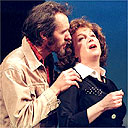
The role is superbly played by Joanne Pearce who, because of the play's time-bending structure, has to turn on a sixpence from youth to maturity and back again: Pearce makes Lindsay as much the play's focus as George in that the character embodies the intellectual betrayal at the heart of Australian, and indeed western, life.
This is the play's great strength. It is excellently directed by Michael Blakemore and ingeniously designed by Peter Davison.
And there are good performances from Stephen Dillane as the permanently tousled, idealistic George, Cheryl Campbell as his amiably conservative first wife and Susannah Wise as their bewildered, underachieving daughter.
Rayson may have tried to cram too much in; but her play bursts with the vitality that is a hallmark of Australian drama.
· Until June 15. Box office: 020-7494 5075.