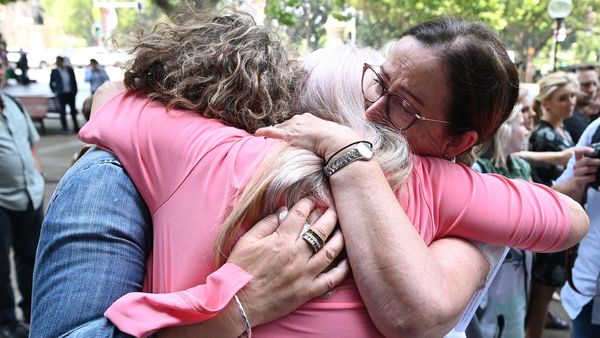
The Canberra Liberals want the ACT government to consider following NSW and impose tougher penalties on people that assault frontline health and emergency workers.
Occupational violence in Canberra's public hospitals gained public attention when a patient with a knife held eight staff hostage in the emergency department on April 22. A year earlier a nurse was strangled by a patient.
Health and Mental Health Minister Rachel Stephen-Smith said 1550 verbal and 1000 physical occupational violence incidents were recorded across the ACT public health system in 2025-26.
Canberra Liberals leader Mark Parton said there was "systemic workplace safety failure" in the ACT's health system.

He called for a review of existing laws and protections, an extension of occupational violence leave and quarterly reporting of incidents.
Stronger punishments would "send a clear signal that violence against healthcare workers is unacceptable".
"We should seriously ask ... whether stronger protections are warranted," Mr Parton said.
"No healthcare worker, regardless of their role, should be expected to tolerate assault, intimidation, strangulation or fear as the price of just showing up to work.
"Behind every statistic is a worker, someone who went to work to care for others and experienced violence themselves."
In 2022, NSW introduced new laws that specifically criminalised obstructing, stalking, harassing, intimidating, assaulting or causing grievous bodily harm to frontline emergency or health care workers.
The maximum penalties for committing these offences against a frontline worker is higher than if the victim was a member of the public.
Mr Parton said these laws should be considered but not "blindly accept[ed]".
Attorney-General Tara Cheyne said occupational ACT prosecutors can use existing criminal laws to prosecute people who offend against healthcare workers.
Ms Cheyne said occupational violence was not an acceptable part of any person's job but raised concerns about replicating the NSW legislation as "creating a new offence for every occupational group" could create "difficult definitional issues" and risk placing some professions above others.
She said specific laws could also "increase the criminal exposure of an already overpoliced and overincarcerated" groups like people with mental health conditions, substance abuse issues or Aboriginal and Torres Strait Islanders.
People committing these offences might be in acute mental health crisis, be drug-affected or have an acquired brain injury.
A 2025 Australian Institute of Criminology report found that people with psychosis were more likely to exhibit aggressive behaviour, and that treating the mental illness could reduce criminal offending.
A 2003 study from the institute found that nearly 90 per cent of studied psychiatric patients had been physically or sexually abused. Psychiatric patients were more likely to be a victim of violence than a perpetrator.
Mr Parton said addressing occupational violence was not intended to stigmatise or harm people with mental illness.
"We can hold two truths at once, that people experiencing acute mental illness, substance dependence, psychological distress or crisis deserve compassionate, evidence-based care [and] healthcare workers deserve to be safe while providing it," he said.
"Supporting vulnerable patients and protecting frontline workers are not competing priorities, they are complementary responsibilities.
"The answer is better system design, better staffing, safer clinical environments, stronger workplace protections, clearer escalation pathways and appropriate security measures, not blame, stigma or neglect."
Ms Stephen-Smith said in many cases patients had dementia or were experiencing delirium when they were violent.
"There is no point in demonising the individuals who are experiencing dementia or delirium or psychosis, that is not helping anybody," she said.
"It doesn't mean we accept it."
Mr Parton also read out a letter he said was from a registered nurse.
The nurse said a significant proportion of healthcare staff work in homes, community health centres and walk-in centres where there are fewer security measures than in hospitals "leaving staff more exposed and with fewer protections".
According to Safe Work Australia, registered nurses have more claims for workplace violence and assault than any other profession.
Ms Stephen-Smith said occupational violence was not unique to the ACT, and was rising in health systems across the world.
"For many years our leadership teams, our management teams, have had a focus on addressing occupational violence," Ms Stephen-Smith said.
"I completely reject the premise that there is a lack of transparency regarding occupational violence in ACT public hospitals."
Canberra Health Services held a forum on occupational violence on May 6 following the emergency department incident on April 22, which was reported on April 27.
Canberra Health Services has an Occupational Violence Action Plan 2024-2028 and a prevention and management committee.
Ms Stephen-Smith also said emergency department staff had told her that "the constant re-litigating of these issues is causing distress to emergency department staff themselves, particularly when the matters are misrepresented in public".