Since there is, as yet, no vacancy and no challenge, there are no formal alternative candidates for the Liberal leadership. Of course not.
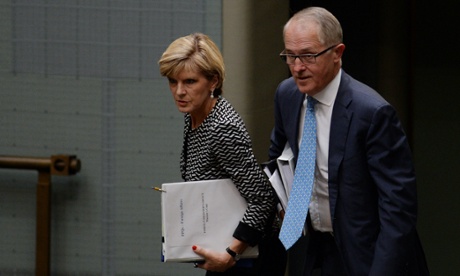
And just say someone moves a spill motion in next week’s Liberal party room meeting and it is carried, the two most mentioned names – Malcolm Turnbull and Julie Bishop – could both stand, or more likely the pair, who are close friends, could come to an arrangement with one another.
Whichever way, Liberal MPs are assessing the contenders’ relative merits.
Turnbull has always been the “voters’ choice” candidate, the one the Liberal party might turn to if it were facing electoral oblivion, the candidate with broad appeal.
As Turnbull noted in a speech to the National Press Club in 2011, ‘’You don’t win elections by persuading your most devoted supporters to cast a vote for you with even more enthusiasm than they did at the last election.
“You win elections by persuading people who didn’t vote for you at the last election to vote for you. Elections are always won at the centre.”
But recent polls suggest Bishop’s profile and standing as foreign minister and deputy leader have seen her close the popularity gap.
This week’s essential poll still had Turnbull ahead as preferred Liberal leader on 24%, but with Bishop now close behind on 21%, and Tony Abbott trailing on 11%.
Turnbull’s problem has always been bitter animosity over the stance he took as Liberal leader in 2009 supporting the former Labor government’s emissions trading scheme. It precipitated an open revolt, led by conservative climate sceptics, which brought on the leadership spill Abbott unexpectedly won by a single vote.
Many of Turnbull’s detractors say he would have to make concessions to the party’s conservative right on climate policy before they would even entertain his return to the leadership.
But in a way he already has. Late last year on the ABC’s Q&A program he said that “emissions trading schemes have worked better in theory than in practice”, and that Direct Action should be given a chance to work, with Australia considering what further policies it could adopt after the global meeting on a post 2020 climate agreement in Paris at the end of this year.
“If there is a global agreement that requires larger cuts in emissions – and I think that would be good if there were, but it’s got to be a global agreement – then obviously Australia would play its part and the government would consider what changes or extensions or whatever to Direct Action would need to be made to achieve that,” he said.
But he also repeated the fact that Direct Action would get “very expensive” if it had to drive deeper emissions reductions – a fact that will confront any Liberal leader but which sections of the party remain unwilling to accept.
The same critics argue Turnbull’s previous stance on climate policy would prevent him “taking the fight to Labor” at the next election since the opposition leader, Bill Shorten, has vowed to continue with some form of carbon pricing as his policy, assuming the debate will not have shifted by that time.
As leader he was also accused of being high-handed, domineering and of not consulting. Turnbull always bristled at the suggestion that he hadn’t consulted, but has also done a lot of bridge building with his colleagues in the past seven years.
Bishop’s career trajectory, by contrast, has been one of surviving as a deputy to three Liberal leaders, and of voluntarily standing aside as Turnbull’s shadow treasurer to become shadow foreign affairs spokeswoman when the view developed – in part because of some heavy backgrounding by ambitious colleagues – that she was failing in the job. (She also made few blunders as shadow treasurer, including getting the current interest rate slightly wrong in an interview and allegedly plagiarising some sentences from the Wall Street journal in a speech.)
As foreign minister she has shone and her standing grew with her handling of the downing of MH17. She has clearly been broadening her public image, she is popular with colleagues and politically close to Turnbull. And while she has always been loyal to Abbott she has clashed with his powerful chief of staff and gone around the prime minister’s office when it blocked her bid to attend United Nations climate talks late last year in Peru.
Bishop, were the day to come, would also confront the extra challenges of a woman in a position of leadership, although it’s not clear whether she believes there are any. She does not identify as a feminist and accused the former prime minister Julia Gillard of playing the “victim card” with her famous misogyny speech. And in Harper’s Bazaar, which named her 2014 Woman of the Year, she advised women to “Stop whining, get on with it and prove them all wrong.”
And of course both Turnbull and Bishop would face the same dilemma that confronted Julia Gillard when she overthrew Kevin Rudd. They both sat in the cabinet that approved (almost) every decision of the Abbott government.