On the green next to Bristol University’s neogothic Wills Memorial Tower, fresh-faced young people sprawl or sit cross-legged in small groups in the early April sunshine, eating food out of paper bags and scrolling through their smartphones.
Here, in the constituency of Bristol West, full-time students are estimated to make up 24% of the adult population. Although that includes 16- and 17-year-old non-voters, it is sizeable enough for the hotly contested seat to be considered in some quarters to be one of a handful where the student vote could tip the balance of power from Lib Dem to Labour.
In its analysis, the Higher Education Policy Institute looked at a potential extra Lib Dem to Labour swing, on account of the party’s U-turn on scrapping tuition fees. However, as the Guardian found out after a day spent on campus and with three of the most prominent candidates, the reality is far from simple.
Bristol West, a mixed constituency that covers the city centre, the affluent suburb of Cotham, deprived inner city areas including St Pauls and Easton, as well as being home to the main student vote, is also the Green party’s second key target seat after Brighton Pavilion. In Bristol, among students at least, their campaign has muddied the waters of what was an intense Lib Dem/Labour race.
“Here it’s Greens and Lib Dems, right?” said one first-year medical student, voicing a common misperception among many Bristol students.
Although the Green party has seen a surge in support among students, it has done so at the expense of the Lib Dems, according to one recent poll. But the same poll, which interviewed students in their final year, found the Conservatives, rather than Labour, were the most popular party at Bristol University, which has a disproportionately high intake from London and the south. The Greens came second and Labour third.
A significant number of those on campus approached by the Guardian turned out to be Tory voters – often citing the economy, business and their future careers as the main driving force.
Taking a lunch break from their second year studies in Aerospace Engineering, George Greenwood, 20, from Huddersfield, and Danny Lee, also 20, both Tory voters, said their concerns were the economy and defence spending respectively. “I can’t imagine Labour doing very well here,” said Greenwood. “I was going to vote Conservative because they have a good plan. The last five years has yielded good results.”
Lee, who plans to join the army after his degree, is convinced by Tory defence promises, which include a pledge not to cut the army below 82,000. “The Greens hate the military, so not them” said Lee. “Labour are wishy-washy on defence. What Conservatives put in their manifesto convinces me.”
The headache for political parties when considering the student vote is threefold: they represent a highly mobile group, making them difficult to track, pin down for registration, or keep data on. They can choose to register in either their home or institution’s constituency, making them more unpredictable, and, even in a left-leaning city like Bristol, they do not represent a clear-cut voting group.
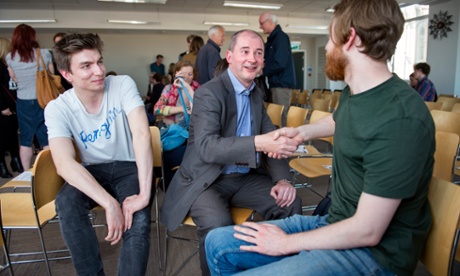
At her campaign office in the Communications Workers Union in Lawrence Hill, where volunteers are busy phone canvassing, Thangam Debbonaire, the Labour candidate for Bristol West, said that, in a seat with a large young population, she is focused on young people, but not exclusively students.
“Bristol students are far from homogenous, far from being the leftwing students of my younger days,” said Debbonaire, recalling how she lost her voice at a meet the candidates event at the university in March, such was the political interest.
Asked whether they could help win the seat for Labour, she said: “The truth is, I don’t know. We don’t have as much data on students as we have on the settled population. I’d like to think that students would vote Labour because a huge amount of what we are saying is about young people. I want my nieces’ and nephews’ generation to be able to rent, let alone buy a house here. It’s about young people as a whole rather than students per se.”
Even the issue of tuition fees, which has continued to haunt the Lib Dems – a few days ago they were branded “liars” by the NUS in an advertising campaign because of the post-election u-turn – fails to unite students here. While fees are an issue among some, those from wealthy backgrounds shrug them off as a “graduate tax” and argue that for those on low incomes, there is extra support.
At Balloon, the newly decorated Union bar and cafe, where students sat with laptops at blond wood tables, Josh and Rob, two economic students who were reluctant to give their surnames, were confident their high earnings in the future would quickly relieve them of their debts.
Rob, 20, from Chichester, who is registered to vote in Bristol, said: “It’s quite an ignorant view but I don’t care about the fees. You pay it back really slowly and you don’t notice. They could charge so much more, but it’s worth it – Harvard charges something like £60,000.” Harvard tuition fees for 2014-16 were $43,000 – about £28,000 annually, or £85,000 for three years.
He said Labour’s plan to reduce fees from £9,000 to £6,000 was misguided. Under the current system, only graduates earning more than £21,000 a year need to pay it back and it is written off after 30 years.
“If you are not earning a large amount as a graduate, it won’t make any difference,” said Rob, who said he was “definitely a Tory person” but would vote Lib Dem in order to keep Labour or the Greens out in Bristol West. “It will benefit the exact people they want to hammer in every other one of their policies.”
Josh, 20, from Cirencester, said: “People like us, who will end up doing quite well, it will benefit us.”
However, back at Wills Memorial Green, Evie Bleach-Lawrence, 19, a sociology student from Derbyshire, said she was voting for the Greens partly because of their policy to scrap fees.
“Tuition fees put a lot of people off and I don’t want my children to be put off going to uni based on my economic position,” she said.
Bleach-Lawrence and her friend, Alice Aitchison, 18, who was undecided between Labour and the Greens, believed they were in the minority. “A lot of people’s parents here vote Conservative and I think students are influenced by that,” said Aitchison.
The incumbent Lib Dem MP, Stephen Williams, had a 20% majority in 2010, with 48% of the vote, aided in some part by his popularity among the town’s many students. But that was before the party’s U-turn on tuition fees.
At Caffe Gusto Siesta, in Clifton Down Shopping Centre, where Williams was taking a quick break between campaign events, the MP since 2005 acknowledged that he may lose votes among students over his party’s u-turn on tuition fees.
Williams, the party’s education spokesperson during the last term, said he abstained from voting for the tuition fee package in 2010, partly because he had worked to improve it to benefit mature students.
“The challenge for me to get across is that we have been in a coalition, not a Lib Dem government,” said Williams. “It’s very frustrating.” Williams, in common with Debbonaire, expressed concern about the Green party splitting the vote. It wouldn’t surprise him, he said, if the Greens took 8-10%, as opposed to 3.8% (they lost their deposit at the last general election).
“I’m worried that the Greens deliver simplistic messages,” he said. “But if you explain to them that the Lib Dems have a seat here and that my party, which is interested in the environment, wants to be in government, wants a coalition government. The Green party doesn’t want to be in government. But they could well determine the outcome here. In a seat like this they represent the anti-establishment.”
Fifteen minutes’ walk from Clifton Down, at a coffee shop in Park Row, the Guardian caught up with Darren Hall, the Bristol West Green party candidate, fresh from a campaign event on Green business. He expressed surprise over polls showing the large number of Tory-voting students at Bristol. While the town’s other university campus, the University of the West of England, lies outside the constituency boundary, many of its students live within the seat, Hall said. It is these students, he believes, more likely to be vocational students, who will vote Green.
“Bristol is a divided city because of health and wealth inequality,” says Hall. “A lot of people under 30 have been responsible for the Green surge.”
“Students are angry about the Lib Dem U-turn on tuition fees, it comes up at hustings all the time. I hear from students who are choosing lower paid jobs, under the £21,000 threshold in order to avoid paying off student debt. I’ve been surprised at the amount of people who say they are never going to pay their student loans. ”
Hall said: “Politics is wide open because of the Lib Dems’ difficulties. At worst this is a three-way marginal, but it could be a two-way between us and Labour. What’s interesting is that if voters think we can win if they are much more likely to vote for us.”
• This article was amended on 5 May 2015. An earlier version referred to Clifton Downs, rather than Clifton Down, and to Park Road, rather than Park Row.