

Lunchtime summary
- An Ipsos MORI poll has shown that Labour is now seen as much more divided, extreme and out of date than it was before the general election following the election of Jeremy Corbyn as leader. The findings, from the firms’s detailed September political monitor survey, are not all bad for Corbyn, but overall there is more to worry the party than to reassure it. The negative findings include:
1 - A striking increase in the number of voters seeing the party as divided (75%, up 32 points since April), extreme (36%, up 22) and out of date (55%, up 19).
2 - Corbyn having worse ratings than Ed Miliband in April on being a capable leader, being good in a crisis, having sound judgment, understanding the problems facing Britain and being out of touch with ordinary people. On all these measures except for being out of touch, David Cameron also beats Corbyn. But although Corbyn’s ratings are lower than Miliband’s on these five measures, the differences are small.
3 - Corbyn has a net satisfaction rating of -3. According to Mike Smithson, this is worse than for any Labour leader from the time of Michael Foot in their first Ipsos MORI poll.
Corrected chart showing Corbyn's opening Ipsos MORI ratings compared with other LAB leaders. pic.twitter.com/KE12uwqWAx
— Mike Smithson (@MSmithsonPB) September 24, 2015
But there are some more encouraging findings for Corbyn.
1 - Corbyn is more liked than Miliband was in March. Some 37% of voters like him, compared to 30% liking Miliband in March.
2 - Corbyn easily beats Miliband’s ratings in March on having a lot of personality (41%, compared to 20% for Miliband) and he beats him too on substance (only 25% think he is more style than substance, compared to 30% for Miliband) and on having a clear vision for Britain (47%, compared to Miliband’s 45%).
3 - Corbyn easily beats Cameron on not being out of touch with ordinary people, on being more honest than most politcians and on having substance.
4 - The Tories’ overall poll lead is just five points. Ipsos MORI puts the Tories on 39%, Labour on 34%, the Lib Dems on 9%, Ukip on 7% and the Greens on 4%.
- Liam Byrne, the Labour former cabinet minster, has described Jeremy Corbyn as the “craft ale” of the labour movement – authentic and flavoursome – and a leader who can start the Labour party on the route back to power. Byrne made the comment despite being one of the authors of a report saying voter distrust of Labour’s use of taxpayers’ money is an existential threat to the party. Heidi Alexander, the new shadow health secretary, is also a joint author of the Red Shift pamphlet.
- Labour has accused Nicola Sturgeon of playing games with the trade union movement after the Scottish first minister appealed for a joint front to attack Conservative reforms of trade union law. As Severin Carrell reports, Sturgeon wrote to Corbyn, the Labour leader, on Wednesday to ask him to back a Scottish National party effort to devolve trade union and employment law from Westminster to Holyrood. She said Scotland had a golden opportunity to defend union rights on strike action that are being eroded by the UK government’s trade union reform bill if the Scottish parliament were empowered to have different legislation to the rest of the UK. A Labour source said the party could not back this measure because it wanted to defend trade union rights across the UK, and claimed Sturgeon was deceiving people that a fresh amendment to the Scotland bill was likely to be accepted in the Commons.
- George Osborne has brushed off suggestions that his grand-scale tour of China at the head of a large delegation was designed to make him appear prime ministerial. As the Press Association reports, when this suggestion was put to him, he replied:
This is all about me doing my job as chancellor. Bringing the jobs and investment to Britain, making sure that the British economy and the plan we have for its future is one that fits in with what is going on in the world. It would be so easy as finance minister to stay in Number 11 and stay in the Treasury and not reach out to the rest of the world and say ‘Come and invest in Britain’. But I’m not that kind of chancellor.
That’s all from me for today.
Tomorrow I will be blogging from the Ukip conference in Doncaster.
Thanks for the comments.
Updated
I’ve updated the Why Labour lost reading list at 12.26pm after getting suggestions from readers. You may have to refresh the page to get the update to appear.
Here’s a Jeremy Corbyn reading list.
Successful party leaders marry the enthusiasms of their supporters to the mood of the wider electorate. By this test, Jeremy Corbyn looks destined to fail. Exclusive YouGov research for the New Statesman finds that the two groups are divided by a gulf that is unprecedented in modern British politics.
Those who voted for Jeremy Corbyn overwhelmingly describe themselves as left-wing. They reject capitalism, and they admire Tony Benn more than they admire Tony Blair. Two-thirds of them want to abolish private schools and the monarchy, and favour higher taxes to pay for greater welfare.
Labour’s target voters think none of these things. Nor do many current Labour supporters.
YouGov polling for New Statesman showing gap between views of Corbyn supporters & potential LAB voters pic.twitter.com/XMed4MZeS2
— Mike Smithson (@MSmithsonPB) September 23, 2015
While the left of the party have been building, Labour’s mainstream has lazily relied on the strength of the party machine and the profile of the leader. It is not a coincidence that this summer the moderate candidates were swamped on social media by so called Corbynistas. They don’t have a gang to fight for them. Facing ‘movement politics’, they had only the strength of their argument. In politics, that is never enough.
Jeremy Corbyn didn’t win this election thanks to miscreant entryists, he won a majority among members and among legitimate Labour supporters. He didn’t win it because he’s personally charismatic. He didn’t even win it because Labour members suddenly surged to the left. He won because people were fed up with a tired status quo, and because Labour’s mainstream failed to organise and renew.
This leadership contest was the New Labour phoenix going up in flames. Labour must now be reborn from the ashes. Jeremy Corbyn knows what party he wants to build. The question is: does everybody else?
Around Westminster you hear of an interesting distinction that’s being drawn by critics of Jeremy Corbyn. There will be policy areas he’s allowed to meddle with, they say, and some that are “no go” areas that could spur walk-outs from his team – there will be “sandbox” issues he can play with (like housing, attacking Spending Round cuts, some though not all welfare changes) and issues like Trident, defence, Northern Ireland and Europe that are deemed amongst those outside the sandbox.
That language will goad Jeremy Corbyn’s many supporters. Some of them have already looked at the frontbench appointments and muttered that it doesn’t look radical enough. Others say, knowing her favourites, that it looks exactly like the frontbench team Rosie Winterton, the Chief Whip, would like to appoint and probably is exactly that.
Here are those Ipsos MORI figures in detail.
Ipsos MORI/Standard poll on Cameron vs Corbyn http://t.co/Dx8eHfXtGU pic.twitter.com/TmBGxko6Dt
— Mike Smithson (@MSmithsonPB) September 24, 2015
Given that Labour clearly is divided, the Independent on Sunday’s John Rentoul is surprised only 75% are saying that it is.
75% say Labour is divided. What's the matter with the other 25%? http://t.co/qMiSEUnknA
— John Rentoul (@JohnRentoul) September 24, 2015
Updated
As the Daily Telegraph reports, Kerry McCarthy, the new shadow environment secretary, has said that “meat should be treated in exactly the same way as tobacco, with public campaigns to stop people eating it”. She made the comment in this interview in Viva! in the spring, before the election. More recently she clarified her views on Farming Today, saying she accepted that we have a lifestock industry and that it needs to be economically viable.

Why Labour lost the election - A reading list
Earlier I said the bookshelves were groaning with reports trying to explain why Labour lost the election. (See 9.08am.) In the comments BarryPearson has helpfully compiled a list.
I’ve read most of these, and they’re good, although many of them are quite similar in their analysis, arguing that Labour lost because it was not trusted on issues like the economy, immigration and welfare, and because voters did not warm to Ed Miliband.
Here are some others I would add to the list.
Dan Jarvis’s Reconnecting Labour report (pdf), which focuses on how the rise of Ukip contributed to Labour’s defeat.
Feeling Blue (pdf), a report by James Morris, Labour’s pollster
Jon Cruddas’s Labour is Lost in England lecture at the Mile End Institute
I’m conscious this list is short of reports with a more Corbynite analysis of why Labour lost. If you are aware of any that I have missed out, please do mention them BTL.
UDPATE AT 1.30PM: Here is one more report worth including - a report by John Curtice for IPPR.
And here are links to five reports with five findings from Jon Cruddas’s review; the link above only takes you to a summary.
First message - Problem with Labour being seen as anti-austerity
Second message - Collapse in working class support
Third message - Labour’s failure on aspiration
Updated
George Osborne, the chancellor, has said that he expects billions of pounds of Chinese money to be invested in UK development projects like HS2, the Press Association reports. It has filed this from China, where Osborne has completed a five-day tour.
Osborne unveiled Treasury analysis suggesting that 265,000 jobs in Britain “only exist because of our links with China” and said his aim was to create hundreds of thousands more.
He hinted that significant new investments could be announced when President Xi Jinping conducts China’s first state visit to the UK for a decade next month.
“I’m pretty confident we are going to get more and more Chinese investment and I think we will have some good announcements in the coming weeks,” said the chancellor.
Osborne’s trip at the head of a large delegation of business figures and leaders of Northern cities has seen him cover thousands of miles and visit four major cities - including the capital of remote Xinjiang province, where no British minister had previously been.
His pledge to make Britain “China’s best partner in the West” was well received by the China Daily - usually seen as a mouthpiece for the Communist government - which drew a contrast with the chilly relations after David Cameron met the Dalai Lama in 2012.
Describing the outcome of the trip as “a win-win result” for China and Britain, the paper’s editorial said: “Compared to the difficult period around 2012, China-UK interactions today present a desirable and harmonious picture under which the two sides are learning to respect each other’s concerns and accommodate each other’s interests, despite their ideological differences.”

Here is another excerpt from the Red Shift report (pdf) that summarises its argument.
In May, the electorate simply did not know who Labour stood for. One voter in Watford told us, “I don’t know [who Labour] stands for anymore. I don’t know if they know what they are about anymore.” Another in Derby said; “Labour used to stand up for working class people – but it has lost its way.”
We’re uncomfortable talking about our English identity – when voters want us to be more patriotic. We haven’t figured out how to talk about our record in a way that works: we suffer a form of self- flagellating amnesia. We’re simply not trusted with public money. ‘Labour just wanted to waste my money’ as one voter told us angrily.
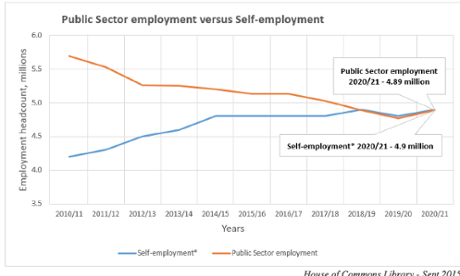
We haven’t grasped the enormity of the radically changing nature of work, the huge rise in self- employment and enterprise. We have little to say about how we’ll create better jobs to replace the ten million British jobs set to be wiped out by technology in the next 20 years. The way we talk about public services belongs to the 20th century, not the 21st. We seem ‘disconnected’ as one young voter told us bluntly.
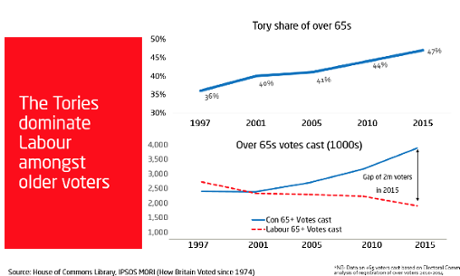
Our appeal is much too narrow. We had little to say to older voters – while the Tory majority amongst pensioners rose to over 2 million votes. We struggled to connect with people who were doing OK, ‘living in the new build estates’, as one party activist put it. And all too often we failed to talk to young people in a language that works – and we left the conversation much too late. Many young voters, growing up in swing voter households, simply don’t feel equipped with the information they felt they needed before they would support us. And finally, our ground game, was simply out-classed. We had millions of ‘transactional conversations’ when voters wanted a party more serious about building a relationship.
And here are two graphics from the report that are interesting.
This one shows how self employment (the blue line) is expected to overtake public sector employment (the brown line). It is based on projected figures, and runs from 2010/11 to 2020/21.
And this one shows how the Tories are increasing their share of the over-65 vote.
My colleague Patrick Wintour says Labour members are trying to get an emergency motion debated at next week’s conference that would commit the party to opposing air strikes against Islamic State in Syria without UN authorisation.
Emergency motion on Syria circulating for Labour conference rejecting UK air strikes without explicit UN authorisation, & other conditions.
— Patrick Wintour (@patrickwintour) September 24, 2015
The Green party conference starts tomorrow. Amelia Womack, the deputy leader, has announced that the party will be asking members who attend to contribute money for refugees at Calais.
Here is some Twitter reaction to Liam Byrne’s interview.
Deborah Mattinson, a former Labour pollster, says being associated with a “craft beer” is actually a liability.
Useful LiamByrneMP report but ironic that he describes Corbyn as 'craft beer' (authentic). Voters use same term for Labour's 'poncification'
— Deborah Mattinson (@debmattinson) September 24, 2015
David Aaronovitch, the Times columnist and no Corbyn fan (to put it mildly), found Byrne’s defence of Corbyn unconvincing.
The New Politics was not obvious in the mangled logic and obvious evasiveness of @LiamByrneMP's defence of Mr Corbyn on @BBCr4today.
— David Aaronovitch (@DAaronovitch) September 24, 2015
But Byrne has launched a Twitter meme.
Ok, if Corbyn is 'craft ale' we need more #LabourDrinks
— David Prescott (@DavidPrescott) September 24, 2015
@DavidPrescott I would have thought @johnprescott would have to be some sort of punch #LabourDrinks
— Michael Dugher MP (@MichaelDugher) September 24, 2015
Chateau Charles Clarke. A full bodied Red Whine #LabourDrinks
— David Prescott (@DavidPrescott) September 24, 2015
Tristram Shandy obviously. And a chukka umunna would be a not very strong cocktail with a little umbrella in it #LabourDrinks
— Barry Lynch (@DrBarryLynch) September 24, 2015
Liam Byrne's Today interview - Summary
I’ve already posted Liam Byrne’s quote about how Jeremy Corbyn could help Labour win back power because he is seen as distinctive, as a “craft ale of the Labour movement”. (See 9.08am.) Here are some other lines from his Today interview.
- Byrne said people did not know what Labour stood for at the general election.
We found that voters really didn’t know any more who Labour stood for. We had lots of people who just thought that we had lost touch with our roots, we had lost our soul, and they just weren’t sure what to make of us. And I’m afraid that went alongside distrust of our record and our plans.
- He acknowledged that the joke “There is no money” note he left in the Treasury for his successor before the 2010 election damaged the party’s reputation.
- He said Labour needed to show that it had a plan, and that it “owned the future”.
What we heard from people is that Labour had lost touch with its roots, Labour had lost touch with the people it had stood for. Now, you’ve got to put alongside that a plan, a bold vision for how, actually, Labour owns the future. So one of the biggest things that I think came through the report is the sense that we didn’t have a plan for business, we didn’t have a plan on the economy. And, actually, if Labour’s going to win a majority in England, we’ve got to be the party of the self-employed, of entrepreneurs, of high-tech jobs with policies, yes, for the people that we’re in politics to change things for but also for the kind of jobs for the future.
- He said he agreed with Jon Cruddas that Labour needed to represent people for whom English identity was important.
I’ve taken the quotes from PoliticsHome.

The space on the bookshelf set aside for reports on why Labour lost the general election is already getting quite full, and today we’ve got another to add to the collection. It’s from Red Shift, a group that includes Liam Byrne, the former chief secretary to the Treasury, Heidi Alexander, the new shadow health secretary, Shabana Mahmood, the former shadow chief secretary to the Treasury, Nic Dakin, the shadow education minister, and Caroline Badley, a Birmingham councillor.
The report proposes 10 “shifts” that Labour needs to achieve to win back England.
It is very critical of Ed Miliband’s “one nation” Labour strategy.
When Ed Miliband tried ‘One Nation’ it was doomed.
The policies did not reflect the brand. One Nation became a label not a policy prospectus.
The One Nation pamphlet – a collection of essays by new MPs published at Conference 2013 – illustrates the point. Designed to show the direction of travel for a new philosophy, it was in fact merely an interesting collection of personal essays by MPs into which the words ‘One Nation’ were inserted to boost the One Nation brand.
But it was brand rooted in nothing.
Byrne is seen as being on the right of Labour, and he backed Yvette Cooper for the Labour leadership, so you would expect him to be sceptical of Jeremy Corbyn. But when he was asked on the Today programme this morning whether Corbyn could help Labour to regain power, he said he could.
I think he can definitely start us on the route back, because one of the things that people said to us is ‘look, we don’t know who you stand for, you used to stand for the man and woman in the street, you used to stand for the people’. And actually what I think Jeremy has done is he’s brought a bit of soul force back to the Labour party. In many ways he is the kind of craft ale of the Labour movement – he’s authentic, he’s got strong flavours, he’s seen as something very different to the bland mediocrity of politics.
The full 29-page Red Shift report is here (pdf). And there is a good summary here, on the Staggers website.
I will be posting more from Byrne’s interview and from the report itself this morning, as well as looking at the reaction it is generating.
As usual, I will also be covering breaking political news as it happens, as well as bringing you the best reaction, comment and analysis from the web. I will post a summary at lunchtime.
If you want to follow me or contact me on Twitter, I’m on@AndrewSparrow.
Corbyn "craft ale of Labour movement. He's authentic, he has strong flavours," @LiamByrneMP: http://t.co/rxPG0I0r8l pic.twitter.com/YEXJstpWI2
— BBC Radio 4 Today (@BBCr4today) September 24, 2015
Updated









Part of why they lost!
This is one of about 8 people or organisations that tell part of the story. Here is the list that I maintain:
1. The Smith Institute: red alert: why Labour lost and what needs to change? By Paul Hunter
https://smithinstitutethinktank.files.wordpress.com/2015/07/red-alert-why-labour-lost-and-what-needs-to-change.pdf
2. The Fabian Society: Never Again - Lessons From Labour's Key Seats, edited by Sally Keeble and Will Straw.
http://www.fabians.org.uk/publications/never-again-lessons-from-labours-key-seats/
3. bbm campaigns: Listening to Labour’s Lost Labour Voters By Alan Barnard and John Braggins
http://labourlist.org/2015/07/research-into-labours-lost-voters-shows-party-faces-existential-crisis/
4. Labour lost because voters believed it was anti-austerity. Jon Cruddas. (Web page, not full report)
http://labourlist.org/2015/08/labour-lost-because-voters-believed-it-was-anti-austerity/
5. The Fabian Society: The mountain to climb: Labour's 2020 challenge. Andrew Harrop
http://www.fabians.org.uk/the-mountain-to-climb/
6. Project Red Dawn: Labour's revival (and survival). Lord Ashcroft KCMG PC
http://lordashcroftpolls.com/wp-content/uploads/2015/09/Lord-Ashcroft-Polls-PROJECT-RED-DAWN.pdf
7. Can Labour Win? The hard road to power. Patrick Diamond & Giles Radice (& Penny Bochum)
http://www.policy-network.net/publications/4963/Can-Labour-Win
8. RedShift: Looking for a New England: The Ten Shifts Labour Needs to Make To Win a Majority in England. Rt Hon Liam Byrne MP, et al
http://liambyrne.co.uk/wp-content/uploads/Red-Shift-Looking-For-A-New-England-FINAL-VERSION.pdf