LGBT rights have come a long way in recent years. In 2015, the US Supreme Court ruled same-sex marriage bans are unconstitutional and the Republic of Ireland became the first country in the world to legalise same-sex marriage by popular vote following a country-wide referendum.However, while stigma against LGBT communities is certainly lessening in some countries, many states continue to criminalise same-sex sexual contact under the threat of imprisonment or even death.
New research published by the International Lesbian, Gay, Bisexual, Trans and Intersex Association (ILGA) serves as a stark reminder of just how widespread such criminalisation can be. In a total of 74 countries, same-sex sexual contact is a criminal offence.
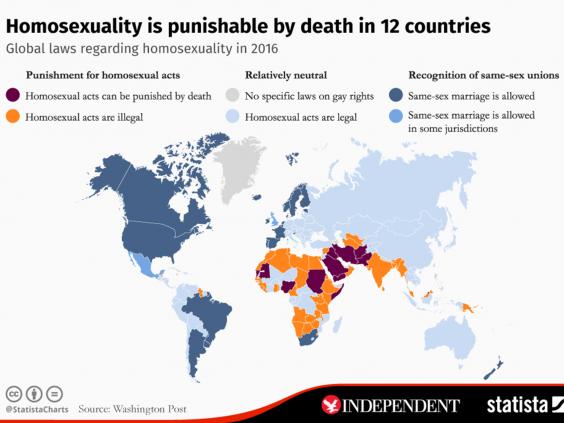
In 13 countries, being gay or bisexual is punishable by death. These are; Sudan, Iran, Saudi Arabia, Yemen, Mauritania, Afghanistan, Pakistan, Qatar, UAE, parts of Nigeria, parts of Somalia, parts of Syria and parts of Iraq.
In 17 countries, bans are in place to prohibit 'propaganda' interpreted as promoting LGBT communities or identities. These are; Algeria, Egypt, Libya, Morocco, Nigeria, Somalia, Tunisia, Iraq, Iran, Jordan, Kuwait, Lebanon, Qatar, Saudi Arabia, Syria, Lithuania and Russia.
Surprisingly, a total of 40 countries retain a 'gay panic' clause which enables people to use as a defence for committing crimes such as assault or murder that they were provoked because the person was gay, lesbian or bisexual.
While the report focused on gay, lesbian and bisexual rights, it is believed transphobic laws and attitudes are also very common as part of persecution specifically targetted at transgender communities.
The report follows research published last week into lesbian and bisexual women's experiences of persecution for their sexual orientation. The research found 'corrective rape' and forced marriages are common in some countries on the basis that this can 'cure' them.
Many countries only criminalise sex between men due to historic penal codes from British colonial rule which define sex as penile penetration. However, a growing number are criminalising sex between women as they believe doing so strengthens laws against men as the countries can assert the legislation is 'gender neutral' and therefore not discriminatory.