Technology has disrupted many businesses, but LG Electronics Inc has embraced it to keep abreast of rapid changes in consumer demand.
The South Korean company has been redefining LG consumer electronics products, providing options for everyday life via its flagship home appliance line-ups, including LG ThinQ, which offers personalised artificial intelligence (AI) for users; LG Signature, with more sophisticated quality for living spaces; and the LG Objet line-up fusing elements of modern furniture with technology for functionality.
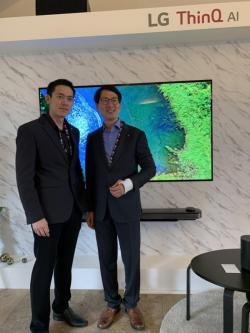
Mr Nipon, left, with Jae Ahn, LG's brand communication director, show off a product highlight display at LG InnoFest 2019.
These appliances seamlessly join with mobile apps and the cloud to facilitate a more personalised user experience, one that constantly evolves through data analysis and interconnectivity to better meet the user's needs.
The products were showcased at the recent annual InnoFest roadshow in Sydney, Australia last week, highlighting LG's living space solutions.
"Understanding that today's consumers want personalised living space solutions over traditional stand-alone products, LG has successfully shifted its focus to providing home electronics as a service," said Steve Song, LG's Asia regional head.
Seung Chul Lee, president of LG Electronics (Thailand) Co, said the local firm will respond to the parent company's policy by continuing to make customers' lives better.
It will launch the first TV with AI technology in Thai language this year before branching out to other home appliance products.
"As Thailand is one of LG's strategic markets in Asean, we will continue to invest and expand the business this year after seeing double-digit growth in sales in 2018," Mr Lee said.
He said Thailand's electrical goods market in 2018 was not as good as expected, but was better than in 2016 and 2017.
LG sales grew at a double-digit rate in 2018, ahead of single-digit growth of the industry.
Key products that drove major growth for LG were washing machines, televisions and refrigerators.
All LG products grew ahead of industry growth, except air conditioners because the rainy season came early.
"It was a cool summer in 2018, but we have high hopes for air conditioners this summer because the weather is very hot," Mr Lee said.
"This is a good sign for sales. During January and February, our air conditioner sales grew by more than 30% as not only the hot weather but also the air pollution boosted demand for air conditioning."
The air pollution scourge in Thailand has helped drive LG sales recently. Some 20 air purifier units were sold daily during January to February, up from only five units prior.
"With people more aware of healthy lifestyles, we will also put more focus on healthy lines this year, including air conditioners, air purifiers and dryer machines," Mr Lee said.
Nipon Wongsaengarunsri, marketing director of LG Electronics Thailand, said the company will allocate more than 300 million baht for promotions this year.
The company will launch more innovative products to lure younger customers, he said.
LG's sales increased by 17% to over 22 billion baht in 2018. The company expects to grow its sales by 15% to about 25 billion baht this year, driven by B2B business including for commercial air conditioners and out-of-home screens.
Of the 25 billion baht, 43% will come from home appliances, 37% from home entertainment, 10% air conditioners and 10% from B2B business, said Mr Nipon.