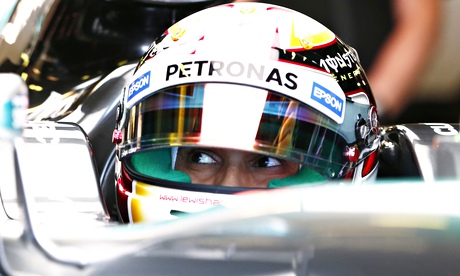
Formula One drivers are usually fitted for their carbon fibre seats well in advance of the new season but Lewis Hamilton is being measured for a gilded chair at the high table of the sport.
He is already among the greats of F1 with 33 race wins; only four drivers in history have won more. And his two world championships – together with the manner in which they were won – place him apart from most drivers, past or present.
But a third world title, the one he really covets because it would place him alongside his idol Ayrton Senna, would establish his position among those at the very top – and he is the short odds favourite to defend the crown he won last November. Then he can be counted among the leading half-dozen drivers we have ever seen, a little behind the holy trinity of Senna, Jim Clark and Juan Manuel Fangio but nudging Alain Prost and Michael Schumacher on the immortal grid. Only nine drivers have won three or more titles; Clark won only two but died at his peak at 32 with his reputation already assured.
So does Hamilton, who was nicknamed Il fenomeno in Italy when he arrived in Formula One like a starburst in 2007, consider himself a legend? At first, he’s a little dismissive. “Not really, no,” he says. “I have no particular cares to be a legend. What does that mean? It’s just an opinion of people, whether you are a legend or not.”
Self-effacement is not normally characterised by the ownership of a scarlet private jet and the pursuit of a celebrity lifestyle underpinned by his status as the only global superstar in his sport. But Hamilton is capable of real humility and, when pushed, adds: “I hope, when I have retired and am much, much older, perhaps in 30 years, a kid might use the word ‘legend’ for me.”
Others do not need to wait 30 years before passing judgment. His former team-mate at McLaren, Jenson Button, who thinks Hamilton will retain his title, says: “He is among the best drivers who have ever driven in Formula One.” The reason he is seen in that light is because Hamilton’s gifts go beyond his already impressive statistics. It is his talent for pulling off passes, for turning seconds and thirds into unexpected victories that make him exceptional.
Nigel Mansell, who won his solitary championship in 1992 and whose record of wins by a British driver Hamilton overtook last season, says: “Lewis is already a legend but he now has an opportunity to do something I never got the chance to do – win back-to-back world titles. He starts this season as the clear favourite. He has great race speed and now has a team behind him that can allow him to dominate the sport for years to come.”
There is a feeling in Formula One that Hamilton could stamp his authority on his time like Schumacher did, even if he is a long way from matching the German’s record of 91 wins and 68 poles.
Pirelli’s motorsport director, Paul Hembery, speaking from the paddock in Melbourne, says: “I would put my money on Lewis this season. His win last season will give him a lot of confidence and give him the edge over Nico Rosberg. And he knows that this is his chance to go into the triple-champion super-status that all the drivers think about. They say that one or two is not enough, but that three takes you into the qualified greats. I don’t know why they feel that way, but I keep on hearing it in the paddock.”
Hamilton’s superior speed will give him the edge over his Mercedes team‑mate Rosberg who, for all his dogged dedication to the cause, knows that he cannot better his rival in wheel‑to-wheel combat. Some observers are even predicting that Hamilton could have the championship wrapped up by September. There is, however, something about Hamilton that makes that scenario unlikely, happily for the sport and those who support it. It is, quite simply, that he is incident-prone.
Ben Edwards, the BBC’s F1 commentator, says: “Lewis is one of those drivers that things happen to, sometimes outside his control. I can’t see him having a totally trouble-free time out there. He might do what Sebastian Vettel did twice in his four wins and dominate the whole season but both championships he’s won were not easy. There have always been ups and downs.”
As for Hamilton himself, there seems little danger of complacency. “There’s absolutely zero danger for me of that, and I don’t for one second believe that my team are like that,” he says. “The team’s as hungry as hell. People keep asking me: ‘Are you defending your championship?’ I don’t feel like I’m defending my championship. I want to win this year. There’s a championship there for the taking. And we might hopefully have a car to fight for it. Damn it, I want to win it. I want to go and grab it. More than ever. Just as much as last year, even more.
“It’s never going to be easy, winning the championship. There were two things, reliability and qualifying, which made it difficult for me last year. We’ve worked on the reliability and if I can improve my qualifying, yes, that will make it a bit easier. But I anticipate that if I am in the fight it will go down to the wire.”
Hamilton talked about how boxing training has helped his fitness: “I’ve been boxing for years. I started out boxing when I was eight or nine. I used to do karate on Tuesday and Thursday every week and then I’d do boxing on Wednesday and Friday.
“It’s a really good discipline. I had the crap beaten out of me in my first boxing match with this kid who was two years older than me and was a real fighter. I had a bleeding nose and everything and my dad told me to go back in there, and I was like: ‘I don’t want to go back in.’
“And I went back in and I didn’t give him one second to punch me. I beat him. So I was overcoming my fear and stuff. I use it today because it’s mega, mega training. It’s good for the reactions, it’s good fun and it’s good to take out whatever issues or feelings you have, you can picture whoever you want on that damn thing, so it’s good.”
But it is Hamilton’s fighting skills on the track that are most impressive. And he is likely to leave everyone else flat on the canvas by the end of the season.