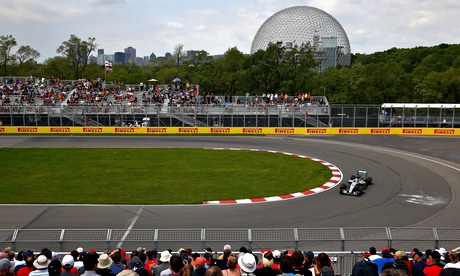
Lewis Hamilton recovered from his misery in Monaco, taking the advantage over his team-mate Nico Rosberg in the first practice session at the Circuit Gilles Villeneuve.
The British driver was quickest early into the session and went on to hold the top spot throughout. Running on the soft tyres, he set a best time of 1min 16.212secs, having put in 34 laps and was four-tenths clear of Rosberg who ran for 38 before Sunday’s Canadian Grand Prix.
Mercedes would expect to be strong here, on a track that features three long straights and, with the Lotus of Romain Grosjean in third and the Force India of Nico Hülkenberg in fourth, they impressed. Ferrari, who brought a new power unit to Canada, upgraded with three of their engine tokens, took fifth. Sebastian Vettel set a time of 1:17.905, a full second and a half back from the leaders but ran for only 25 laps, as the team set the car up. His team-mate Kimi Raikkonen was more than two seconds behind in 12th. Hamilton had run error free on the circuit where he has previously won three times but, pushing in the final 30 minutes, spun at the turn 10 hairpin.
McLaren, too, had brought a new power unit, with Honda also having used engine tokens for upgrades. Earlier in the week, however, Jenson Button and Fernando Alonso had both been keen to play down any great expectations for a major step forward in Canada. Indeed, Button suffered a problem early on, becoming stuck in second gear and losing time in the pits before ultimately completing 25 laps in 15th place, with a time of 1:18.786. Alonso did better, putting himself into ninth with a 1:18.128. Elsewhere, one of the F1 strategy group’s recent recommendations for ways to improve the spectacle of the sport – bringing back refuelling in 2017 – will not be implemented after it has been unanimously rejected by the teams.
The proposal was brought forward last month, alongside other proposals such as tyre-rule changes and increasing the speed of the cars by five to six seconds a lap. Refuelling was last used in 2009 but with the concept now having been addressed by all the teams it is understood to have been not deemed beneficial on various levels.
The major stumbling block is that it would not ultimately increase the spectacle, indeed that it could herald a return to the racing becoming a series of short sprints, as it had in the past. A major argument against it was that overtaking had increased in 2010 after refuelling was banned. Equally the increased costs, in building and shipping refuelling rigs, was a huge disincentive during a period when the sport attempts to limit costs.