
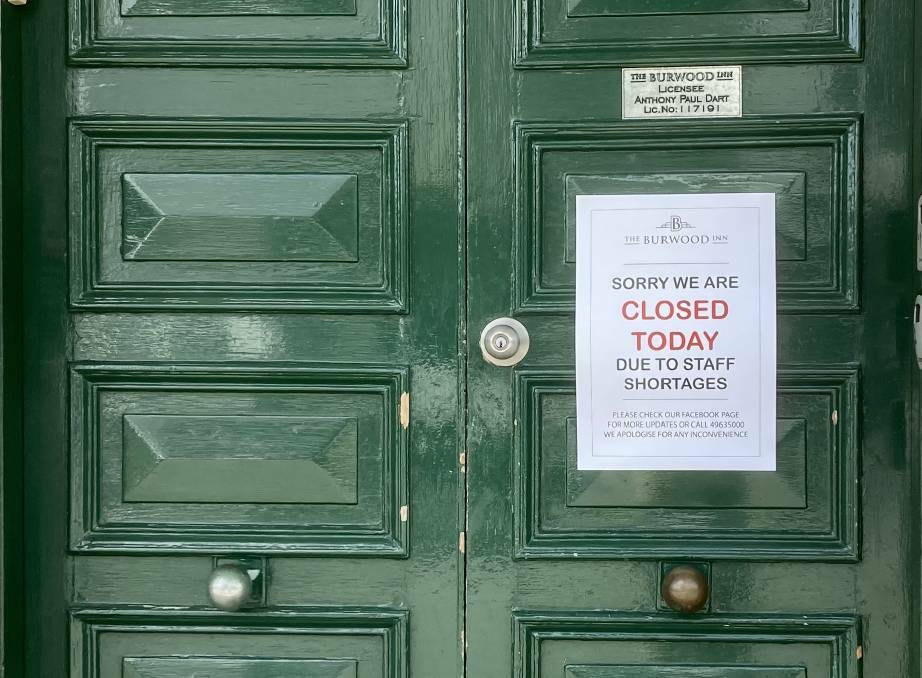
IT saddens me to see so many people turning away from the pubs and clubs in droves ("'Lockdown by stealth' hurts pubs", Herald, 7/1).
Especially when the pubs and clubs only had a short time to flourish in between the end of the lockdown and the outbreak of the Omicron variant.
Even though care should always be exercised, I do not think that any licensed premises should be avoided like the plague.
I haven't seen any businesses take the threat of COVID-19 as seriously as any pub I've been to since the original outbreak.
Masks are mandatory rather than merely being optional as they seem to be in many other places, as are check ins and double vaccinations.
How many other businesses can honestly boast that?
I feel one is much more likely to be exposed to COVID-19 in a shopping centre than in a licensed premise.
Since the pandemic began, I have also observed much better behaviour in pubs than in shopping centres.
Even after the lockdowns ended, I never witnessed any binge drinking or violent assaults in any pub.
I have, however, witnessed disgraceful and selfish panic buying, plus physical alterations just to acquire toilet paper.
Adz Carter, Newcastle
Topography not a VFT problem
TONY Winton (Fast rail, nothing but a dream, Letters, 12/1) tells us that high speed rail plans are not practical because of the topography between Sydney and Newcastle. It would appear that Mr Winton should be aware that all over the world high speed trains travel through mountains, along viaducts and through cuttings.
Engineering has come a long way since the 19th century. Perhaps Mr Winton, the Sydney to Newcastle railway was not necessarily built on its current route for reasons of topography but because it was thought necessary that 20mph trains should service Gosford and other villages?
I am not saying that high speed rail is feasible or that Australia needs it but the fact is that topography is a cost, not a problem. Further, as has been noted by other contributors, the Snowy Mountains, Medicare, compulsory superannuation were all ideas that, at the time, were said to be unfeasible. However, these schemes all had one thing in common; they were all brought about by far seeing big spending ALP governments.
One has to ask should we vote for a political party that dares to dream big and spend plenty or for a Coalition who base their ideology in terms of low taxation and private enterprise. You will shortly have the chance to choose.
Mike Sargent, Cootamundra
Tank purchases raise questions
AUSTRALIA will spend $3.5 billion buying tanks and armoured personnel vehicles from the US. Why? When will we ever use tanks?
I agree that armoured personnel vehicles could be required in some engagements where Australia is invited to assist our neighbours in the South Pacific. But why source them from America when we have Thales Australia designing and building Hawkei protected vehicles at their manufacturing facility in Bendigo. All this using Australian workers and Australian materials. Hawkei is recognised as a world class, top quality military vehicle that can be transported by helicopter expeditiously to regions of conflict.
I wonder if we are buying from the US so that we can demonstrate a perceived loyalty to them, or is it because America has a surplus of old stock that it needs to off-load?
Whatever the reason, we should be supporting our own Australian industries by spending taxpayers' money locally, rather than overseas.
Ask ourselves again - why tanks? From my memory, the most recent vision of tanks showed them being used to run over demonstrators. Surely we have evolved beyond that!
Stan Keifer, Arakoon
Focus on renewables' variability
PETER Devey (Short Takes, 10/1) expresses concern that the massive Chinese pumped hydro system (PHS) only has 75 per cent energy efficiency, when even the best examples only operate at 80 per cent.
Snowy 2 is likely to be less efficient. It makes no economic sense to pump up to the top reservoir of a PHS system using expensive electricity fueled by coal, using a process that has a thermal efficiency of just 37 per cent; the rest lost to waste heat.
It makes perfect economic sense however, when that pumping power takes advantage of the variability of renewables; pumping up in periods of excess energy that result in very low to negative electricity prices; storing; then generating when demand exceeds supply and prices are high.
While Peter suggests this Chinese project shows "how inefficient renewable energy is" it actually shows how renewable variability can be utilised cost effectively, and it is obviously an important part of China's transition to renewable energy.
Richard Mallaby, Wangi Wangi
Legacy lives on in Newcastle
LAST week Australia lost Professor Mike Gore AO, physicist at ANU, and one of our most inspirational science communicators.
In 1978 Mike, inspired by a family visit to the Exploratorium in San Francisco where interactive exhibits were bringing science to the public in an interactive and fun way, decided to build a similar interactive science facility in his spare time in Canberra.
Mike lobbied for the use of the unused Ainslie Public School and in 1980 the Questacon opened to the public staffed by volunteers and containing just 15 hands-on exhibits. So began an exciting journey that led to Questacon becoming a national icon, with some 500,000 people visiting each year.
In 1979, I was similarly inspired by a family visit to the Oregon Museum of Science and Industry and resolved to build an interactive science centre in Newcastle on my return. I soon learnt that the man to talk to in Australia was Mike Gore.
Mike was a wonderful warm, enthusiastic and sharing person whose mentorship helped bring the Newcastle dream to fruition. With the support of the University of Newcastle and a dedicated group of volunteers we launched the Supernova Science Centre in the old Store building in 1982, morphing in 1988 into the new Newcastle Regional Museum. Forty years later it is still running as part of the Newcastle Museum.
Mike Gore's legacy endures not only in Canberra but in interactive science centres across Australia - Newcastle, Wollongong, Melbourne, Brisbane, Darwin and Hobart. Vale Mike Gore.
Tim Roberts, Newcastle East
SHORT TAKES
THE Premier's threat of a hefty fine for non-reporting positive RATs is a case of putting the trap before the RAT. Let's focus on getting the RATS out there before we think of penalising those who fail to report. I've been to 17 places in three days looking for RATs without success. My neighbour fluked one for me today at her chemist when the (small) stock came in while she was there.
Gordon Tindall, Belmont
ONE for the suggestion box. How about prioritizing Rapid Antigen Tests (RATs) for the existing network of COVID-19 testing clinics and the public hospitals that are already conducting tests? There are established facilities, staffing, medical advice can be provided on positive tests and if a PCR test is required due to RAT uncertainty then it's a one stop visit. Hopefully, this can alleviate the pressure on hospital emergency departments, pharmacies, NSW Ambulance call takers and doctor's surgeries. Might be an option rather than reinventing the wheel and maybe only requires a Medicare number to cover the RAT service provision.
Garry Blair, Maitland
GRAHAM Jones (Short Takes 11/1) says his relations were charged $450 for one night in a motel at Ballina recently, approximately four times the normal rate. One of my grandsons and his girlfriend were charged $800 for four nights for a campsite at a South West Rocks caravan park over the holiday period, again approximately four times the usual rate. I understand the tourist industry has really been doing it tough and is trying to make up for lost ground but these types of increases seem a bit over the top and could put people off getting back on the road again so may do more harm than good.
Ian King, Warners Bay
I SEE in Newcastle Heights restrictions are inverted. Anything that is too low, has to be demolished to allow Heights to be unrestricted. The next thing to understand is how this permits access to the foreshore.
Niko Leka, Mayfield
RE: the labour shortage. Easy solution, there are two million oldies that are still capable of a fair day's work for a fair day's pay. All the government needs to do is let all who are prepared to chip in, leave the pension payments in and let the oldies make an extra spare buck whilst this troubled time is affecting business.
Dennis Crampton, Swansea
JOHN Tierney, so true, (Still waiting, "East Coast VFT vision never leaves the station", 13/1). Pigs will fly first, for some very good reasons. But, as you say, "rail is neglected", for there is no resilient transport system. Contemporary rolling stock, bringing signalling out of the 1930s, and freight heading directly to Maitland, from Fassifern, are affordable givens. For the telling record: when standard gauge went through to Brisbane, 1930, the north coast development line was used, with all its ups and downs and bending, following the land layout.
Graeme Tychsen, Toronto
CONGRATS and thanks to the team of gardeners who create and care for the gardens at Lambton Park. The display of petunias and zinnias are glorious. Well done.