There may be some who disagree when I write that a sumo bout starts when the two wrestlers feel they are ready to begin the contest. "Isn't it when the referee gives the signal?" they may say.
Certainly, you hear the referee in the ring start shouting loudly, "Nokotta! Nokotta!" at the moment wrestlers come out of their stances and blast into each other. However, such calls start immediately after the referee observes the initial charge. It is not meant as a verbal signal to start.
"Nokotta" means "the match has not yet been decided." Even if a wrestler corners his opponent, a referee will repeat this phrase. In the meantime, both wrestlers may slow down or stop moving. Then, the referee will call, "Hakkyoi!"
"Hakkyoi" comes from the phrase hakki-yoyo and is a shout to spur the wrestlers. It's fun to listen carefully to the way the referees say the word because it differs slightly depending on the person.
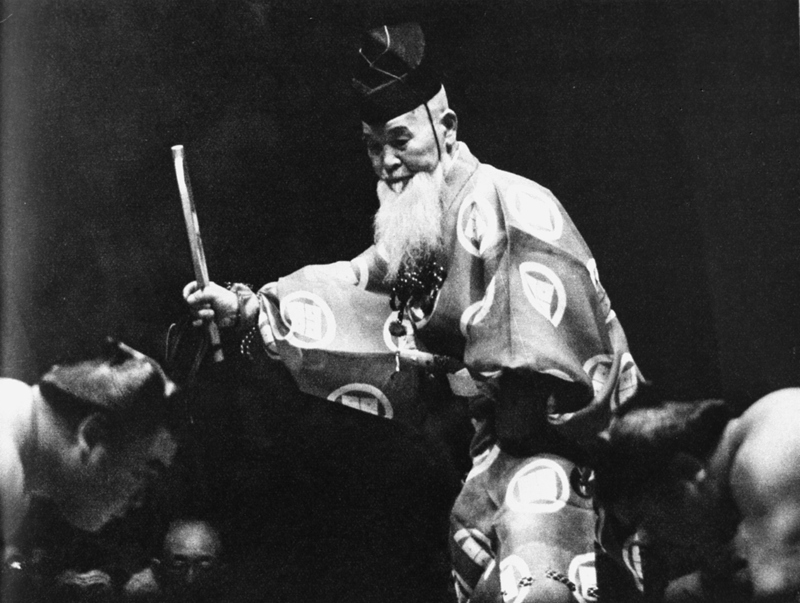
It is said that the ring referee shouldn't remain in one place, so as to avoid blocking the view of the fans and judges sitting at ringside. He particularly tries not to stand in front of the main portion of the stands. This is because in olden times, the shogun, emperor and other VIPs would watch the action there, and it was disrespectful to turn one's backside to them.
Let's get back to the bouts, though. When the time for the prematch rituals is up, the referee says, "Jikan desu" (It's time). Checking the rhythm of their movements, he then says, "Kamaete" (Get into position), "Te o oroshite" (Put your hands down), or "Mada mada" (Not yet).
It is said that top referees of the past, like Shikimori Inosuke and Kimura Shonosuke, called to the wrestlers as if they were stepping between them, and the moment that they swiftly withdrew, the combatants would begin the tachiai, or jump-off.
In other words, the tachiai is said to be established only when there is synchronization of all three -- two wrestlers and a referee. The image is the spirits of the three beings concentrated in the center of the ring and then exploding in one rush.
In modern sumo, though, the spirits of the three are separate. The two wrestlers are trying hard to gain an advantage at the start, while it seems the referees lack conviction to bring out the fighting spirit of the wrestlers. Article 5 of the Japan Sumo Association's rules for referees stipulates that "the referee gives guidance and advice to the wrestlers so that they start together in a fair manner."
If the referee's heart is not in his calls, then he will not grasp the rhythm of the wrestlers.
-- Miki is a sumo expert.
Read more from The Japan News at https://japannews.yomiuri.co.jp/