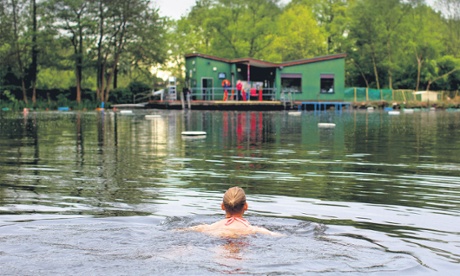
The Kenwood Ladies’ Pond on Hampstead Heath, north London, has been a swimming pond since 1926, and is the only pond on the Heath reserved solely for female swimming.
Margaret, 71, is a member of the Kenwood Ladies’ Pond Association (KLPA). A year-round wild swimmer, Margaret has an early memory of open-water swimming was in the river Aire, near Leeds, where she remembers the water as sparkling and clear. “I must have been three or four years old and I was splashing in the shallows,” she recalls. Margaret’s parents tried unsuccessfully to teach her how to swim in the icy North Sea in the 1940s, but her favourite memories of wild swimming come from when her family moved to Bristol and used to swim in the Avon.

“My mother, a keen rower, would take us up river to a picnic spot where we would pull into the reedy bank and swim,” she says. “Some of my earliest wild swims were there on summer afternoons that smelt of lemon-scented reeds and the skiff’s sun-warmed varnish.”
Margaret has been surprised at how many open-water swimming spots she has discovered around London. During one afternoon swim at Leigh-on-Sea in Essex, she came across a group of teenagers swimming and repeatedly leaping off the jetty. “Hopefully, like me, they found a pleasure that will sustain them through life.”
Sally, 31, is also a member of the KLPA. Born and raised in the Lake District, she can remember going wild swimming as a toddler, negotiating her way over the rocks from the banks of Coniston Water.
Open-water swimming has remained a vital part of Sally’s life. “Whether hiking up to a tarn and enjoying a cooling dip, or jumping off a bridge somewhere along the river Duddon, wild swimming is a key part of my DNA,” she says.
Sally tries to swim outside London whenever she can: “My husband used to think I was crackers, but now he joins me. It’s meant that we’ve enjoyed some fantastic adventures together, be it finding a hidden river during a walk in Sussex, stripping off and jumping in, or plunging into the freezing sea off the coast of Devon in the middle of winter.”
Briony, 58, who has a passion for endurance sports, grew up on Alderney in the Channel Islands, and was also plunged into the sea to swim at the same time as learning to walk. She describes wild swimming as “life enhancing” and as “one of the most, if not the most, important aspects of my life”.
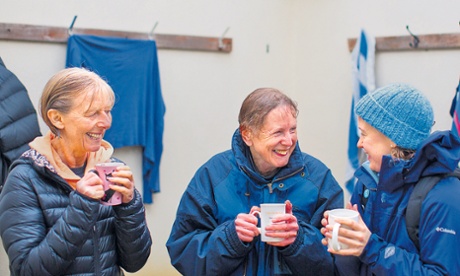
Having been diagnosed with a degenerative back disease, Briony finds wild swimming helps her cope with the pain. “Winter swimming in particular has enormous benefits both physically, for pain relief, and mentally, for the mood lift that follows swimming in the cold water,” she says.
If you are a bit nervous about wild swimming, use artificial pools as places to practise and improve. For your first open-water swim, choose somewhere with lifeguards such as the ponds on Hampstead Heath or the Serpentine in London’s Hyde Park, and mention to the lifeguard that you haven’t swum there before. The KLPA also suggests that you go with another swimmer and try places where you can walk into the water and swim without getting out of your depth.
There are plenty of organisations you can join, such as the Outdoor Swimming Society or local clubs. As Briony says: “Not only is the community of wild swimmers ageless and welcoming, but the activity itself is life-changing, life-affirming and endless. Wild swimmers are special people.”
About the author
Daniel Start is the author of Wild Swimming and founder of wildswimming.co.uk
Dip in and out
The KLPA is running a series of walks and swims this summer. The first three are suitable for people who can swim but are nervous about open water. For more information, visit the KLPA website.
For more on the best wild swimming locations, go to outdoorswimmingsociety.com
Correction
This article was amended on 16 June 2015 to remove all surnames, at the request of the Kenwood Ladies’ Pond Association.