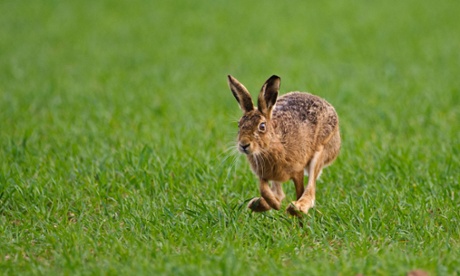
Something was afoot among the hares in these fields. Three of a quartet were sunk to ground, ears flattened to their backs. Aside for the frog’s bulge of their half-closed eyes, whose long slits reminded me of those unearthly faces in west African fetish masks, their owners could have been old weathered molehills.
Yet a singleton was upright and alert, his barrel chest bright ginger in the direct sun and those ludicrous ears sending stripes of darker shade across the brindled back.
As they rotated I could see how the ears’ curves caught the shadows at their shell centre and I wondered which of the world’s nuances were being funnelled into the mysterious chambers of a hare’s brain.
He was restless. In fact, even the other three temporarily returned to life to groom and scratch, before collapsing once more. Hare kinetics has a strangely involuntary quality. It’s as if all that compressed energy and those coiled limbs cannot be contained at will. They need some intermittent outlet.
There was one glorious moment when the singleton made full stretch, the ears spiked back and the hind legs pulled to their fullest extent, with the beautiful white curve of the belly drawn taut behind the ribs.
Briefly this mammal had the weird proportions of a grasshopper and one sensed that such a luxurious arc of limb should be a yogic posture - the hare: good for breath control and stretching sinew.
Weirder still was a cycling action he performed with his forelimbs. They rotated in sequence with the speed and rhythm of a boxer madly rattling a punch bag. Then he trotted away, levered up at intervals by the disproportion of his back legs.
How strange that an animal built for speed seems to limp when it walks. He came back and sank down. An hour later no one, including me, had really moved. As I drove home and the new moon cut its white curve in the blue-black of nightfall, I imagined them there in the dark: poised and sculptural with outstretched limbs like a sphinx, yet still restless.