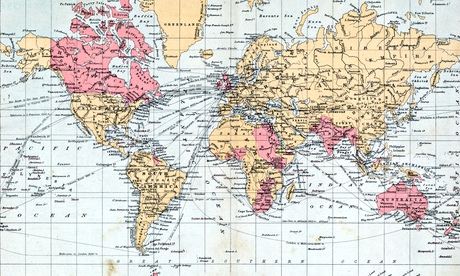
David Reed (Letters, 13 February), referring to David Oyelowo’s article (Ending education’s black history gap, 10 February), says that our children should be told that the “greatness” of Britain came by exploitation of other people, directly as in slavery, indirectly by indentured labour and through our strong colonial presence in much of the world from Africa to Burma and beyond. The Chartist Ernest Jones said about the British empire: “On its colonies the sun never sets and the blood never dries.”
The problem is that the British are in denial about the brutality of our past. Germany has been forced to confront its brutal past. It is now illegal to deny the Holocaust, for example. In Berlin, on the site of Gestapo headquarters, stands the Topographie des Terrors, which catalogues how the Nazis got into power. It pulls no punches and makes clear that it was the German nation, and not just Hitler, that allowed the barbarity of the Holocaust to happen. The message is that they must confront their history and never let this happen again. German children are taught about their nation’s past by, for example, visiting gas chambers.
Most in Britain see the empire as generally a force for good and are blind to the brutality that brought it into existence. Without an insight into this, how can we educate our children, both black and white, to have an understanding of how we got to where we are now?
Is there not a case for a museum, similar to the one in Berlin. A museum of terror about the British empire? We then might all begin to understand why our past meddling has helped cause the present chaos in the Middle East. And our politicians might pursue better, less damaging policies.
David Lucas
Bath
• In the early 1980s,striving to meet the needs and aspirations of our increasingly diverse intake, the East End girls’ school of which I was then head introduced a course for all in year 7 “Travellers on the Earth”, to which we all contributed. One teacher, originally from Sierra Leone, brought in the slave shackles once worn by her great-grandmother. So I heard for the first time the name of Mary Seacole, let alone the story of her life and her writing. Harriet Tubman and the anti-slavery Underground Railway also featured, as did the British colonial past. This was further developed in our compulsory world studies, designed and approved as a CSE course, devised by two inspirational teachers. I cannot be the only retired teacher who despairs at the stifling of curriculum creativity. And while we’re at it why don’t Thomas Hepburn and his ilk feature in the history syllabus?
Beth Smith
Colchester, Essex