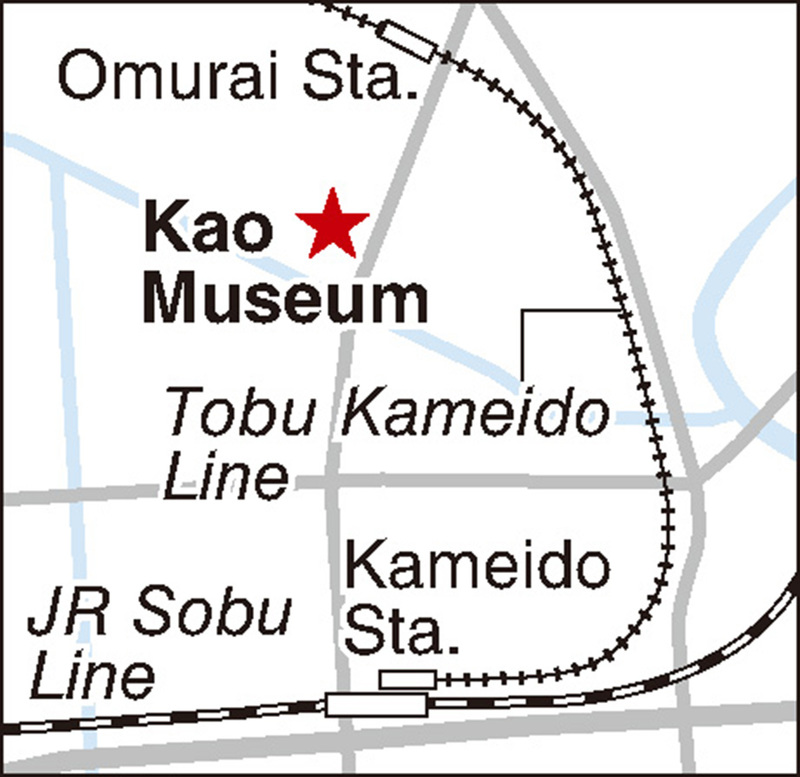
Starting with Kao Sekken soap, Kao Corp. is also known for familiar products such as shampoos and detergents. The Kao Museum in Sumida Ward, Tokyo, is operated by the company to introduce "The Culture of Cleanliness" through tools used in the past for laundering, bathing, household cleaning and other tasks.
Within the museum is a re-creation of the entrance, eat-in kitchen and bathing area of a public housing block apartment using doors, balcony railing and other parts donated from the Takanedai housing complex in Funabashi, Chiba Prefecture.
In the Showa era (1926-89) from the mid-1950s to mid-'60s, life in a housing complex was admired. Today it's usual, but one of the components of modern life then was to have an indoor bathing area and soap to wash the body every day.
Soap dates back to about 2,500 B.C. The first soap was developed by Sumerians living in Mesopotamia (present-day southern Iraq). They used soap not only to wash things, but also as ointment for skin diseases. The museum has on display a replica of a clay tablet engraved with cuneiform characters that explain a method of producing soap.
It is unclear when soap was introduced to Japan, but it is believed to have arrived in Japan just after the introduction of firearms during the Sengoku period (1493-1573). Military commander Ishida Mitsunari sent a letter of appreciation to a merchant in Hakata for presenting him with "shabon."
At that time, soap was a luxury product that only a few people were able to use. The common people used such saponin-containing materials as nut husks of Japanese honey locust trees and skins of soapnut tree fruits as substitutes. Saponin is a substance that helps remove stains, according to the museum.
In 1890, Nagase Shoten, which later became Kao, launched Kao Sekken soap. Up to that time, many domestic soaps were of bad quality, but the Kao soap was of high quality and obtained a good reputation. In 1931, after Nagase Shoten became a corporation, the company improved the quality of the product and renewed the package design. In addition, it reduced the price from 15 sen (100 sen equals 1 yen) to 10 sen, so that common people could afford it.
"Purifying the body brings about cleanliness of the mind," said Seiichi Maruta, 64, director of the museum. "The source of a rich life lies in cleanliness."
Indeed, I feel that bath time at the end of the day heals not only the body, but also the mind.
-- Kao Museum
Opened in 2007 within the Kao Sumida office, there are three exhibition zones: "The Culture of Cleanliness," "Kao History," and "Communication Plaza." There are about 220 items exhibited, including Kao products from the Meiji era (1868-1912) to today. While there is no admission fee, reservations are required to visit the museum. Only those in the third grade of elementary school or older are allowed to enter. Please make reservations by phone.
Address: 2-1-3 Bunka, Sumida Ward, Tokyo
Open: 10 a.m. to 4:30 p.m. (Closed on Saturdays, Sundays, public and Kao holidays)
Admission: Free
Information: (03) 5630-9004
Read more from The Japan News at https://japannews.yomiuri.co.jp/