In front of the Suzuki Kantaro Memorial in Noda, Chiba Prefecture, stands a stone monument with the inscription "the place of death of Kantaro Suzuki, prime minister at the end of the war." The engraving is a copy of calligraphy originally written by postwar Prime Minister Shigeru Yoshida.
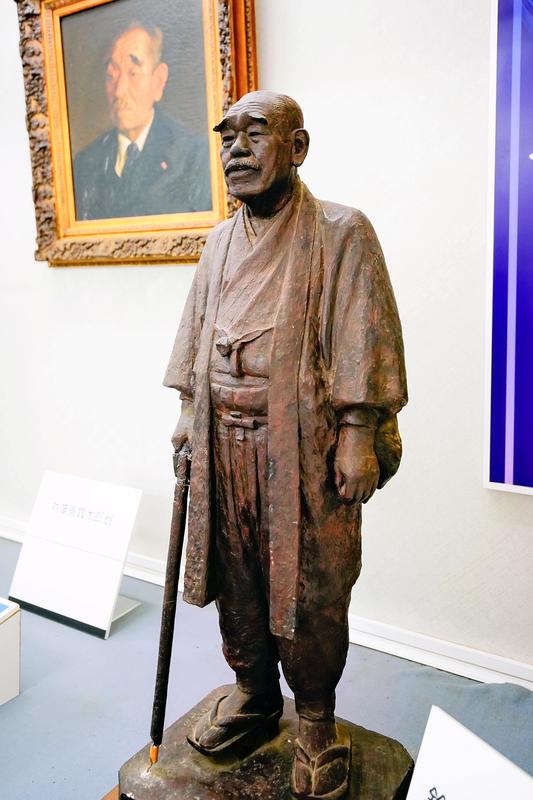
On Aug. 14, 1945, Japan decided to accept the Potsdam Declaration at a conference before the Emperor Showa. Using his distinguished reputation and forceful personality, Suzuki (1867-1948), who was prime minister at the time, maneuvered against hard-line military officials calling for a decisive battle on the Japanese mainland. Suzuki led Japan out of the war, pulling the nation back from the brink of destruction.
Items related to Suzuki and a chronology of his life are on display at the memorial hall. The former navy officer took part in the Sino-Japanese and Russo-Japanese wars, eventually earning a promotion to admiral. The taireifuku official court dress he once wore appears faded, but clearly captures his height of 1.8 meters.
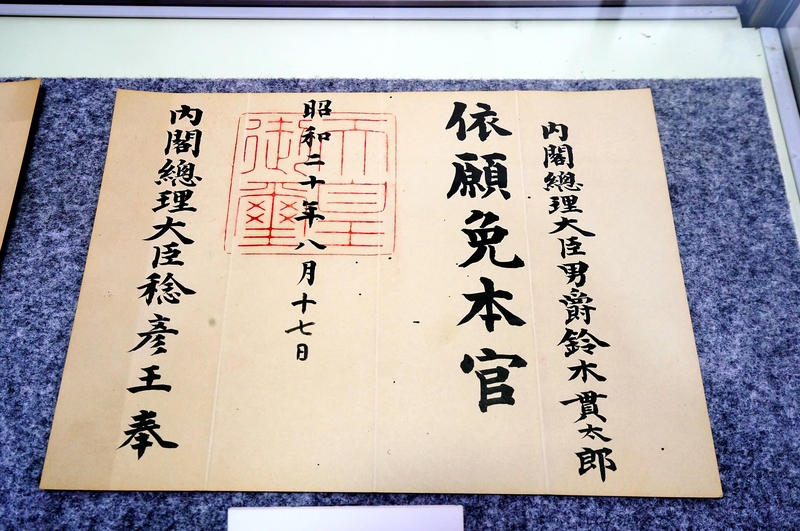
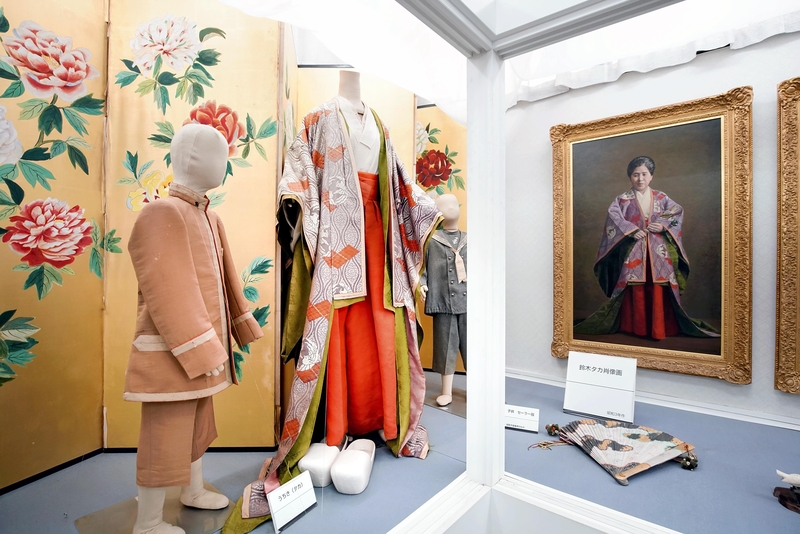
His wife Taka helped raise the young Emperor Showa for about 11 years before marrying Suzuki. A kimono owned by Taka is among the items on display. Western-style clothes and a sailor-style outfit worn by Emperor Showa as a child are also showcased.
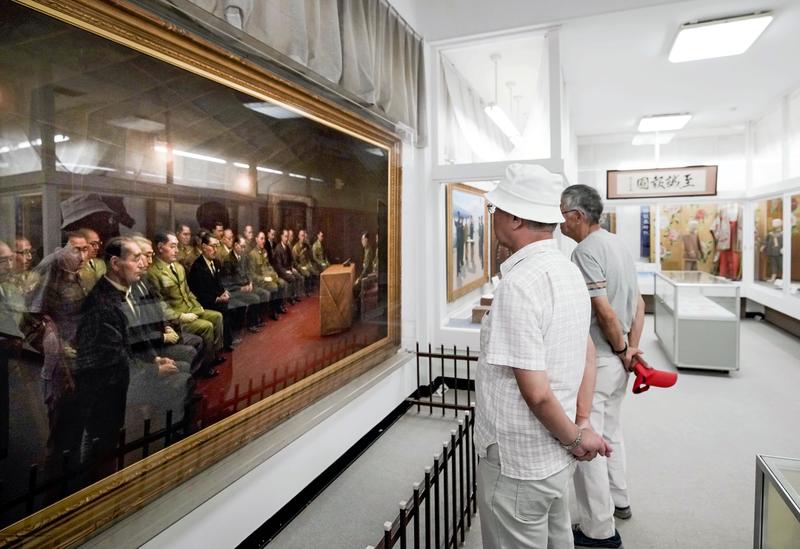
The highlight of the exhibit is "Saigo no Gozen Kaigi" (Final conference before the Emperor), an oil painting by Ichiro Shirakawa from the 1960s. Shirakawa's masterful depiction is based on what he heard from those with firsthand knowledge of the conference.
In April 1945, Suzuki was recommend to be prime minister and assumed the office.
In August of that year, the government debated whether Japan should accept the Potsdam Declaration to end the war or continue hostilities. A decision remained elusive even after the Soviet Union entered the war and Japan suffered two atomic bombings.
Suzuki twice sought a decision at conferences attended by the Emperor on Aug. 10 and Aug. 14.
Suzuki's actions were extremely rare, as the Emperor typically did little more than endorse government decisions, in line with the country's constitutional monarchy and the Meiji Constitution. Though such tactics were generally forbidden, the government decided to end the war following remarks by the Emperor.
Shirakawa's painting depicted this event on Aug. 14.
Suzuki had previously served as Emperor Showa's grand chamberlain. According to "Jijucho no Kaiso" (Memoir of the grand chamberlain) written by Hisanori Fujita, Emperor Showa said after the war, "Suzuki's behavior at the end of the war was only possible because he was someone with whom I had exchanged strongly held beliefs."
Curator Tomoki Sasagawa, 27, an employee of the Noda city government, said Suzuki spent his retirement in his hometown of Sekiyado, which is now part of Noda, and dedicated his efforts to the development of the dairy and other industries. "Everlasting peace" are said to have been his last words.
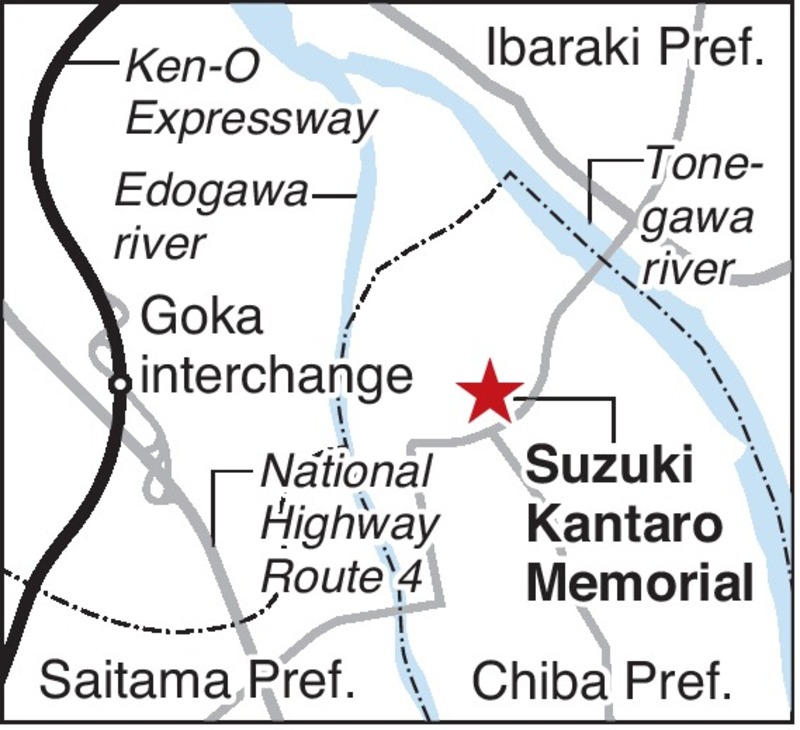
-- Suzuki Kantaro Memorial
The Suzuki Kantaro Memorial opened next to Suzuki's former residence, which no longer exists, in 1963. It displays more than 1,000 items donated from his relatives and others connected to him. Born in Sakai, Osaka Prefecture, Suzuki spent his childhood and about two years later in life in the town of Sekiyado, which is now part of Noda. When he died in 1948, people are said to have lined up for more than 2 kilometers to attend his funeral, mourning the death of the "prime minister of national salvation."
Address: 1273 Sekiyado, Noda, Chiba Prefecture.
Open: 9 a.m. to 5 p.m. Closed on Mondays (Open on national holidays)
Admission: Free
Inquiries: (04) 7196-0102
Read more from The Japan News at https://japannews.yomiuri.co.jp/